Coming home


The taxi refused to take the Eastern Bypass — too dangerous in the wee hours of the morning before the sun comes up and lights up the despair of Kolkata. Instead, we took the old route from the airport in the northeastern part of the city to the south.

I had not taken these old roads in a while. But as a little girl, when life was harder, but oh, so much simpler, we traveled to the airport this way and stood on the “viewing deck” to see planes take off and land. It was a rarity then. Flying seemed so exotic, so other-worldly. Now, all I do is complain about sitting in cramped seats as we pass over oceans and continents.

At 3 in the morning, the city is finally quiet.

The thousands and thousands of street stalls and stores (like the ones in this photo of a shopping area near my house) are shuttered. Those who can afford it are sleeping soundly in the comfort of air-conditioning. Most are under whirring ceiling fans that bandy the humidity about — or nothing at all.

The heat has fallen after months of the monsoon, but after the glorious autumn weather in Atlanta, I feel hot. Restless.

I had not expected to pass by the flat my parents called home for so many years. I have returned to Kolkata this time to finalize its sale.I thought I would not have to see it until later.

But instead, we pass by the front gate, the taxi driver unknowing of the burst of emotions within me. I try hard to hold back the tears. I feel them welling. I don’t know whether to look or not. But I cannot control my glance.

I peer at the gate through which the taxi might have driven had Ma and Baba still been here. Ma always stayed up for me, no matter how late. I’d walk in through the front door and see her in her wheelchair, her eyes heavy with sleep would light up instantly at the sight of her only daughter.

She’d have tea ready for me. Maybe a snack. My bed would be made up with fresh sheets, a clean towel hanging in the bathroom.

There is no one waiting for me now.

The taxi driver carries me away from that moment of intimate familiarity to another place. A friend’s flat, perfectly comfortable but with the sting of loneliness. Daylight breaks early here; by 5:30 the city is springing to life again. But for me, today, everything is dark.

Bangla kobita (poetry)


This poem is written by one of my favourite Bengali poets, Joy Goswami. It loses in the translation, of course. And yet…

In the evening sadness comes and stands by the door, his face
Is hidden, from the dying sun he took some colors and painted his body
The sadness comes in the evening,
I stretched my hand and he caught my wrist, in an iron-hard clasp
He caught me out from my room, his face
Is black, he is ahead of me and I follow him
I crossed from the evening to the night, from the night to the dawn, then the morning, the noon, the day, the month
Crossing water, tree, boat, city, hill
Crossing blows, stumbling, poison, suspicions, jealousy, graves, genocide, the bones and ribs of civilization, swamp and grass
Then crossing my own death, death after death, going on and on
The bony fingers holding nothing but a pen
Nothing…

Loadshedding


India has come a long way since my childhood.

And not.

This week’s headlines: Celsius rises, so does loadshedding. In American English, this means temperatures soaring above 100 degrees Fahrenheit and no electricity for hours and hours and hours.

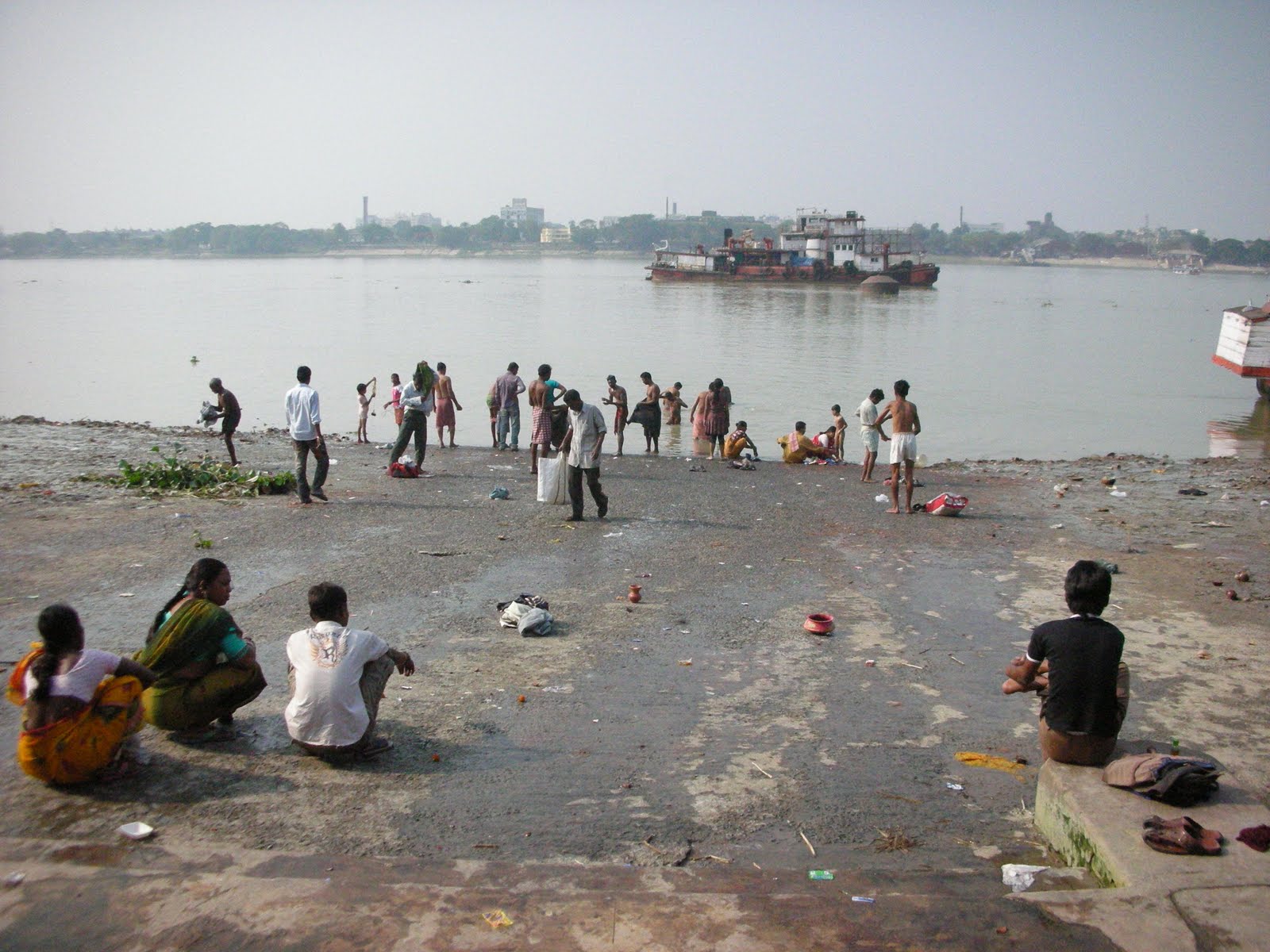
That’s the way it was when I was growing up in Kolkata. The only relief was to take a plunge in the rather polluted Ganges (see photo).

At school, it was difficult to concentrate. Instead, I’d be busy wiping dry the droplets of sweat on my textbook. One time, I’d obliterated the face of Shah Jahan (the Mogul emperor who built the Tak Mahal) in my history book with a good dousing. I watched the black ink run down the innards of the cheaply printed text. Too bad his son Aurangzeb could not dispose of him that easily.

Going home on a searing summer day was no comfort either. No bath because there was no power to pump the water to the roof. No fan. No respite. At night, we wet our bed sheets and put slabs of ice on our mattresses to stay cool inside the thick cotton mosquito nets and watched flying cockroaches and creepy insects crawl up the sides.

We’d wait for the monsoons to begin– usually the first or second week of June. My brother and I would stand in the courtyard fully clothed and let the rain soak us through. There was nothing that felt more soothing.

And now, in 2010, despite all of India’s economic gains, my friends and family in Kolkata are doing the same as we did 40 years ago.

The problem, says the Telegraph newspaper: Snags in the coal-supply chain are causing power generation units to perform below capacity.

While government agencies played the blame game, almost every Kolkata resident suffered power cuts this week for at least six ours. Worse still, the monsoonal rains are still far from the congested city — the weather forecast calls for hot and humid days.

Still feel like complaining about the pollen?

My Christmas gift


This is the season when we feel compelled to give. We give our time at homeless shelters, buy bags of food for the hungry and write checks out to charities that help people in far-flung places. Sometimes, it’s difficult to choose an agency. Many of us are cynical about how effectively the money will be spent. Or we question whether it will do any good at all.

I do not pretend to know the answers to solving global poverty, but I will share with you a story about one family whose life is about to change radically.

Ibrahim Gulam lives in a part of central Kolkata that is usually not seen by visitors to the city. I would guess that many of my friends and relatives have never even been to this part of town. The main road still bears its British name — Colin Road.

the streets are overflowing with workshops and warehouses. Gulam lives in an area where plaster molding is manufactured. Some of the men and women look like aliens, their dark faces perpetually smeared with white dust.

Crime and drug addiction is rampant in this part of town. So, too, are broken hearts. Broken dreams.

You have to snake through tiny lanes bursting with humanity to get to the room that Ibrahim shares with his parents and three siblings. He and his brother sleep atop the hard bed, his mother and sisters share the floor and his father, an asthmatic who has not been able to hold down a full time job because of his respiratory ailments, lies under the bed.

In the summer, the heat and humidity are so intense that the whitewash on the walls peels off. Little adorns the dark, cramped room save scripture from the Quran. Ibrahim’s mother cooks on a coal-burning stove on the floor outside, where shoes heap up and the cement is incessantly wet from household use.

The family shares a latrine with countless other people. Often, bathing is done is public at the local tubewell.

The smells here are like nothing found in America — a mixture of life and waste and human misery.

Westerners dubbed this “the city of joy.” I heard a businessman on my flight back telling the flight attendant that he had taken his young son for a tour of Kolkata slums. He leaned back in his $4,000 business class seat and talked of how “fascinating” the lives of the poor were.

He should talk to Ibrahim.

To say that his life has been a struggle is an understatement.

I met him when he was in grade school. He was one of several children my brother and I sponsored. We paid for their schooling so that they would have a chance in life.

No one in Ibrahim’s neighborhood has finished high school. His father, Gulam Siddiq, studied in a Bengali medium school but dropped out in the second grade, later learning how to be an electrician. His mother, Rabyia Sultana, stopped in the fifth grade in her native Bihar.

I wanted Ibrahim and his siblings not to live the life of his parents. I wanted to do everything in power to preserve his joie de vivre.

I watched him grow, visited him when I went home every year. He did well in Navjjyoti, a school for poor children that my friend Vijay helped establish. He was admitted to the reputable Assembly of God Church school. So was his brother Zahid and sisters Anjum and Zahida.

Ibrahim is now 24 and will soon earn a degree from Seacom Engineering College. I visited him in early December and his latest report card showed him excelling in almost every subject.

His brother and sister followed in his footsteps and are also in college. His youngest sister will enroll in college next year. She wants to study microbiology.

Ibrahim’s mother beamed with pride as she talked about her children. She knows that one day soon, the family will leave that dismal room. On Ibrahim’s salary, they will be able to afford a flat in a nicer part of the city, put better food in their bellies.

Ibrahim had the fortitude to win against all odds — to study in dim light, distracted by the hub-bub of the slum. He persisted when I had half expected him to give up. Yet, year after year, he delighted me with his report cards. A few years ago, he came to visit me with his grades in hand. That’s when he told me: “I want to be an engineer. I want life to be different.”

In India, a nation of 1.1 billion people, sometimes, not even an education is a ticket out of poverty. But without it, a young man or woman stands no chance of success. There, vocations do not pay as well as they do in America. Labour is cheap and the life of an electrician like Ibrahim’s father is far from comfort.

I sponsor other children in Kolkata as well. I talk to their parents, who want to pull them out of classrooms and put them to work instead. Many of them are not supportive of their children and even punish them for wanting to sit down with their books. But it’s not easy persuading a poor person to give up another source of income.

Not all my kids have been as successful as Ibrahim. Ranjeet Shaw is struggling to pass his high school board exams, though he told me when I saw him a few weeks ago that he was not giving up. He has seen hope and he is not going to let it go without a fight.

I don’t have children of my own, but my Kolkata kids have filled that void in my life. And then some.

Mehndi

I met my dear friend Vijay Chowdhary when I was in the fifth grade. My brother and I went to school with Vijay and his sister Renu. They were Marwaris originally from Rajasthan who had settled in Bengal and I quickly became fascinated with facets of their culture that were, up until then, unknown to me.
Like mehndi.
Bengali women in my family lined their heels with alta, a red dye that matched the traditional red bordered white saris they wore. But the women in Renu’s family adorned themselves with mehndi or henna.
On occasion, Renu’s mother would call upon mehndi artisans for a visit and I would tear away from home, running down the streets of New Alipur’s Block N to make sure I was included. The mehndi artisans were old Marwari women, their hands so crinkled and worn that the liquids involved in the process would trickle down the crevices of their skin like ancient rivers snaking from the Himalayas to the Bay of Bengal.
The women needed no tools. No brushes or tubes or pens or instruments used in modern-day beauty salons. They worked quickly and deftly with their fingers, applying the thicky, goopy paste made from a powder of dried henna leaves, lemon, tea, eucalyptus or nilgiri oil. It smelled heavenly.
The paste went on dark as they worked their magic on my hands. Intricate designs with paisleys, flowers, geometrics. I was mesmerized.
Renu and I hardly had the patience to sit for three hours for the mehndi to work its magic. But somehow we managed to keep still, applying a sugary concoction to make sure it didn’t dry and fall off our hands prematurely.
And then came the fun part. We scraped off the dried paste with butter knives and marveled at the burnt orange stains on our skin. My mother would get after me for not washing my hands properly for days after that — I wanted to preserve the henna as long as I possibly could.
These days, mehndi is everywhere in India. Everywhere here. You can find mehndi artists at craft fairs and salons. Was it Madonna who made the ancient Eastern practice trendy here? Or Gwen Stefani?
It’s so popular that you can get it done on the streets of Calcutta by village men who have decided to make a penny off the trend. So here I am in this photo, on the streets of Gariahat, Kolkata’s busiest Bengali shopping area, sitting on a cheap plastic stool on Rash Behari Avenue, getting my arms adorned.
I told Mr. Pal I had little time. “Ten minutes,” he said. “And one hundred rupees.”
He wanted extra for making it speedy. So I paid him what amounted to about $2, watched the world around me — and a whole new one emerging on my arms.

Kolkata

On my way home.

It has been more than a year that I was in my beloved Kolkata. A feast and sore for the eyes all at once. An assault on all the senses.

I feel the excitement of a bride to be. And of someone who, near death, fulfills every dream.

I am minutes away now from Lufthansa Flight 445 that will carry me across the Atlantic. Then, another jet that will sail over the gentle landscapes of Europe and the rugged terrain of Iraq, Afghanistan, Pakistan. My heart will beat faster as the flight trackers shows names like Varanasi, Patna, Dhaka. It will pound as the plane descends into Kolkata.

Below me I will see the dim twinkling lights of a city that operates on 25 watts, save the glaring fluorescent tubes that are off at this late hour.

It’s a feeling I have known for many years. Familiar and comfortable like an old pair of shoes that no longer suit me but stay in my closet year after year.

I used to think of my mother’s smile as the plane touched Kolkata soil. My father used to be waiting for me among the throngs of people. That stopped when my father became incapacitated with Alzheimers. I began taking a taxi in the dead of night, smelling the cow dung and the acrid smell of the Chinese tanneries as we raced our way to Ballygung on the Eastern Bypass.

Ma would always be waiting for me. At 3 in the morning, she was waiting. In her wheelchair. Her eyes battling the kind of deep sleep awoman in her 60s needs at that hour.

But she was waiting.

No one waits for me anymore. I pay the $300 for a rickety Ambassador taxi that takes its time meandering in the dead of night.

I rest my head on an unfamiliar pillow, in an unfamiliar room, sadness and excitement gelling inside to keep me awake. Sleep finally comes when the sun begins to rise and the horns of the Tatas and Marutis begin the city’s symphony of sounds.

It is still my city, I think. But not.

Tussling over Teresa


One of the quietest, most peaceful places in the heart of Kolkata is Mother House.

The non-descript building can be easily missed. The entrance on Lower Circular Road is far from grand.
But inside, nuns clad in crisp white saris with blue borders go about their business. The rooms are sparse but sparkling clean.
And thousands flock to the tomb of Mother Teresa, who arrived in India many years ago to pick up the poor from the streets and given them shelter, food — and most importantly, love.
Kolkata claimed the Macedonian-born, ethnic Albanian Catholic nun as one of their own. She became an Indian citizen later in life and the South Asian nation embraced her.
Hailed as a savior for the destitute, Mother Teresa relinquished her gala Nobel Peace Prize dinner in 1979 and asked that the money be spent on poor people.
She died in 1997 now a squabble has erupted over her remains. Albania wants her sent to that country before her 100th birthday next year. The prime minister says Mother Teresa ought to be buried next to her mother and sister.
India says: No.
She should remain in her adopted home, where she made her life, India says.
I’m not sure exactly what motives are here, but if the intention is to make Mother Teresa a tourist destination, the fight over her remains should fade quickly. There’s something distinctly wrong about the notion that a woman who gave selflessly all her life should not become such a bickering point over tourist dollars that will, I am sure, not go to help the needy.
Few people identify Mother Teresa with Tirana. They think of her with leprosy victims and slum dwellers in my hometown. I know what an impact she had in Kolkata because I spent several months teaching slum children in a program run by the Missionaries of Charity. Perhaps it’s best to leave her in that plain compound on Lower Circular Road.
I have an etching of Mother Teresa done by B.P. Panesar, one of India’s most talented artists. I look at her weary face every evening when I get dressed for work. And find hope in her ever-so-faint smile.
It seems such a shame that we would think to trouble her in her final rest.

Goddess of strength

Thousands of deities are on their way to the banks of the Ganges in West Bengal today. The immersions have to be finished by Wednesday in the capital, Kolkata.


Ma Durga, the goddess of strength, returns to Ma Ganga, the holiest of rivers.


In the next few hours, murtis or images made from clay, wood, paper mache, bamboo, straw, shell and sand will begin dissolving in murky river waters.


Durga Puja, the biggest Hindu festival in my home state, is culminating this week.


When I was young, Durga Puja was the highlight of my year. Like an American kid looking forward to Christmas.


The five-day festival usually falls in September or October, depending on the position of the stars. We were off from school for several weeks. The streets were filled with fun and food. We wore new outfits for each day of the puja and went from pandal to pandal (temporary structures that housed the images) to see which one was the biggest, the baddest.


Hindu mythology tells the tale of Durga this way: Only a woman could kill the demon named Mahishasur. So the gods got together and each gave a virtue and skill to create the ultimate warrior, the goddess of strength. They gave Durga 10 arms so she could carry weapons in each to slay the Earth’s evil.


And so she did.


As I grew older and Kolkata became more congested, Durga Puja became somewhat of an inconvenience. The crowds, the road closings, the heat, the rain, the mud and muck of the dwindling monsoons. Last year, I almost missed my flight back to Atlanta because it took so long to weave through city streets to get to the airport.


The 15 million people of Kolkata all seem to be out together during Durga Puja. The constant banging of the dhol (drums) and blaring Bollywood music deafens my ears. At the end of every street, on every corner and in the neighborhood parks and schools, clubs fight for best in show. Who will win the prize for the most attractive Durga display? Some images are realistic. Others abstract. Some simple, others so ornate they would make Marie Antoinette gasp.


And when the five days of worship are over, throngs of people parade down the streets behind a lorry carrying their neighborhood Durga to the Ganges, so she can return to the heavens.


Whether you get into the Hindu puja spirit or not, there is something awesome about seeing millions of people fall at the feet of a woman to worship her strength, especially in a country like India, where women still have a long way to go to gain equal standing with men.


Last year, I was walking home from the bank and I stood and watched workers put the finishing touches on their Durga display. The beautiful and mighty woman, steely in body and soul (and loaded with weapons to boot!).


I stared into the eyes of the image. And felt her strength recharge me.


Check out this Web site for more information on the ceremony, rituals and story behind Durga:

http://www.durga-puja.org/


Another one rides the bus


Finally. Someone in my beloved hometown came up with a brilliant idea: a bus tour of Kolkata.

That may seem like a given to us here in America. We’ve all been on the duck tours of various cities or climbed to the top of a double decker for a tour along the Thames or boarded a bateau along the Seine. But there seems to be a dearth of organized tours in places that need them the most. And I put Kolkata at the top of the list.

Chaotic. Disorganized. A maze of human congestion.

No map can be of service. No GPS can possibly see every unnamed, snaking lane.

This is a city where directions are given thusly: You get off the main road, then go a few blocks. You will see Annapurna Sweets on the right and immediately after, there is a small lane. Take that until you see a house with blue window grills and turn left. Then stop at the corner snack stall and ask for Rajada. Hop on a rickshaw with him and he will bring you to our house. Third floor, West-facing. It will say Chatterjee on the mailbox.

Ooof, as goes the Bengali expression for frustration.

And this is a city foreigners are supposed to navigate? A city where even my 84-year-old aunt gets lost (and not because her memory is failing, either).

There are no street signs. Only cows and taxis and buses and rickhsaws and stray dogs and people. And people. And people. And cars. And cars. It took me three hours to travel four miles once. This is not a city where walks are pleasant.

My husband, Kevin, got ripped off in a taxi in New Delhi once. The man travelled less than a mile and was charged for 10 times that. And Delhi has street signs. Sort of.

Do you see where I am going with the moral of this story?

India is an unforgiving place for foreigners. Not only are most cities unnavigable but you can’t trust a soul to take you where you want to go without shelling the big buckeroos. Or rupees, in this case.

So, finally.

The government of West Bengal has come up with the idea of a government-guided tour of the city I so dearly love.

“The non-AC bus, which took streetchildren on a joyride on Monday, will start from the department of tourism office on Shakespeare Sarani daily at 8am. For a Rs 200 ticket (minus food), it will take passengers as far as Belur Math and Dakshineswar temple while covering routine city spots like Indian Museum and Mother House,” says the poorly-phrased Telegraph story. Mother House, of course, refers to Mother Theresa.

Key wording here: “non-AC.” Beware the “Oh Calcutta” heat. But at least the bus will take you from place to place without worries of getting lost or being penniless. All for Rs. 200. That’s less than $5, y’all.

Why it took so long for this brilliant idea, I do not know. But I have a feeling other big changes are in store for my hometown. More on that later.

Taxi!


We’re used to bandhs in Kolkata. Bandh means close or stop in Hindi and usually refers to a labor strike of some sort. Kolkata, of course, is the heartbeat of West Bengal state, ruled by the Communist Party of India (Marxist) for more than three decades. The communists like labor strikes and we have plenty of them in my beloved hometown.

The latest has not so much to do with politics but the environment.

The operators of private buses and taxis have gone on strike to protest a government order to ban commercial vehicles more than 15 years old. It’s a pollution-curbing measure in a city where children grow up never knowing blue skies and where nails and nostrils turn black with a walk of a few city blocks.

I am glad the government is finally thinking of pollution. Kolkata is already unbearable in its sweltering heat and humidity that makes the walls peel. Then there’s 18 million people fighting for inches of space.

The dust coupled with pollution makes it tough for non-Kolkatans to enjoy the city.

But with the ban on smoke-spewing vehicles slated to take effect on Aug. 1, 60,000 taxis and 10,000 buses are standing idle. Hordes of people have no way to get from place to place.

One doctor who still makes house calls told the BBC that he could not get to his ailing patients.

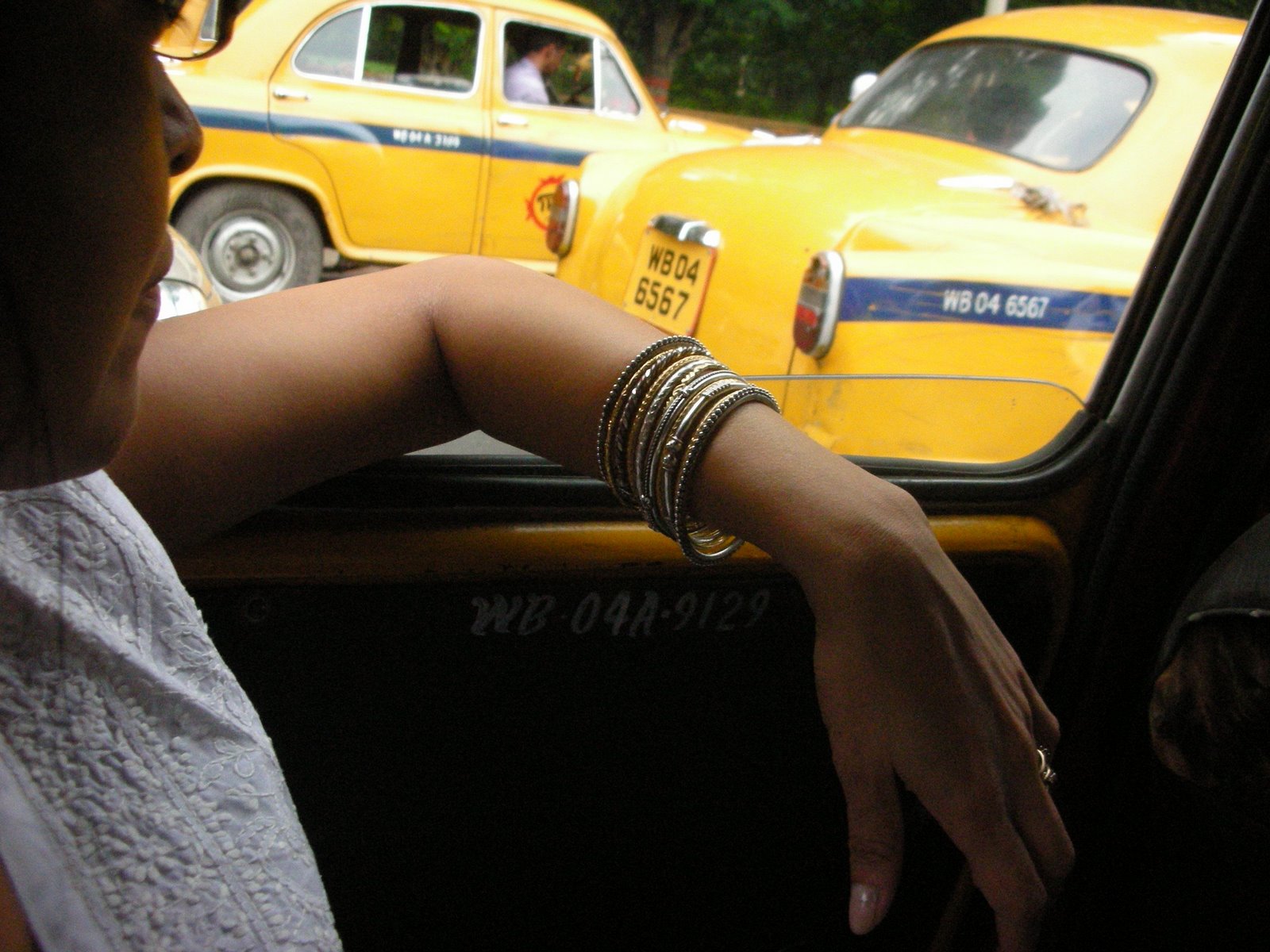
I, for one, cannot imagine Kolkata without its taxis – some black and yellow, others, plain yellow, all rickety, grimy, aging Ambassadors. They bounce down pot-holed streets and wreak heavily either of cheap incense or the driver’s fast-burning bidi.

Taxis are everywhere in Kolkata. And quite affordable for the middle classes.

The drivers say they cannot afford to buy new vehicles and switch from diesel to greener fuels. Nor can they seem to get loans in the economic downturn.

Such are the dilemmas of living in a poor nation.

I’m not sure what the solution is. I shudder to think what Kolkata would look like without pollution controls. But nor can I imagine standing on a congested corner, perhaps on Ballygunj Circular Road and Gariahat Road, and yelling: “Taxi!”