Memories of assassination


It has been 25 years since Indira Gandhi was assassinated by two of her Sikh bodyguards.

The impact on Indian history is undeniable: a nation mourned its beloved daughter and simultaneously displayed its ugliest side for the rest of the world to see.
Rioting in New Delhi led to the killings of innocent Sikhs, destroying families, communities and any semblance of national unity in the country’s darkest days. If you have never seen the film, “Ammu, ” do so.
A quarter century ago, I was a young reporter just learning the business. I penned my emotions about the assassination in a piece that ran in “The Florida Flambeau,” an independent, student-run newspaper that, sadly, is no longer around.
It was a first-person story. I recalled seeing Indira’s black-and-white photo in the stairwell of the Catholic convent school I attended as a 2nd grader. The photo occupied the entire wall of the landing. Every morning I drew hope from it. No matter what you thought of Indira, the politician, she certainly served as inspiration to little brown girls in India.
It was ironic, then, that her death helped launch my career in journalism.
That is what I will think of as I read all the anniversary stories in the next couple of days. And how history might have unfolded differently had she lived.

Tussling over Teresa


One of the quietest, most peaceful places in the heart of Kolkata is Mother House.

The non-descript building can be easily missed. The entrance on Lower Circular Road is far from grand.
But inside, nuns clad in crisp white saris with blue borders go about their business. The rooms are sparse but sparkling clean.
And thousands flock to the tomb of Mother Teresa, who arrived in India many years ago to pick up the poor from the streets and given them shelter, food — and most importantly, love.
Kolkata claimed the Macedonian-born, ethnic Albanian Catholic nun as one of their own. She became an Indian citizen later in life and the South Asian nation embraced her.
Hailed as a savior for the destitute, Mother Teresa relinquished her gala Nobel Peace Prize dinner in 1979 and asked that the money be spent on poor people.
She died in 1997 now a squabble has erupted over her remains. Albania wants her sent to that country before her 100th birthday next year. The prime minister says Mother Teresa ought to be buried next to her mother and sister.
India says: No.
She should remain in her adopted home, where she made her life, India says.
I’m not sure exactly what motives are here, but if the intention is to make Mother Teresa a tourist destination, the fight over her remains should fade quickly. There’s something distinctly wrong about the notion that a woman who gave selflessly all her life should not become such a bickering point over tourist dollars that will, I am sure, not go to help the needy.
Few people identify Mother Teresa with Tirana. They think of her with leprosy victims and slum dwellers in my hometown. I know what an impact she had in Kolkata because I spent several months teaching slum children in a program run by the Missionaries of Charity. Perhaps it’s best to leave her in that plain compound on Lower Circular Road.
I have an etching of Mother Teresa done by B.P. Panesar, one of India’s most talented artists. I look at her weary face every evening when I get dressed for work. And find hope in her ever-so-faint smile.
It seems such a shame that we would think to trouble her in her final rest.

85,000

That’s how many Iraqis died in the war between 2004 and 2008. Iraq’s human rights ministry released that grim number a week ago.


We keep an exact count of the number of Americans who were killed in Iraq and Afghanistan. Or the number of British troops and other coalition members. But no one really counts the civilians. The children. The mothers. The grandmothers. They remain nameless, numbing numbers in headlines. “42 died in suicide bombing.”

“Outlawed groups through terrorist attacks like explosions, assassinations, kidnappings or forced displacements created these terrible figures, which represent a huge challenge for the rule of law and for the Iraqi people,” the ministry said.

“These figures draw a picture about the impact of terrorism and the violation of natural life in Iraq,” the ministry said in a draft report on deaths in Iraq.


But no one really knows how many Iraqis died.

The Iraqi government report was compiled with death certificates issued by the health ministry. What about all those people who never saw home again. Or whose families never reported a death out of sheer fear.

I know people who have lost loved ones and kept silent. One death in the family was enough.

Some Iraqis were killed by AK-47 fire, rockets, mortars, and bombs, otherwise known as improvised explosive devices. Some were abducted, stabbed or beheaded. In places like Ramadi, such gruesome acts were carried out in public places and in broad daylight.


The capital of al-Anbar province was once al-Qaida’s haven and an Iraqi citizen’s hell on Earth — the neighborhood of Melaab was known as “the heart of darkness.”

I asked Ramadi residents what life was like before the insurgency was quelled. They glided their right index finger across their throats. The insurgents brazenly beheaded people in public and distributed videos of the executions. Think of what kind of fear an ordinary Iraqi lived through. And still does.
The headlines these days report fewer incidents of violence.

But one bullet, one bomb — is all it takes.

C’est la vie

A few years ago, my cousin’s young wife told me that she looked forward to turning 50.

Gasp.
Silly, lass, I thought, struggling with the fact that I was indeed many years older than she. I envied her youth and scoffed at her eagerness to gallop forward into time.
I don’t scoff anymore.
I turned 47 on Tuesday, a number that would have made me shriek a few years back. But I welcomed it and like my cousin’s wife, I look forward to 50, though I am much closer to it now than she was when she made her shocking declaration.
For the first time in many years, I am working next to people who are, well, very young. I am old enough to be their mother, I tell them. That was perhaps the biggest adjustment for me when I transitioned into a new job at CNN. For so long, I was the kid, surrounded by sage newspaper folks.
I look at my new colleagues and wish them well in their journey. And I’m glad that I have progressed as far as I have. For the things I know. The lessons I learned. The mistakes I made. The joys of love and marriage. And the sorrow of losing a mother, a father and friends and relatives I cherished.
It took 47 years to make me who I am today.
I look forward 50. 60. And beyond.
I hope.

When the earth shook and a girl smiled

The earthquake in Sumatra took me back to Gujarat. 2001.


It was Republic Day — January 26, when the earth shook so hard in the western Indian state that we felt it as far away as Kolkata. I was home, on vacation, visiting my parents. That winter, I knew, would be my father’s last. He was losing his battle against Alzheimer’s.

Then came the call from the managing editor of the AJC, John Walter, another man who is no longer alive. “Do you have a computer with you?” he asked. “What will it take to get to Bhuj?’

That was the epicenter of the massive quake.

A few hours later I was in Mumbai, waiting for a flight into Ahmadabad.

It was the first time I had covered a quake. I had seen hurricanes and blizzards. And floods and dust storms. But never a quake.

This week, as I watched my CNN colleagues covering the Indonesian tragedy, I thought back to the days when I slept under the stars for fear of being in a building that could crumble. I could smell again the wicked stench of rotting flesh trapped in rubble and the Muslim cleric who doused his handkerchief with scented oil and tucked it under my nose.

I thought of how foolish I was when I asked a member of a radical Hindu group why he was carting bodies to the crematorium. “How do you know if they are Hindu or Muslim?” I asked, with all the disdain of an insufferable journalist.

He pulled off the burlap covering a mangled piece of flesh. It was a woman, he said, because you could see the bangle on what used to be a wrist. “But you tell me, madam,” he said, “if she is Hindu or Muslim and I will act accordingly.”

I wanted to walk away. I was so ashamed.

I marveled at the resiliency of suffering people.

I wrote about a school girl I met while sitting at the airport in Bhuj, waiting for a plane to carry me back home, away from the horror. I meant to write it as a journal entry; the paper ended up publishing it as a column. To this day, I wonder about her.


Anjar, India

Will you remember me?” 14-year-old Bhavika Vegad asked peering straight into my camera, the smile disappearing from her face.

How could I not? Bhavika’s world was turned upside down when a Jan. 26 earthquake leveled her city. And I was there to bear witness.

All around her, relatives, friends, classmates and teachers perished under the concrete and bricks that tumbled to the ground the day the earth roared in Anjar.

Six days later, a sprightly Bhavika roamed the rubble-filled streets, shielding her nose from the dust and dodging the debris in her path. She followed me from a temporary clinic and shelter halfway to the devastated Mistry Failyu neighborhood.

“I miss going to school, ” she said in almost perfect English. “I miss my friends and teachers.”

No one knew when Bhavika would be able to return to school. Anjar, with 65,000 residents, is a bit bigger than Roswell. And the only thing left here is misery.

Now the journalists have started to leave Gujarat state. The relief agencies are also temporary. But Bhavika’s life has changed forever.

And, yet, in the midst of Gujarat’s tragedy, her face was a ray of hope — an inspiration to begin healing.

When I first arrived in Ahmedabad, the former state capital that has roughly the same population as the Atlanta metro area, the scale of the devastation eluded me. The airport in this industrial center is located in an area that was largely spared.

It was two days after the massive temblor. It was midnight. I had been traveling for almost 24 hours.

I felt lucky that I had been able to reserve a hotel room in a city suddenly bursting at the seams with media, dignitaries and relief workers. All I wanted was the comfort of a clean bed.

The first sign that something was terribly wrong struck me as the auto-rickshaw made its way deeper into the heart of Ahmedabad. So many people were out in the streets — some of them sleeping under the stars, others too scared to close their eyes.

When I arrived at the hotel, the deep fissures in the wall made me wonder whether I, too, might not be better off sleeping in the street.

“This hotel is not safe, ” the auto-rickshaw driver said.

That was all it took. That first night I slept in a dump across from the railway station. But it was a dump without cracks in the walls.

I found a better room on my second day in Ahmedabad, in the Best Western Moti Manor. But I didn’t realize that the rail tracks ran past the back of the building. Every time a train went by, my heart raced at the thought that another aftershock might be rattling the city.

The seismology experts said Gujarat was experiencing aftershocks at the rate of one every hour. It was hard to sleep at night, knowing that the walls could crumble around me at any moment.

It was then that I understood the fear and panic that had gripped this part of the world.

Usually, we find solace in our homes. But here, a two-minute temblor had robbed Gujaratis of that fundamental comfort in life. People regarded their homes not as a place of sanctuary but as a menace, an enemy.

As I visited town after town in Gujarat’s Kutch region, I realized the enormity of what had happened. Entire towns and villages lay flattened. Thousands of people were left out on the fields and streets with nothing left to their names. Out of every pile of rubble wafted the acrid smell of rotting corpses. Men and women wailed openly. Others, shellshocked, grieved in silence. Or didn’t feel at all.

In Anjar, I walked from block to block surrounded by desperate rescue workers. Four hundred dead here. Thirty-two still trapped there. Renu Suri of the Atlanta-based relief and development agency CARE had warned me the death toll is certain to be much higher than reported. She said as many as 100,000 people could have died, but that we may never know with certainty.

I thought of a conversation I’d had a week before the quake with a friend in Calcutta. We agreed that India, the world’s second-most populous country, would go nowhere without family planning. India’s best method of population control, he added, came in the form of natural calamities. We need more cyclones and floods, he said.

I thought his statement gross then. In Anjar, the words became unbearable.

Back in Calcutta, I showed my family a video of Gujarat recorded on my camcorder. As Bhavika Vegad’s face lit up the TV screen, I wondered what she was doing at that moment, 12 days after the quake.

Was she still sleeping in the cold? Was she afraid of entering a cracked building? Had her school reopened? How many of her friends died in the quake?

Bhavika told me her parents had survived. So I knew she was one of the lucky ones.

Yes, Bhavika, I will always remember you. I’ll remember your long black braid bouncing down your back as you ran.

Your smile was the only one I saw in Anjar.

Gandhi Jayanti


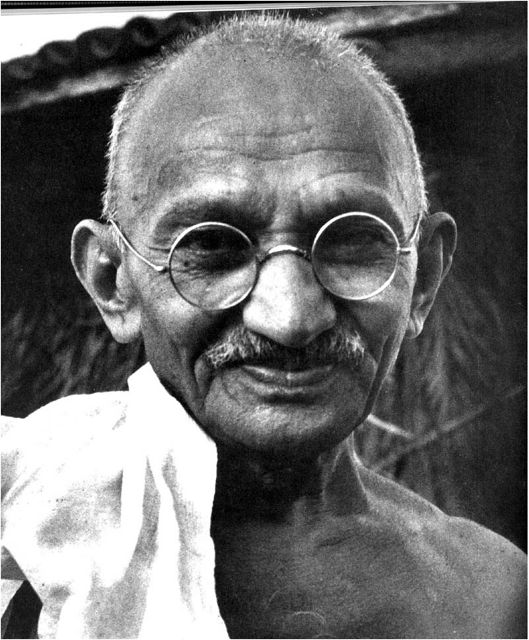
I know several folks who were born today. They share their birthday with one of history’s greatest men: Mohandas Karamchand Gandhi. Otherwise known as Mahatma, the great soul.

Check out Google today and you’ll see the familiar profile. Round glasses, balding, round head, ears to rival an elephant’s. Walking stick. Dhoti, the white muslin worn by men.
A new four-volume book translated from Gujarati comes out today. I am looking forward to acquiring a copy.
There has always been debate about Gandhi’s non-violence tactics and civil disobedience in India, which ultimately led to freedom for millions from the tyranny of British colonialism but at a great cost. More than a million people died crossing the borders between Islamic Pakistan and predominantly Hindu India. In the end, Gandhi’s critics said, independence was not non-violent, but downright bloody.
Was Gandhi right in trying to beat a master not with physical strength or ammunition but by stronger will — and courage?
Martin Luther King Jr. thought so. He adopted Gandhi’s practices to make America’s civil rights movement.
In my home, Gandhi was a hero. My father, a deep-thinker, a pacifist, revered Gandhi’s teachings, his spirit. I grew up staring at an oversized black and white photo poster of Gandhi in our house. It still hangs on the wall at my flat in Kolkata, one of the few embellishments left there in the years since my parents died.
Gandhi lived a simple life of purity and protest. In the end he was gunned down by a man who failed to understand him. Someone who bore the kind of hate that Gandhi devoted his entire life fighting against.
Whether or not you agreed with Gandhi’s political strategy, you can’t help but admire his everyday practice of ahimsa — an important tenet of the great Eastern religions of Hindusim, Buddhism and Jainism. Do no harm and speak the truth. Always.

Goddess of strength

Thousands of deities are on their way to the banks of the Ganges in West Bengal today. The immersions have to be finished by Wednesday in the capital, Kolkata.


Ma Durga, the goddess of strength, returns to Ma Ganga, the holiest of rivers.


In the next few hours, murtis or images made from clay, wood, paper mache, bamboo, straw, shell and sand will begin dissolving in murky river waters.


Durga Puja, the biggest Hindu festival in my home state, is culminating this week.


When I was young, Durga Puja was the highlight of my year. Like an American kid looking forward to Christmas.


The five-day festival usually falls in September or October, depending on the position of the stars. We were off from school for several weeks. The streets were filled with fun and food. We wore new outfits for each day of the puja and went from pandal to pandal (temporary structures that housed the images) to see which one was the biggest, the baddest.


Hindu mythology tells the tale of Durga this way: Only a woman could kill the demon named Mahishasur. So the gods got together and each gave a virtue and skill to create the ultimate warrior, the goddess of strength. They gave Durga 10 arms so she could carry weapons in each to slay the Earth’s evil.


And so she did.


As I grew older and Kolkata became more congested, Durga Puja became somewhat of an inconvenience. The crowds, the road closings, the heat, the rain, the mud and muck of the dwindling monsoons. Last year, I almost missed my flight back to Atlanta because it took so long to weave through city streets to get to the airport.


The 15 million people of Kolkata all seem to be out together during Durga Puja. The constant banging of the dhol (drums) and blaring Bollywood music deafens my ears. At the end of every street, on every corner and in the neighborhood parks and schools, clubs fight for best in show. Who will win the prize for the most attractive Durga display? Some images are realistic. Others abstract. Some simple, others so ornate they would make Marie Antoinette gasp.


And when the five days of worship are over, throngs of people parade down the streets behind a lorry carrying their neighborhood Durga to the Ganges, so she can return to the heavens.


Whether you get into the Hindu puja spirit or not, there is something awesome about seeing millions of people fall at the feet of a woman to worship her strength, especially in a country like India, where women still have a long way to go to gain equal standing with men.


Last year, I was walking home from the bank and I stood and watched workers put the finishing touches on their Durga display. The beautiful and mighty woman, steely in body and soul (and loaded with weapons to boot!).


I stared into the eyes of the image. And felt her strength recharge me.


Check out this Web site for more information on the ceremony, rituals and story behind Durga:

http://www.durga-puja.org/


Betrayal

In the summer of 2004, when word came that John Kerry had tapped former presidential rival John Edwards as his running mate, I climbed into my Honda CRV and drove fast and furious up Interstate 85 from Atlanta to Edwards’ hometown of Robbins, North Carolina.

It took me about five hours and by the time I arrived in the small town, downtown businesses were shuttering for the day. I had hoped to speak to local folks about their boy made good.
Instead, I drove to Edwards’ parents house, where Bobbie and Wallace Edwards invited me in. Johnny’s about to be on CNN, they said. Do you want to stay and watch with us? You drove all this way from Atlanta? Are you hungry? Would you like to eat supper with us?
I was amazed at how down to earth they were. How humble. How gracious.
I had been covering Edwards for the Atlanta Journal-Constitution during the campaign. After he won the South Carolina primary, I hopped aboard his campaign plane and traveled with the handsome man lauded for his populist message. He was the son of a mill worker, after all. His heart was good.
I was impressed not just by his parents but by his wife, Elizabeth. She and John married in 1977 and had weathered the loss of their son, Wade, who died in a tragic car accident.
When I interviewed Elizabeth, she recalled how she met John when they were both law students at the University of North Carolina at Chapel Hill. How on their first date, they went dancing and John kissed her gently on the forehead. She was taken by how sweet he was.
After all these years, she was his ballast.
Then came loss for Kerry-Edwards in November, 2004. And the announcement that Elizabeth had been diagnosed with cancer.
Through it all, everyone thought that Edwards had a terrific chance of occupying the White House one day. Until the wretched story broke about his affair with Rielle Hunter and whether he had fathered her daughter.
Details about the sordid sex scandal are still emerging but one thing is quite clear: John Edwards, once the sunshine of the Democratic Party is shrouded in darkness forever. His political career is finished and a New York Times story last week documented how he largely lives in seclusion these days.
Neil Lewis’ story makes Edwards out to be the epitome of narcissism. Some of the comments made by his former aide are shocking. Check out Lewis’ account of the rise and fall of Edwards at http://bit.ly/1aDPOV
It’s sad to read such stories. I had believed in Edwards’ integrity when I wrote about him. He was electric, well-loved. Reporters found him genuine, refreshing. It was invigorating to cover his campaign.
Now, I feel betrayed.
What else did Edwards lie about?
I think about his parents — such simple people who must now see their son disgraced in such a public manner.
And I wonder: How could he do this to Elizabeth?

In the Jungle

Late one night, I was flipping channels and came across a 2002 docudrama made by Michael Winterbottom called “In This World.”


The camera followed two Afghan brothers, Jamal and Enayatullah, on a harrowing journey from a Peshawar refugee camp through the Middle East and Europe. Because they were crossing borders illegally, the risks were enormous. They climbed snowy mountains without warm boots, were smuggled out in crowded trucks and shipped in stifling hot containers.


I won’t tell you how that particular journey ends – you will have to watch the movie.


But this morning, the French government dismantled “the Jungle,” a makeshift camp that housed men who had fled their homelands in search of prosperity in Europe. They were all illegal; most had been motivated to flee because of persecution. I would think that they ought to qualify for refugee status.


They go to Calais with hopes in their heart of one day crossing the English Channel into Britain, which for some reason has developed a reputation as a haven for illegal migrants.


On a clear day you can see the white cliffs of Dover from the French coast. The men from Afghanistan, Iraq, Iran, Somalia and other troubled lands, cast their eyes across the 20-mile stretch of water, wondering if there is a future for them across the waves.


Just like the brothers in Winterbottom’s movie, they hope to be smuggled into England, perhaps hidden underneath a lorry crossing the water by ferry.


Illegal immigration has, of course, become a big problem in Europe. Hence, the crackdown. The French government has not yet said what will become of the migrants who were detained Tuesday. Humanitarian workers are pressing both Britain and France to take in those who are at great risk.


One Afghan man told CNN reporter Phil Black that the Taliban had accused him of being a spy. He feared for his life in Afghanistan and left his family behind to seek a safer prospect. Tuesday, the uncertainty in his life became greater. He only knew one thing for sure. He could not turn around and go back home.


A different sort of revolutionary


Norman Borlaug died over the weekend.


Who?


OK. Borlaug’s name isn’t familiar to most, though he was one of only five people to be awarded the Nobel Peace Prize, the Presidential Medal of Freedom and the Congressional Gold Medal. The other four recipients are Martin Luther King Jr., Nelson Mandela, Elie Wiesel, and Mother Teresa.


So why was Borlaug in such esteemed company?


He is credited with saving millions from starvation. Not through philanthropy but with science.


He collaborated first with Mexican scientists and then with Indians and Pakistanis on efforts to improve wheat production. High-yield, disease-resistant wheat varieties pioneered by Borlaug in the 1960s led to successful increases in food production and earned him the title of father of the agricultural “Green Revolution.”


In my native India, Borlaug’s plant science was considered a godsend at a time when the nation could not match food production rates to a burgeoning population. Green Revolution technology enabled India to go from famine to agricultural self-sufficiency.


For helping alleviate human misery in developing nations, Borlaug won the Nobel Peace Prize in 1970. The Statesman newspaper in India hailed him this week as the greatest hunger fighter of all time.


“It is true that the tide of the battle against hunger has changed for the better during the past three years,” he said in his Nobel acceptance speech in Oslo, Norway. “But tides have a way of flowing and then ebbing again. We may be at high tide now, but ebb tide could soon set in if we become complacent and relax our efforts. For we are dealing with two opposing forces, the scientific power of food production and the biologic power of human reproduction.”


Some people say the ebb tide has set in. That Borlaug’s science didn’t really work. Millions of people suffer from food shortages.


Borlaug blamed high rates of population growth in defending himself against critics who argued that Borlaug’s science had created more problems than it had solved. Environmentalists said Green Revolution technology relied too much on chemicals and toxic pesticides. Social critics said it hurt small farmers.


But some humanitarian workers still hail him as a saviour.


“No single person has contributed more to relieving world hunger than our friend, the late Norman Borlaug,” said Rev. David Beckmann, president of Bread for the World. “Normanwas truly the man who fed the world, saving up to a billion people from hunger and starvation.”


Josette Sheeran, the executive director of the United Nations World Food Programme said this: “His total devotion to ending famine and hunger revolutionized food security for millions of people and for many nations.”


Last month, Iowa Sens. Chuck Grassley, a Republican, and Democrat Tom Harkin introduced legislation to designate Borlaug’s birthplace and childhood home near Cresco, Iowa, as a National Historic Site. He was born on a farm there on March 25, 1914.


“Dr. Borlaug and his work to save the lives of hundreds of millions people are historically significant for Iowa,” Grassley said in a press release. “By designating his birthplace and boyhood home a National Historic Site, we’ll be preserving his legacy for years to come and continuing to inspire future generations of scientists and farmers to innovate and lift those mired in poverty.”


Maybe now, more people will know Norman Borluag’s name.