Bangali biye (Bengali wedding)


Members of the younger generation in my family think differently than did my grandparents. Many of the centuries-old traditions and rituals are falling away as young men and women adopt a more progressive — and often more gender equitable — outlook toward life.

But one thing that remains constant are the intricate ways of a Bengali Hindu wedding.
My cousin’s daughter, Shoma, had been planning her wedding for months. I arrived early on the morning of December 2 for the remaining five days of festivities. That afternoon, family members blessed the bride (many with 22 karat gold jewelry in hand) in a ceremony known as Aai Budo Bhaat. It’s also a bachelorette party of sorts and several of Shoma’s friends showed up later in the evening for a dinner party.
The next day, the women of the family grind turmeric with a mortar and pestle and anoint the bride with the paste. This allegedly brightens the complexion and makes her skin glow on her wedding day. It’s a messy affair, leaving women with stubborn ochre-stained nails.
There are numerous pre-wedding rituals. What they have in common is food.
With each ceremony, the family gathers for an elaborate feast, which for Bengalis is incomplete without a spectacular fish preparation. Often the fish is saturated with mustard paste and steamed inside a banana leaf.
Then there is rice. Lentils. Fried puffed breads. Roasted eggplant. Medleys made with vegetables we never see here — red pumpkin, bitter gourd, and greens and beans that I couldn’t even name in English. Mutton curries and savory chutneys.
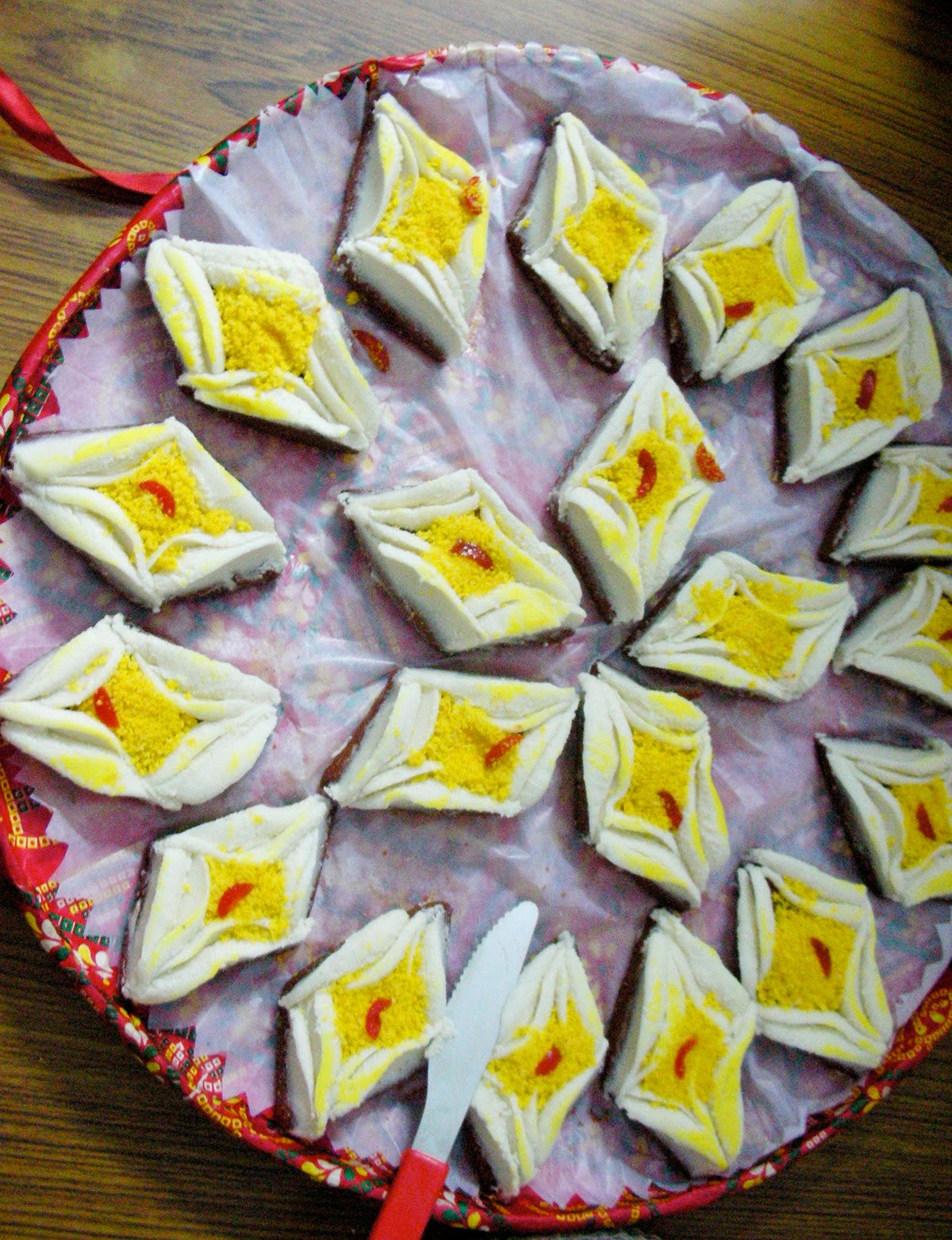
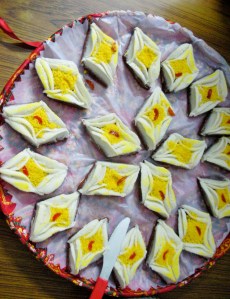
And, of course, the sweet stuff — the other thing that have made Bengalis famous. Sweet curd, sandesh, rasagollahs, malai chom choms. (Pictured here are some sweets that arrived from the groom’s family. The photo of the fish, a Ganges carp, was sent along with other gifts as an offering of goodwill from Shoma’s family to the groom’s household.)
By wedding day, I swore I could not eat another morsel.
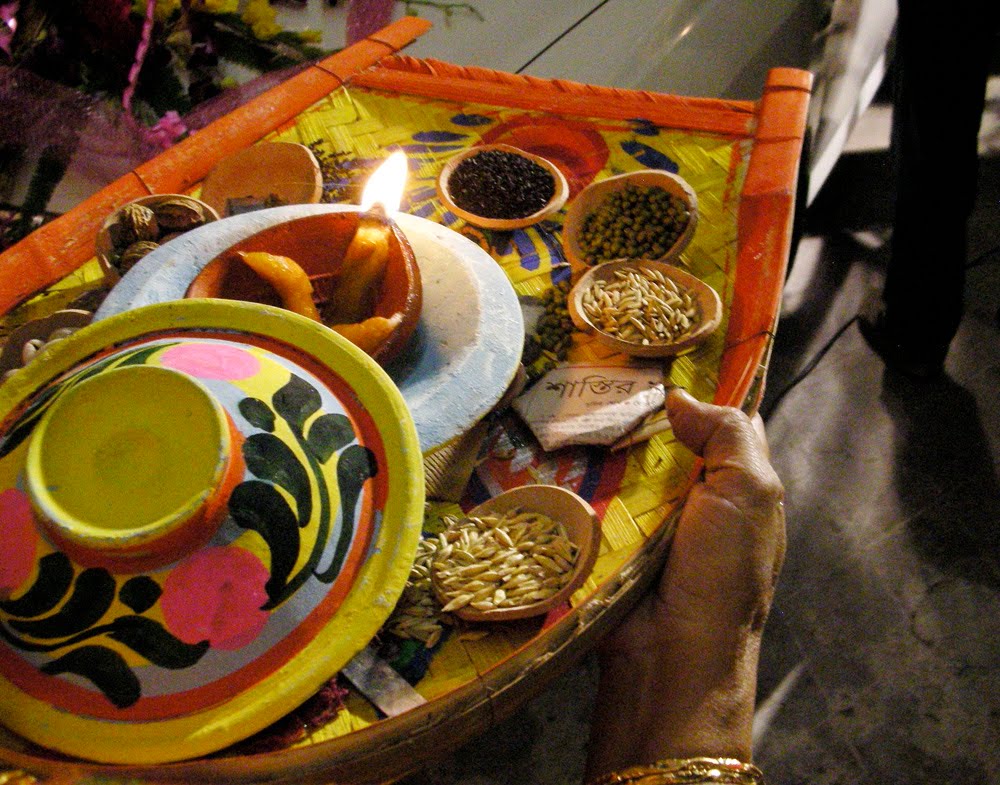
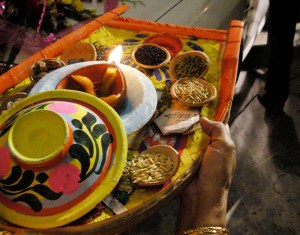
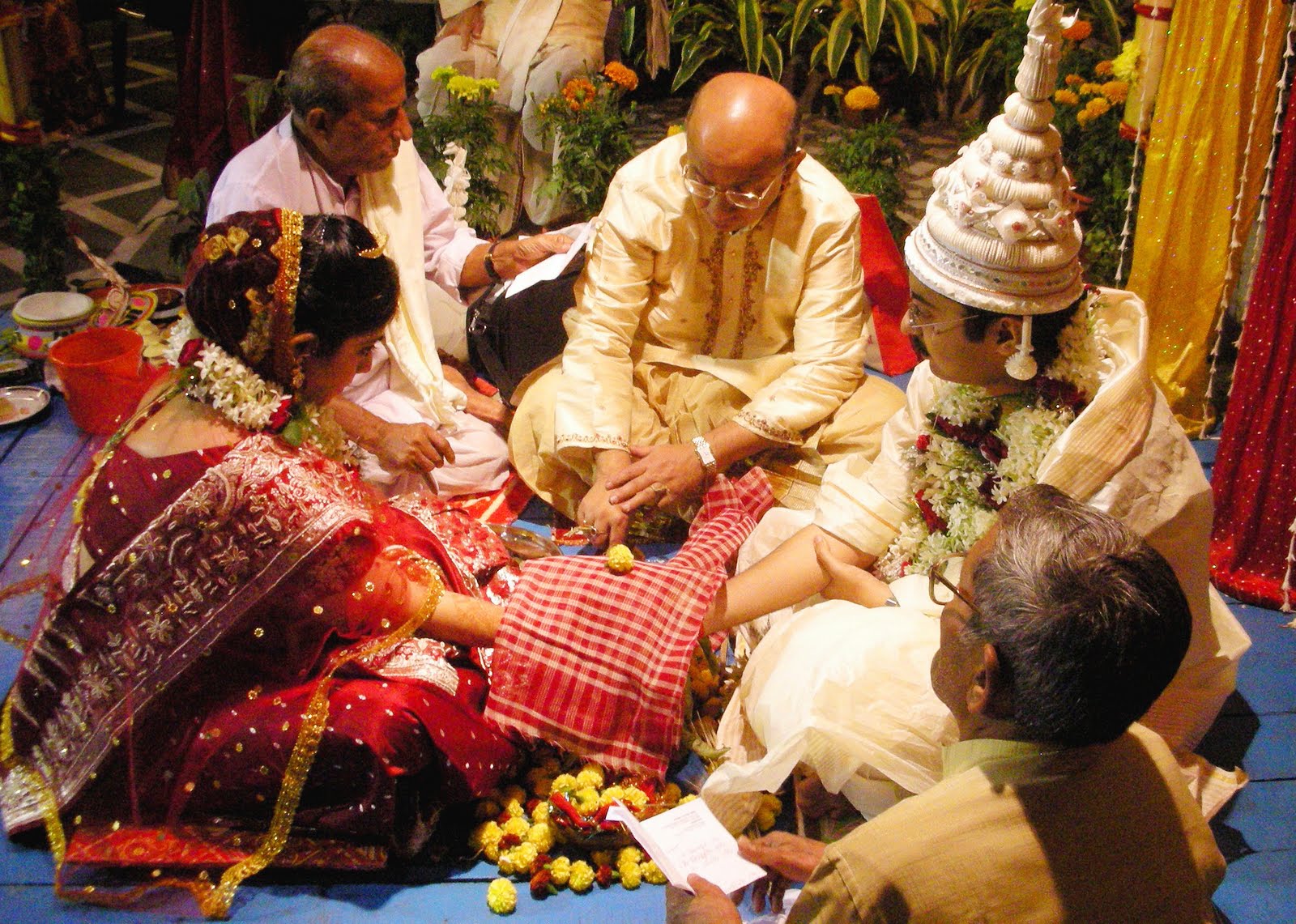
Shomas’s family greeted the groom, who arrived in a flower-laden car with a large entourage. Shoma’s mother blessed him with a bamboo tray containing an earthen lamp, husked rice and trefoil (see photo).
The actual ceremony, oddly enough, is often not even witnessed by guests. Astrologers set the time for the nuptials and sometimes, it’s in the middle of the night! Luckily, Shoma’s was in the evening and people did gather around the marriage platform, though few really understood the Sanskrit mantras the priest was chanting.
Shoma looked like a princess, a blanket of gold around her neck and chest and the henna on her arms hidden by filigreed and bejewelled bangles. Even her tiara was solid gold.
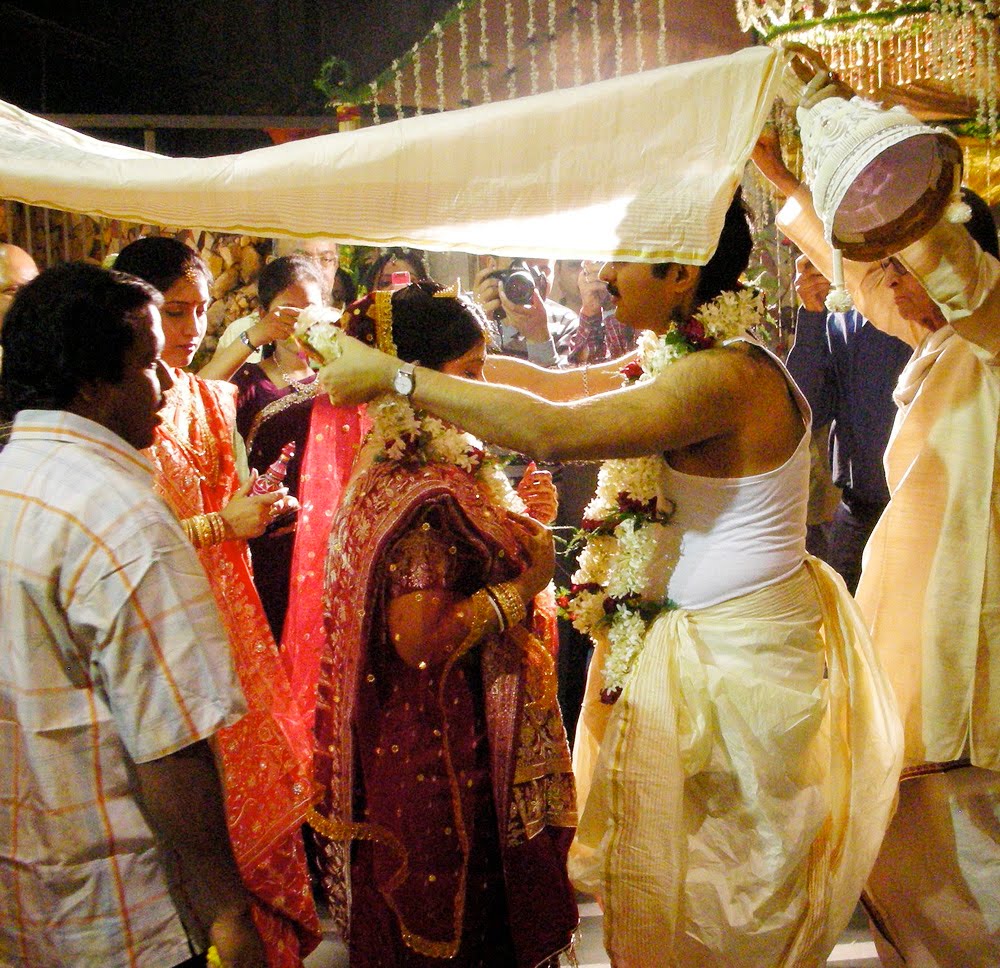
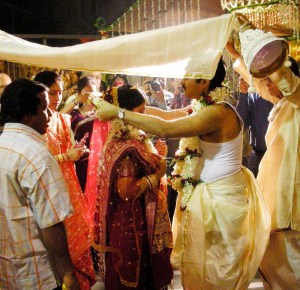
Bride and groom exchanged flower garlands (see photo). The end of her maroon brocaded sari was tied to one end of his perfectly pleated and ironed white muslin and silk.
Shoma and her groom, Bishan, sat on front of a fire to chant mantras after the priest. They took seven rounds around the flames. Agni, the god of fire, is the divine witness to the union.
Shoma and Bishan will be living in Istanbul, where he has a job with a bank. The rituals performed on a hazy Kolkata December night will soon become as distant as the moon.
I was glad to have witnessed the actual ceremony for once. It reminded me of what an ancient land India is. Steeped in tradition. And it made me ponder whether the next generation, consumed with McDonalds and Macintoshes, will still foster such ceremony.
And then, I, who was determined not to fill my belly once again, did just that.

Kolkata

On my way home.

It has been more than a year that I was in my beloved Kolkata. A feast and sore for the eyes all at once. An assault on all the senses.

I feel the excitement of a bride to be. And of someone who, near death, fulfills every dream.

I am minutes away now from Lufthansa Flight 445 that will carry me across the Atlantic. Then, another jet that will sail over the gentle landscapes of Europe and the rugged terrain of Iraq, Afghanistan, Pakistan. My heart will beat faster as the flight trackers shows names like Varanasi, Patna, Dhaka. It will pound as the plane descends into Kolkata.

Below me I will see the dim twinkling lights of a city that operates on 25 watts, save the glaring fluorescent tubes that are off at this late hour.

It’s a feeling I have known for many years. Familiar and comfortable like an old pair of shoes that no longer suit me but stay in my closet year after year.

I used to think of my mother’s smile as the plane touched Kolkata soil. My father used to be waiting for me among the throngs of people. That stopped when my father became incapacitated with Alzheimers. I began taking a taxi in the dead of night, smelling the cow dung and the acrid smell of the Chinese tanneries as we raced our way to Ballygung on the Eastern Bypass.

Ma would always be waiting for me. At 3 in the morning, she was waiting. In her wheelchair. Her eyes battling the kind of deep sleep awoman in her 60s needs at that hour.

But she was waiting.

No one waits for me anymore. I pay the $300 for a rickety Ambassador taxi that takes its time meandering in the dead of night.

I rest my head on an unfamiliar pillow, in an unfamiliar room, sadness and excitement gelling inside to keep me awake. Sleep finally comes when the sun begins to rise and the horns of the Tatas and Marutis begin the city’s symphony of sounds.

It is still my city, I think. But not.

Remembering 26/11

A year ago, I was making my way to Mexico City, dreaming of the serene canals of Xochimilco and the burst of a hot tamale in my mouth.
By my heart was heavy.
In my homeland, Mumbai was under siege, attacked by gunmen in hotels, the main train station, a popular restaurant and a Jewish cultural center. More than 160 people perished on that day that came to be known as “26/11.”
I watched the flames engulf the Taj Mahal Palace and Tower Hotel, a majestic landmark in India’s largest city. The stairwell there is mesmerizing. British Raj architecture at its finest.
On my last visit to Mumbai, I had stayed at the Oberoi-Trident in a room that offered a view of Marine Drive and the waves of the Arabian Sea.
Both hotels were scenes of tragedy a year ago.
Mumbaikers are like New Yorkers. They never stop in a city that hardly sleeps.
But they did stop on Thursday. Just as they had a year ago. Except then, it was forced upon them. Today, they chose to pause — and remember.
Fallen citizens and local heroes. And what it’s like to survive.
In the CNN newsroom, I sat quietly in a corner to write about the anniversary. Tragedy is always difficult to convey. It’s that much harder when it becomes personal.
Read the story: http://bit.ly/8wGQgc
And with each bite of turkey, give thanks for all we have.

White House feasting

President Barack Obama hosts his first state visit today. The guest? Indian Prime Minister Manmohan Singh.
Makes me proud.
Singh, India’s first Sikh leader, is an a Cambridge- and Oxford-educated economist who was first sworn in as prime minister in May 2004 and again this past May when the Congress party won national elections.
During his visit to Washington, Singh will certainly be looking for ways to continue strong bonds forged between India and the United States under the administration of George W. Bush. Talk may not come easy — India’s chief rivals China and Pakistan are both strong U.S. allies.
Foreign policy aside, here comes the real question. What’s for dinner?
Politico reports that the White House has invited super chef Marcus Samuelsson of Aquavit fame to cook the divine for Obama’s first state dinner. Wonder if Samuelsson will be mixing masala on the menu.
Though he’s nearing 80, Singh is known to be hale and hearty partly because he follows a strict diet, preferring vegetarian over carnivorous fare. A potato-filled dosa over mutton kabobs.
I’ll be waiting to find out what goes onto Singh’s plate tonight. He is, after all, the leader of a nation that now, after years of post-colonial poverty, has become an economic giant commanding global attention.
Tonight’s state dinner might just contain the ultimate carrot.

Ode to a water tank


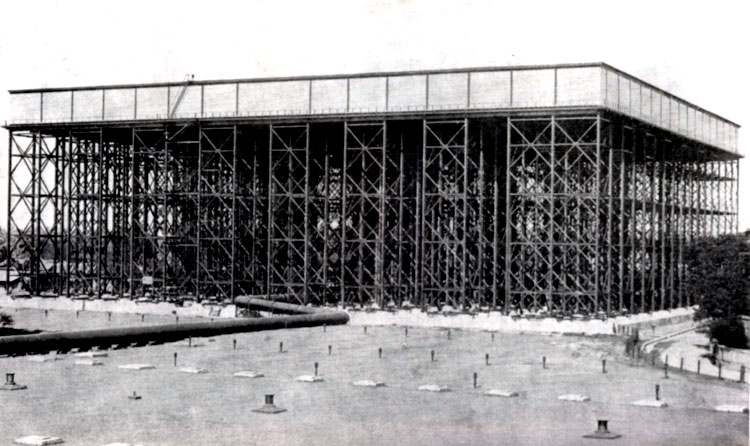
Tallah Tank turns 100 today.

What is Tallah Tank, you might ask. It’s allegedly the world’s largest water tank of its kind, holding a whopping nine million gallons of water to supply a city burgeoning with over 15 million people. If Tallah were to store aviation fuel in its belly, writes The Telegraph newspaper, it would be enough to fuel 158 jumbo jets.
It’s a landmark in my native Kolkata that very few tourists ever see. Located in the northern part of the city, Tallah is hardly a destination. But it’s a marvel in a city where very few things work efficiently.
“In fact,” a local Kolkata Municipal Corporation official told The Telgraph, “the city would run dry of the tank were to be shut down for a day.
Tallah has never let Kolkatans down. It has sprung only 14 leaks since it was built in the days of colonialism. The British Empire crumbled (thankfully) but Tallah kept standing. Massive. Majestic. Even menacing.
That’s how I looked at Tallah as a little girl who passed it by in a taxi on the way home to Baranagar from New Alipur, in the southern half of the city.
After a long ride through congested streets and snaking lanes, Tallah was my sign that home was near. Once the rickety black and yellow Ambassador whizzed by the tank on Barackpur Trunk Road, I could see the tops of coconut palms and the muli-story buildings of the Indian Statistical Institute.
I didn’t know then that Tallah was Kolkata’s source of water. But it was appropriate that it was such a vital symbol for me.
Happy 100th, Tallah.

Invisible people

We take so many things for granted here in the United States, among them a little piece of paper documenting births. But millions of people across the world do not have birth certificates.
Their existence is not documented. They are often unable to access benefits, including life-saving medicines.
In many places, a person lacking a birth certificate cannot marry, vote, get a good job, obtain a passport or register their own children’s births.
They are invisible, really.
I know what it feels like. I don’t have a birth certificate.
I was only a few days old when I left on the steps of a Calcutta orphanage. My world changed when my parents adopted me and gave me a life I could never have even dreamed of as an orphan.
My father took out a small newspaper ad announcing to the world that he was claiming me as his daughter. If anyone had an objection, this was their time to speak. That was how the law worked back in 1962 in India.
I grew up without that essential birth document. Nor did I have an adoption certificate. I didn’t think about it until the day I faced a U.S. immigration officer in Jacksonville, Florida, during an interview for a green card.
“As far as I’m concerned,” he said, “you don’t exist.”
I felt small. Unwanted.
Invisible.
An international charity called Plan has been working hard to make sure that fewer people feel invisible. So far they have enabled 40 million people in 32 countries gain access to documents.
“A birth certificate gives you legal identity as a child or as an adult. It gives you a nationality and a sense of belonging,” Plan’s chief of global advocacy Nadya Kassam told CNN in a story posted online today.
The certificate, Kassam said, proves who you are.
I still don’t have a birth certificate ( I never will) but I am now a U.S. citizen and hold my new passport close to my heart. For me, it’s so much more than a travel document.
It just might be a lifesaver one day — my only proof that I exist.


Remembrance


Amazing Grace and Taps echoed through the vastness of Fort Hood on Tuesday, to remember 13 soldiers gunned down on post last week.


Soldiers are supposed to die in gruesome fashion at war — not in the safety of their own home.

That is what made Fort Hood so horrific for Americans. That is why the president showed up for the memorial service and television carried it live.

And yet, I remember sitting on a hard wooden bench, listening to another sergeant major do a roll call, perhaps the most poignant part of a military ceremony. At Fort Hood, the names of the dead were only called once, perhaps because there were so many to call. But in Baghdad, the names sounded three times. And there was silence each time.

It was so hot on that August day that my tears instantly dried on my cheeks. I blessed Iraq for not giving me away.

There are those who have died in horrific fashion in Iraq and Afghanistan whose names will never be called out live on television. The president will not attend their ceremonies. The entire nation will not mourn for them.

But some of their names will sound over and over again in my head today — on Veteran’s Day.

On this day, I choose the words of Benjamin Franklin:

“Never has there been a good war or a bad peace.”


Slaughter and sensitivity

We don’t know enough yet about Army Maj. Nidal Malik Hasan to draw any conclusions about why he would launch a killing spree at Fort Hood.

Was it that Hasan, the psychiatrist had absorbed too much combat stress from the soldiers he counseled? Or did his interactions brew anger within? Or was he just evil?
We know nothing about the victims, either.
The story is sure to thicken with detail as the next few days progress and perhaps the ironies, too, will continue to grab headlines.
My irony is that I was amid a crowd of people who are specialists in stress and trauma when I began to learn the details of this story — long before I went to work at CNN Thursday night. I was at a reception thrown by the Dart Center on Journalism and Trauma, speaking with folks like Frank Ochberg, Alana Newman, Jonathan Shay and Bruce Shapiro, when the story was breaking.
The International Society for Traumatic Stress Studies is meeting in Atlanta and Dart hosts its annual fellowships in sync with the conference. So that journalists are exposed to people who have devoted a lifetime to studying trauma.
My colleague Tom Watkins came running from CNN to see what he could find in this room rich with knowledge to add to our stories on the shooting. I just know that I had little inclination to work. My only desire was to soak up the humanity of these folks.
I’m thankful to be an Ochberg fellow, to be among journalists courageous enough to cover tough stories, even when it takes a toll on them. (More TK) While you watch the footage of the shooting, remember the cameraman or woman, the producer, the writer, the photographer who got close enough to tell the story with the depth and sensitivity it deserves.
And remember that journalists are people, too.

About journalists and trauma

“Hey! Welcome back. How was Iraq?”

That’s something I heard often in the hallways of the Atlanta Journal-Constitution when I was freshly returned from war. But how do you answer such a question when the person who asked hasn’t even slowed their gait to listen. I mean, really listen.
So the answer, inevitably, went like this: “Iraq was great. Glad to be home.”
Keep moving.
Tonight, at the Atlanta Press Club, I have been asked to contribute to a discussion on journalists who cover traumatic events. I’m not sure what I will say because I’m not sure I have figured it all out.
I just know that after seven trips to Iraq, life became rather difficult to navigate at times. I felt lonely, cocooned really, thinking that no one here understood me anymore. I was frustrated to hear my friends speak of things I considered dull, irrelevant, inane. I wanted the paper to laud me for my heroic efforts. It didn’t. I considered every assignment boring — what could top a war story?
I saw rivers of blood in my dreams and when I awoke, I wanted to return there. It was the only place that had meaning.
I don’t know what I will say tonight. That, perhaps, is the entire point.
Covering These Troubled Times: What Journalists Should Know about Trauma


WHEN
Wednesday, November 4
6 – 6:30pm reception
6:30-7pm Screening: Breaking News, Breaking Down
7- 8:30pm Panel discussion

WHERE
The Commerce Club, 16th Floor
34 Broad Street Atlanta, GA 30303 Valet parking is available for $6 and is not included in the ticket prices. For directions, please visitwww.thecommerceclub.org/location.html. Because of limited parking at TCC, please consider using MARTA, whose Five Points station is across the street, or parking in nearby decks on Marietta Street.

R.S.V.P.
This program is open to the public. APC members and students receive complimentary admission to the event. Please R.S.V.P. so we know how many people to expect. Nonmembers may purchase tickets for $10. Tickets may be purchased by clicking the link below or by calling 404-57-PRESS. Payment must accompany reservations, and there is a 48-hour cancellation policy.