Is it a revolution?

I have not posted anything in a while — I’ve been drowning at work with the Egypt story.

But today, it happened. The unthinkable, really. I never thought that sheer people power would bring own Hosni Mubarak. But he was gone, as abruptly an surprisingly as he ascended to power after the assassination of Anwar Sadat in 1981.

And now, the world waits and watches as Egypt moves on. After euphoria, after celebration, what will happen? Mubarak is gone but has there really been a regime change? Or will the military rule now with an equally iron hand?

It is too early, I think, to say that Egyptians succeeded in their revolution, which incidentally coincided with the 32nd anniversary of the fall of the shah of Iran. I can still remember the joy in the hearts of all of my Iranian friends and fellow students at Florida State University in 1979. They did not know then that their beloved homeland would soon become a repressive state, an Islamic republic.

So, I will keep writing the main Egypt story for CNN.com and hold my breath to see whether it turns out to be as momentous as everyone said it would be today.

Hannah

On a dark and wintry night, the bar at Fornino looked inviting. Warm. Soft candles on the white marble counter.

We were going to have just one drink, to warm our souls and rest our feet before we headed back down 5th Avenue to visit some friends.

But somehow, one drink turned into many hours of good wine and conversation. Behind the bar was Hannah Norwick, young and eager in a No. 12 green and white Joe Namath jersey that was a Christmas present. Was she even born when Namath played for the Jets? Probably not. She was fresh out of Smith College. Interested in writing — maybe even going to Columbia Journalism School.

Turns out Hannah was only 24 and excited about the life that lay before her. Tonight, that meant rooting for the home team in the AFC game, though everyone knew the Jets didn’t have a chance. But Hannah never gave up, her verve for life matched by her enthusiasm this New York night. She even bought us doubters a round of wine and beer.

Sure enough, Hannah. I took the stunning Jets win to be a sign of all good things to come your way. I’ll be thinking of you during the AFC championship game and wishing I were in Brooklyn.

‘Misery adds to misery’


A year ago, I wrote a blog that began like this: “My heart breaks.”

I had just arrived in Haiti after the earthquake and the scale of suffering was shocking.

A year later, my heart is still breaking.

In Port-au-Prince, so many lives are unchanged. Survival was difficult in this nation before the quake. Now it is that much more so.

I met a man named Carlos Jean Charles, who spoke English well and took me around the tent city at Place Toussaint, across from the National Palace. He had a life once as a software engineer, as a husband, as a father. But after a year of homelessness and despair, the will to live was fading.

I wrote about him in an anniversary piece for CNN. Here is an excerpt:

Charles shakes his head, in disbelief that he lives in this reality.

Misery, he says, adds to misery. “It makes people fight,” he says, showing a scar on his face. “Someone tried to kill me for my phone.”

The government, he says, doesn’t care about people like him. “I know Haitian politics. They like it when we are living like this.”

More than a million Haitians displaced from their homes by the earthquake are still eking out lives in tent cities once thought to be strictly temporary.

Charles puts a few drops of chlorine bleach into the water supply at his shack. Now there is another worry: cholera.

He fears that the day when he can leave this place is still far in the future. He hopes that when it comes, he will be able to remember how to live like a human being.

Until then, he walks — from Place Toussaint, uphill to distant neighborhoods like Petionville. He is a man without destination. He walks to forget.

You can read the full story and watch a video here:
http://bit.ly/eul8bX

Suchitra

“If they answer not to your call, walk alone,
If they are afraid and cower mutely facing the wall, open your minds and speak out alone.
If they turn away, and desert you when crossing the wilderness,
trample the thorns under thy tread, and along the blood-lined track, travel alone.
If they do not hold up the light when the night is troubled with storm,
with the thunder flame of pain ignite thy own heart
and let it burn alone.”

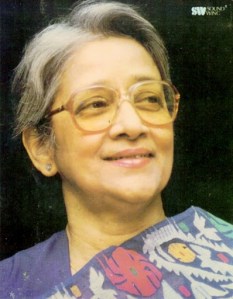
This is the poetry of Rabindranath Tagore that was set to music and became a favorite of Mahatma Gandhi’s during the struggle for Indian independence. I heard the poetic words of courage first from my mother. She had a big booming voice and loved to sing this song. I also heard this sung by Suchitra Mitra, one of Bengal’s most well-known Rabindrasangeet singers.

There was a time in the late 1970s and early 1980s when my uncle would organize musical sessions at his house. Mitra would come to lend her voice on sultry Saturday evenings.

She died of a heart attack at her Kolkata home on Monday. She was 86, born the same year as my father. My cousin informed me of her death. She knew how much Mitra’s songs meant to me.

She took music lessons at Viswa Bharati University, where my mother had also gone to hone her skills. My mother filled our house with Mitra’s voice.

She loaned her voice to yet another song that came to represent another struggle for independence: “Amar Sonar Bangla” (My Golden Bengal) played on every radio in Kolkata during the Bangladesh war. It later became the national anthem of independent Bangladesh.

I have a Suchitra Mitra CD playing now and think of my beloved Bengal mourning her death.

For all my Bengali friends, here is the news story in Anandabazar Patrika.
http://www.anandabazar.com/

Survival — and love


I first met Falone Maxi when she was lying on a mattress on the dirt. A sheet was her roof. But she liked it that way. Healing from her wounds suffered in Haiti’s massive earthquake, Falone did not want to be within concrete walls. What if there was another “catastrophe?” she said to me.

She was only 23. Quiet. Shy. Yet I admired her strength, her courage to face recuperation in, of all places, Haiti, where her family has little and life offers her even less.

I kept in touch with her over the months, even took her back to stand in front of the rubble of her university. I did not know if I was doing the right thing. What if all her nightmares returned?

She longed to see Mica Joseph, the classmate she had been trapped with for six long days under the rubble. Falone told me she survived because of her faith in God. And because Mica has been there with her. On my last trip to Haiti, earlier this month, I took Falone to see Mica.

I don’t cry often when I am on assignment, but when the two women, closer now than sisters, met, I found myself reaching for a tissue.

Read the story on CNN.com
http://bit.ly/e22flJ

A long and winding road


It’s not that far from Port-au-Prince to Ouanaminthe, a town that borders the Dominican Republic in northern Haiti. I’d say it was about 200 miles at most.

We ventured out Thursday morning after a day and half of intense post-election protests in Haiti, encouraged that the light rain would cast a calm. The main road outside our hotel was clear. The airport was open again. So was the market nearby.

We — I am on a reporting trip with colleague Jim Spellman — were on our way for a story for CNN.com.

We drove by the turquoise waters of the Caribbean, past the big island of La Gonave, and over the Artibonite River, now rampant with cholera. We made our way through Gonaive, a town hit hard by successive hurricanes a few years back and then on a bumpy, winding road through the mountains where sometimes our maximum speed was perhaps less than five miles an hour.

Haiti’s landscape is breathtaking. Mountains accost the sea. Banana trees grow alongside ferns, bougainvillea, oleander. But everywhere in this troubled land, beauty is marred by human misery.

High up on this road, we mingled with the clouds and tasted the dew on our tongues. We came across a small trading post, where oranges and papayas took on neon hues against the black mud and grime of the market.

A woman held up live chickens with one hand; another had partially skinned a freshly slaughtered goat strung up by its legs on a wooden post. Medieval was the word Jim used.

Onward through small towns where people eek out minimal existences. Through Plaisance. Limbe. And Cap Haitien, the nation’s second largest city. We passed the Hao Jin Great Motorcycle Company, the Ebenezer Depot, the Alexis Car Wash, Bar and Restaurant, the Flambeau Hotel and the Thanks God store.

Darkness fell. We had been travelling for more than seven hours. The road was pitch black. And still rife with potholes and tar that had peeled off who knows how long ago.

Then in Romeo, everything changed. Street lights shone brightly and the road turned smooth. I felt as though I had come off a dirt road onto I-75. Even the lanes were clearly demarcated and signs warned of upcoming speed bumps.

“That’s because we are near the border with the Dominical Republic,” said Yardley, the translator. Everyone laughed, but I could not come up with a better reason why things had suddenly changed for the better.

We were only a few miles away from the other nation that shares Hispaniola with Haiti. The two nations are night and day. And the DR, though very much a developing country, seems like paradise to most Haitians.

“It’s a different world there,” Yardley said.

Onto Ouanminthe, our final destination. We were tired. No, exhausted, from the car ride. But we all noticed how things quickly changed back to Haitian standards inside this small town, where cross-border trading is one of the biggest activities.

We checked into a gloomy hotel with no hot water nor much electricity but that charged us $120 a night. Its name was Ideal.

Protests in Haiti


I have been covering the post-election fallout in Port-au-Prince, Haiti, where people tell me they are fed up with a government that has failed to deliver.

This year alone, Haiti has endured a massive earthquake, a hurricane and a cholera outbreak. They say they can’t take that their will not be respected now. They say the November 28 presidential election was rigged; that Jude Celestin, the government-backed candidate, did not win a place in the runoff.

Many favor Michel Martelly, a popular and flamboyant Kompa singer known by the monicker of “Tet Kale,” which means bald head in Creole.

The city was tense Wednesday after many hours of protests. People set buildings and tires on fire. They used the concrete rubble from the earthquake to block the streets and torched Celestin’s campaign headquarters.

Here are two pictures of me covering the story for CNN. You can read it on http://www.cnn.com

Elizabeth


I was working at a table at the outdoor cafe at the Plaza Hotel in Port-au-Prince when the news hit my BlackBerry. “CNN confirms Elizabeth Edwards dies.”

My heart sank the way it would at the news of the passing of a friend. Just the night before, I’d fallen asleep to images of Elizabeth — Anderson Cooper was reporting that she was near death.

A burst of emotions overcame me because for all the stuff you hear about a politician’s wife, all the drama she had been through in the last few years, I remembered a reporter covering her first presidential campaign who was taken with the down-to-earth nature of Mrs. Edwards.

On a frigid winter day, I was among the crowd at the Manchester Public Library at a Edwards campaign stop. John Edwards introduced his wife on stage. Elizabeth, standing just behind her husband in a black pantsuit, stepped forward on the stage and waved to an enthusiastic audience.

“That’s his wife?” asked a woman in the crowd. “She looks so real.” She was not the trophy wife everyone had expected of the candidate known for his good looks and charm.

“I was 25 years old when I first met John Edwards, ” she said when he announced his candidacy a few months before. “He was earnest and energetic and unashamedly sweet. He was principled and wildly intelligent, and he was a tremendously warm person. Twenty-nine years later, John Edwards is exactly the same person. To my great chagrin, he also looks exactly the same.”

But many of her supporters saw her as the smarter of the two. They viewed her as the backbone of the campaign.

“Sometimes I see him getting bombarded with information, so I will tell him to be himself and not to forget to smile,” she told me in an interview I did for the Atlanta Journal-Constitution. “I’ll be the ballast for. . .the people whose job it is to download information to him.”

She told me about the time she met John, how it was not love at first sight, how he eventually swept her off her feet. “He was nice enough,” she said. “Pleasant. But it never occurred to me that he might be the person I would spend a quarter century-plus with.”

But when he leaned over and kissed her gently on the forehead to say goodbye, she was smitten.

It never occurred to us that he would have an affair, father a child with another woman while he was running for president in the next go around. Not after everything she had given on the campaign trail. She had even thought about how she would behave if she got into the White House.

“You get a megaphone as first lady, ” she said. “You have to use it responsibly, but you also have an obligation to use it or the betterment of the country.”

Elizabeth Edwards never got that chance. But I am thinking of her words now as I await results of the Haitian presidential election. And I’m glad I came home from the 2004 Democratic convention with a sign that simply said: Elizabeth.

Tourist

Tourist, don’t take my picture
Don’t take my picture, tourist
I’m too ugly
Too dirty
Too skinny
Don’t take my picture, white man
Mr. Eastman won’t be happy
I’m too ugly
Your camera will break
I’m too dirty
Too black
Whites like you won’t be content
I’m too ugly
I’m gonna crack your Kodak
Don’t take my picture, tourist
Leave me be, white man
Don’t take a picture of my burro
My burro’s load’s too heavy
And he’s too small
And he has no food here
Don’t take a picture of my animal
Tourist, don’t take a picture of the house
My house is of straw
Don’t take a picture of my hut
My hut’s made of earth
The house already smashed up
Go shoot a picture of the Palace
Or the Bicentennial grounds
Don’t take a picture of my garden
I have no plow
No truck
No tractor
Don’t take a picture of my tree
Tourist, I’m barefoot
My clothes are torn as well
Poor people don’t look at whites
But look at my hair, tourist
Your Kodak’s not used to my color
Your barber’s not used to my hair
Tourist, don’t take my picture
You don’t understand my position
You don’t understand anything
About my business, tourist
“Gimme fie cents”
And then, be on your way, tourist.

By Félix Morisseau-Leroy

Now this


Tomas is approaching.

The hurricane is predicted to hit Haiti by Friday. I called my friend Mariot in Port-au-Prince. “Are you OK? What about your family? Are you still living under a tent?”

“No,” he said. They were living with his aunt in Delmas. He had resisted concrete walls until now. What were they to do?

“It’s crazy,” he said. “People have nowhere to go. There is cholera everywhere.”

How do you survive a hurricane when all you have is plastic sheeting for a home?

My heart is breaking. Again. For Haiti.