Hannah

On a dark and wintry night, the bar at Fornino looked inviting. Warm. Soft candles on the white marble counter.

We were going to have just one drink, to warm our souls and rest our feet before we headed back down 5th Avenue to visit some friends.

But somehow, one drink turned into many hours of good wine and conversation. Behind the bar was Hannah Norwick, young and eager in a No. 12 green and white Joe Namath jersey that was a Christmas present. Was she even born when Namath played for the Jets? Probably not. She was fresh out of Smith College. Interested in writing — maybe even going to Columbia Journalism School.

Turns out Hannah was only 24 and excited about the life that lay before her. Tonight, that meant rooting for the home team in the AFC game, though everyone knew the Jets didn’t have a chance. But Hannah never gave up, her verve for life matched by her enthusiasm this New York night. She even bought us doubters a round of wine and beer.

Sure enough, Hannah. I took the stunning Jets win to be a sign of all good things to come your way. I’ll be thinking of you during the AFC championship game and wishing I were in Brooklyn.

‘Misery adds to misery’


A year ago, I wrote a blog that began like this: “My heart breaks.”

I had just arrived in Haiti after the earthquake and the scale of suffering was shocking.

A year later, my heart is still breaking.

In Port-au-Prince, so many lives are unchanged. Survival was difficult in this nation before the quake. Now it is that much more so.

I met a man named Carlos Jean Charles, who spoke English well and took me around the tent city at Place Toussaint, across from the National Palace. He had a life once as a software engineer, as a husband, as a father. But after a year of homelessness and despair, the will to live was fading.

I wrote about him in an anniversary piece for CNN. Here is an excerpt:

Charles shakes his head, in disbelief that he lives in this reality.

Misery, he says, adds to misery. “It makes people fight,” he says, showing a scar on his face. “Someone tried to kill me for my phone.”

The government, he says, doesn’t care about people like him. “I know Haitian politics. They like it when we are living like this.”

More than a million Haitians displaced from their homes by the earthquake are still eking out lives in tent cities once thought to be strictly temporary.

Charles puts a few drops of chlorine bleach into the water supply at his shack. Now there is another worry: cholera.

He fears that the day when he can leave this place is still far in the future. He hopes that when it comes, he will be able to remember how to live like a human being.

Until then, he walks — from Place Toussaint, uphill to distant neighborhoods like Petionville. He is a man without destination. He walks to forget.

You can read the full story and watch a video here:
http://bit.ly/eul8bX

Survival — and love


I first met Falone Maxi when she was lying on a mattress on the dirt. A sheet was her roof. But she liked it that way. Healing from her wounds suffered in Haiti’s massive earthquake, Falone did not want to be within concrete walls. What if there was another “catastrophe?” she said to me.

She was only 23. Quiet. Shy. Yet I admired her strength, her courage to face recuperation in, of all places, Haiti, where her family has little and life offers her even less.

I kept in touch with her over the months, even took her back to stand in front of the rubble of her university. I did not know if I was doing the right thing. What if all her nightmares returned?

She longed to see Mica Joseph, the classmate she had been trapped with for six long days under the rubble. Falone told me she survived because of her faith in God. And because Mica has been there with her. On my last trip to Haiti, earlier this month, I took Falone to see Mica.

I don’t cry often when I am on assignment, but when the two women, closer now than sisters, met, I found myself reaching for a tissue.

Read the story on CNN.com
http://bit.ly/e22flJ

A long and winding road


It’s not that far from Port-au-Prince to Ouanaminthe, a town that borders the Dominican Republic in northern Haiti. I’d say it was about 200 miles at most.

We ventured out Thursday morning after a day and half of intense post-election protests in Haiti, encouraged that the light rain would cast a calm. The main road outside our hotel was clear. The airport was open again. So was the market nearby.

We — I am on a reporting trip with colleague Jim Spellman — were on our way for a story for CNN.com.

We drove by the turquoise waters of the Caribbean, past the big island of La Gonave, and over the Artibonite River, now rampant with cholera. We made our way through Gonaive, a town hit hard by successive hurricanes a few years back and then on a bumpy, winding road through the mountains where sometimes our maximum speed was perhaps less than five miles an hour.

Haiti’s landscape is breathtaking. Mountains accost the sea. Banana trees grow alongside ferns, bougainvillea, oleander. But everywhere in this troubled land, beauty is marred by human misery.

High up on this road, we mingled with the clouds and tasted the dew on our tongues. We came across a small trading post, where oranges and papayas took on neon hues against the black mud and grime of the market.

A woman held up live chickens with one hand; another had partially skinned a freshly slaughtered goat strung up by its legs on a wooden post. Medieval was the word Jim used.

Onward through small towns where people eek out minimal existences. Through Plaisance. Limbe. And Cap Haitien, the nation’s second largest city. We passed the Hao Jin Great Motorcycle Company, the Ebenezer Depot, the Alexis Car Wash, Bar and Restaurant, the Flambeau Hotel and the Thanks God store.

Darkness fell. We had been travelling for more than seven hours. The road was pitch black. And still rife with potholes and tar that had peeled off who knows how long ago.

Then in Romeo, everything changed. Street lights shone brightly and the road turned smooth. I felt as though I had come off a dirt road onto I-75. Even the lanes were clearly demarcated and signs warned of upcoming speed bumps.

“That’s because we are near the border with the Dominical Republic,” said Yardley, the translator. Everyone laughed, but I could not come up with a better reason why things had suddenly changed for the better.

We were only a few miles away from the other nation that shares Hispaniola with Haiti. The two nations are night and day. And the DR, though very much a developing country, seems like paradise to most Haitians.

“It’s a different world there,” Yardley said.

Onto Ouanminthe, our final destination. We were tired. No, exhausted, from the car ride. But we all noticed how things quickly changed back to Haitian standards inside this small town, where cross-border trading is one of the biggest activities.

We checked into a gloomy hotel with no hot water nor much electricity but that charged us $120 a night. Its name was Ideal.

Tourist

Tourist, don’t take my picture
Don’t take my picture, tourist
I’m too ugly
Too dirty
Too skinny
Don’t take my picture, white man
Mr. Eastman won’t be happy
I’m too ugly
Your camera will break
I’m too dirty
Too black
Whites like you won’t be content
I’m too ugly
I’m gonna crack your Kodak
Don’t take my picture, tourist
Leave me be, white man
Don’t take a picture of my burro
My burro’s load’s too heavy
And he’s too small
And he has no food here
Don’t take a picture of my animal
Tourist, don’t take a picture of the house
My house is of straw
Don’t take a picture of my hut
My hut’s made of earth
The house already smashed up
Go shoot a picture of the Palace
Or the Bicentennial grounds
Don’t take a picture of my garden
I have no plow
No truck
No tractor
Don’t take a picture of my tree
Tourist, I’m barefoot
My clothes are torn as well
Poor people don’t look at whites
But look at my hair, tourist
Your Kodak’s not used to my color
Your barber’s not used to my hair
Tourist, don’t take my picture
You don’t understand my position
You don’t understand anything
About my business, tourist
“Gimme fie cents”
And then, be on your way, tourist.

By Félix Morisseau-Leroy

Now this


Tomas is approaching.

The hurricane is predicted to hit Haiti by Friday. I called my friend Mariot in Port-au-Prince. “Are you OK? What about your family? Are you still living under a tent?”

“No,” he said. They were living with his aunt in Delmas. He had resisted concrete walls until now. What were they to do?

“It’s crazy,” he said. “People have nowhere to go. There is cholera everywhere.”

How do you survive a hurricane when all you have is plastic sheeting for a home?

My heart is breaking. Again. For Haiti.

Evita


She was a bastard child whose rags to riches story enthralled the entire world. At the tender age of 15, Eva Duarte moved to Buenos Aires to make a name in showbiz. She sang, she acted. She saved all she could to move into a flat in fashionable Recoleta. It was her way of telling the elite that she had arrived.

She had escaped the misery of life in the provinces for one of comfort.

But none of it would have been noted had she not met and fallen in love with Juan Peron and become the first lady of Argentina. The soul of the country. Standing up for the working man, even while she dressed in her furs and pearls.

Whether you believe in her purpose or whether history has deemed her disingenuous, Evita was iconic in life — and death. She succumbed to cervical cancer at the young age of 33.

After a massive funeral, her embalmed body was to be placed at a monument in her honor. But a military dictatorship ousted Peron. The names Juan and Evita became taboo; it was illegal even to possess a photo of them. Evita’s body was taken out of the country.

It took 16 years for it to be relocated. Many say her corpse had been mutilated.

Juan Peron returned to power in the early 1970s; his wife Isabel, who succeeded him as president, brought Evita home. She now rests in the Recoleta Cemetery in the Duarte family crypt. Every day, tourists visiting the cemetery flock straight to her grave, much like they do to see Jim Morrison at Pere Lachaise in Paris.

It’s an unassuming memorial to a woman who lived so grandly. A bigger tribute to her is at the Eva Peron museum, which has a collection of photos, film footage and her things, including her elegant gowns, suits and shoes.

Ironically, I returned from the museum to my flat in San Telmo only to see the movie “Evita” with Madonna and Antonio Banderas playing on television. Well, not so ironic, perhaps. Argentine TV probably shows that film quite often.

I had never seen the Andrew LLoyd Webber musical. I tuned in in time to hear Madonna sing: “Don’t Cry for Me, Argentina.”

The next day, I stood before the pink government house, where so many years ago Evita had stood in victory on the balcony. Where her husband had propped her up when she was too weak form cancer to even stand up. I imagined the roar of the crowds chanting her name. What a time it must have been.

Soweto


Hector Pieterson was only 12 when he was gunned down — a hail of bullets cutting short the life of a young black boy and triggering what came to be known as the Soweto Uprising against South Africa’s brutal system of apartheid.

On this gloriously beautiful spring day, I stood at a plaza named after him. A stark monument, a museum, a photograph. All around, life goes on in Soweto, still a world away from Johannesburg, just like it was when Hector was a school boy.

I was a little older than Hector when he was killed. I only learned about him when I entered college, protested apartheid, marched for divestment. Read about Nelson Mandela and Steve Biko.

On June 16, 1975, students were protesting the use of Afrikaans, the language of their oppressors, as the medium of instruction in schools. When police opened fire, Hector fell on the corner of Moema and Vilakazi streets. Sam Nzima captured a black and white photograph of Pieterson’s limp and bloodied body being carried by a fellow student.

I stood now in that very spot with Nathaniel Mudau, a driver who works for CNN in Johannesburg. He insisted we have a photo taken in front of the memorial. So we did. A teenage boy named Karabo snapped the photo and printed it out on a battery operated printer.

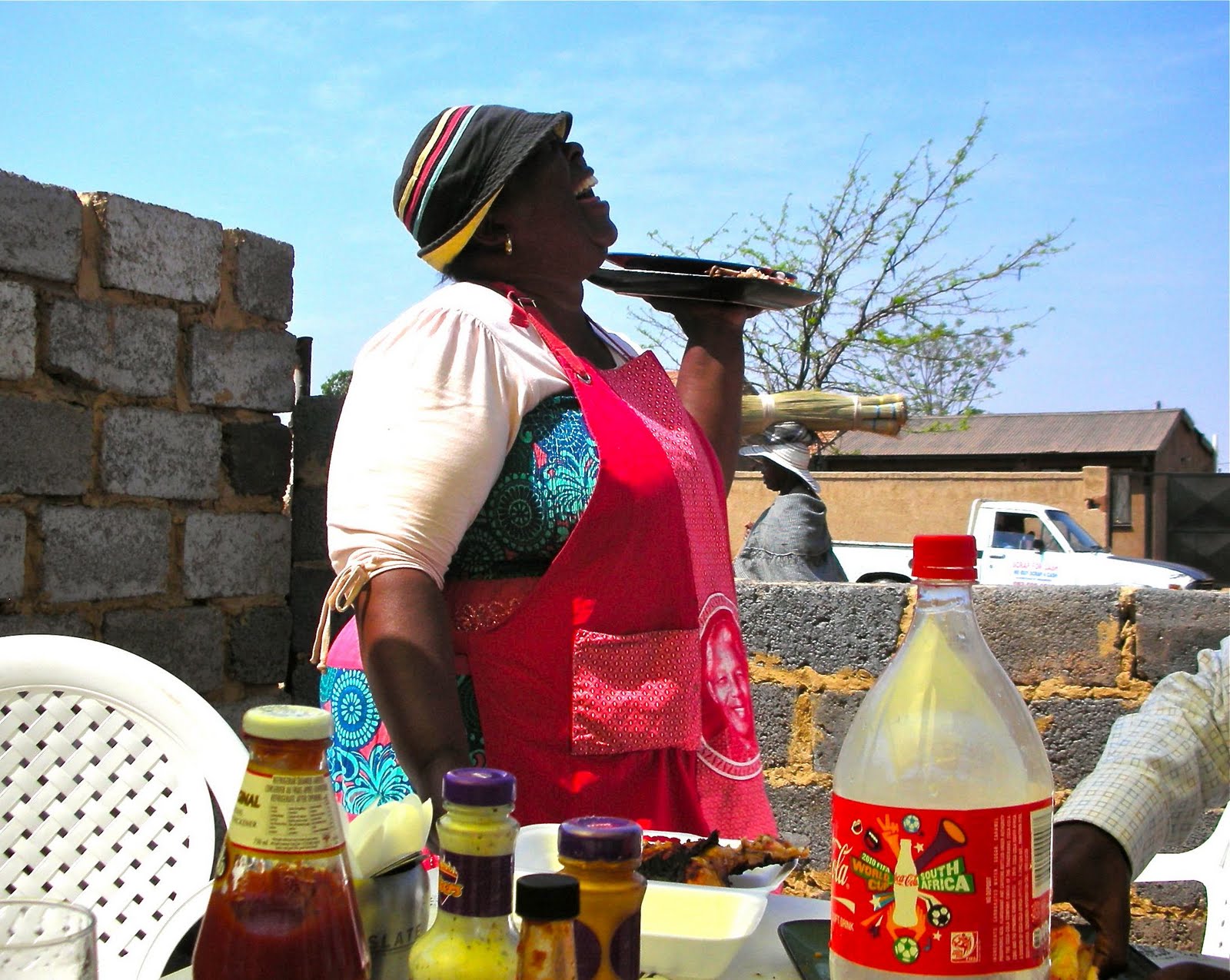
Nathaniel showed me around Soweto, where he grew up, where his family still lives. We stopped for lunch at Ethel Maria’s. She grills chicken and beef in her front yard and serves them with salads, rice and porridge mostly to local policemen, teachers and nurses.

Ethel Maria has lived in her two-room shack in Soweto since 1965. She still doesn’t have running water inside the house. Life is still a struggle for her, 16 years after a black-majority government finally took power in South Africa. At 51, Ethel Maria does not harbor hope in her heart anymore.

Maybe it will be different for her children but freedom has meant very little life changes for her. Freedom did not give her a bigger place, respite from work seven days a week

On top of a makeshift grill, she made the best chicken I tasted in South Africa. After the meal, everyone at the table shared a wet towel to wipe our hands and paid her $4 for the meal.

Then Nathaniel took me around Soweto. I’ve posted photos here of the murals painted at a power plant and the shanties that still dot the landscape.

In the days of apartheid, black people were forced to live here. Many awoke at the crack of dawn and spent a fortune on a rickety old bus that took them into Johannesburg for work. Now, downtown Johannesburg is apocalyptic. Abandoned by whites, the wealth has been sucked dry and the one-posh apartment buildings and skyscrapers have stood still in time.

Nathaniel made me put up the windows to the car in neighborhoods like Hillbrow — the crime there makes the most violent parts of Atlanta look like paradise.

Life is much calmer in Soweto. But hard still for most of the residents.

“This is the way my house was then,” said Ethel Maria. But back then, she did not have her Nelson Mandela apron, the one she proudly wears every day when she cooks in her front yard.

Mosi-oa-Tunya


Mosi-oa-Tunya means: the smoke that thunders.

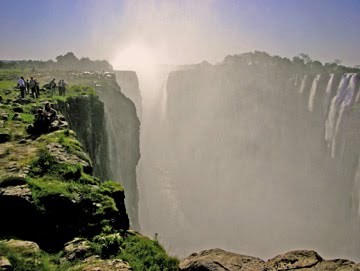
It’s an appropriate name for what the British named Victoria Falls, the largest curtain of water in the world, a mile-wide cataract in the Zambezi River between Zambia and Zimbabwe.

My father spoke of it when I was a little girl. He told me one day, I should feast upon this incredible site, one of the seven natural wonders of the world.

We traveled from the town of Livingstone, named after the famous British physician and missionary David Livingstone, by bus to Zimbabwe. We could hear the roar of the water, feel the spray long before I actually laid eyes on nature’s magnificence. There it was, in all its glory. Enormous amounts of water tumbling into a deep gorge, water and sun meeting everywhere to form rainbows.

In 1855, when Livingstone first encountered the fall of the Zambezi River, this is how he described it:

“After twenty minutes’ sail from Kalai we came in sight, for the first time, of the columns of vapor appropriately called ‘smoke,’ rising at a distance of five or six miles, exactly as when large tracts of grass are burned in Africa. Five columns now arose, and, bending in the direction of the wind, they seemed placed against a low ridge covered with trees; the tops of the columns at this distance appeared to mingle with the clouds. They were white below, and higher up became dark, so as to simulate smoke very closely.

The whole scene was extremely beautiful; the banks and islands dotted over the river are adorned with sylvan vegetation of great variety of color and form…no one can imagine the beauty of the view from any thing witnessed in England. It had never been seen before by European eyes; but scenes so lovely must have been gazed upon by angels in their flight.”

My photographs do not do Victoria Falls justice.

If you every have a chance to see for yourself, go! Victoria makes Niagara look like a backyard waterfalls.

In Cape Town, I cried


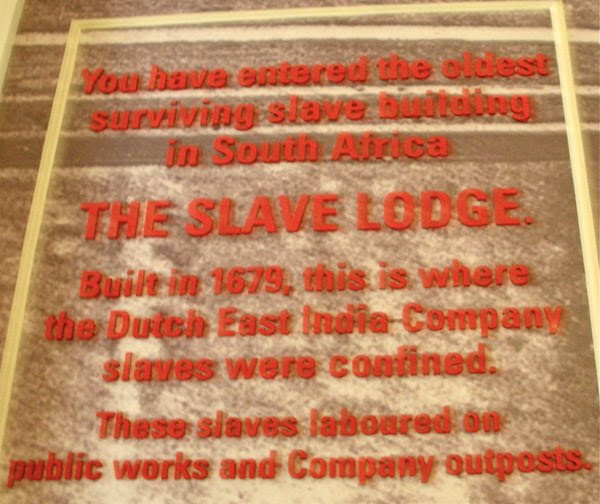
I will start my southern Africa journey here, at the Slave Lodge in Cape Town.

It is not where I physically began my 10-day trip to this part of the world. But it is where I choose to begin — in a place of beginnings and endings, of hate and love, of breathtaking natural landscapes and ugly scars of human cruelty.

For all the magnificence I have seen on this incredible trip — lions in the wild, one of the seven natural wonders of the world and the collision of two great oceans at the Cape of Good Hope — nowhere did I shed more tears than in this stark rectangular building that once housed thousands of human beings who were not recognized as such.

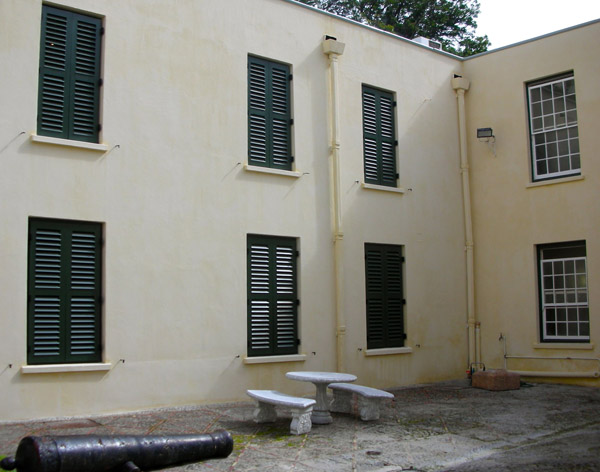
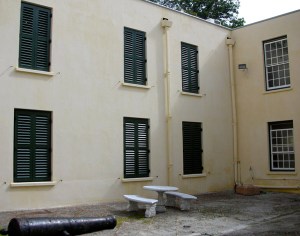
Today, the oldest slave lodge in South Africa looks beautiful in structure. (See picture.) But go back in time.

There were no windows then, just slits in the wall. People manacled and tied together in a manner worse than animals. They spent hot, suffocating nights here. During the day, they were marched out to toil.

The tourist guide books don’t tell you much about the wretched history of South Africa. My book dedicated most of its Slave Lodge blurb to the architectural splendor of the building, not to the unimaginable pain that was borne here.

It is now a museum dedicated to those whose names will be forgotten by history. They are no Vasco de Gamas or Simon Van der Stels (for whom the now famous Stellenbosch winelands are named). Just ordinary people plucked from their homes and taken to suffer and die.

I stood before a map that showed all the places from where the Dutch brought in their human captives. My eyes went straight to India. Malabar. Cochin. And yes, Kolkata. I stared at the Bengal dot on the map of South Asia. I felt a hot drop land on my clenched fists.

I thought of my mother telling me stories about British colonial rule in India and the picture at my grandfather’s house of a water fountain in Maniktola: “Europeans,” it said on one side. “Indians and dogs,” on the other.

I sat in the dark museum, staring at images of mothers torn from sons and daughters, separated forever. I heard the clack of wooden clogs slaves were forced to wear here so that their Dutch masters could hear them if they tried to move at night.

I imagined.

And for all the death and war I have seen, I could not ever feel the sorrow of this non-life that thousands of people, including my ancestors, lived through.

Or didn’t.

I have many friends in the United States who tell me personal stories of racism. Their ancestors were slaves. Their parents lived through segregation. I recalled my conversations with the poet Natasha Tretheway. Of racism, hate, ignorance.

I grew up with stories about Bapuji, father of the nation. That’s how Indians revere Mahatma Gandhi. I read about how Gandhi, as a young lawyer, fought for rights in South Africa. We all know what he did when he returned to India.

School was filled with history lessons on the East India Company, the Dutch, the Portuguese and the British. I grew to womanhood familiar with colonialism’s fury.

Yet, I had never felt its sting in India — I was fortunate to have been born 15 years after independence. I felt it more in the Deep South but never in ways that were physically or psychologically damaging to me.

So here I stood, in lovely Cape Town, surrounded by majestic landscape, and all I saw was heartbreak and blood. It was mapped out before me, on a museum wall.

It was the first thing I saw in Cape Town. And for the next few days, I would think of nothing else.

Next: A guide with a view.