It was six decades in the making, the fruit of a strong separatist movement that argued neglect by successive governments and finally succeeded in breaking off a chunk of land from Andhra Pradesh. The man who once went on a hunger strike in defense of Telangana, K. Chandrashekar Rao, became its first chief minister Monday.
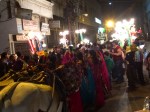
The celebrations began Sunday night. Hyderabad, which will now serve as capital for both states, was awash in pink, the color of Rao’s party, the Telangana Rashtra Samithi.
India’s newly elected prime minister, Narendra Modi, hailed the newest state in the republic.
India gets a new state! We welcome Telangana as our 29th state. Telangana will add strength to our development journey in the coming years.
Amid the joy, however, there was reason for pause, especially among the citizens of Andhra who were against the carving up of their state. For economic reasons. For political reasons.
Proponents of Telangana argued that holding together different peoples under linguistic lines was silly; that it was better to have a more culturally cohesive state. Others pulled out proof that small states can prosper in India. The cited Uttarakhand and Chhatisgarh as examples.
It’s a good thing the two states will share Hyderabad, a city that was at the forefront of India’s high-tech boom and houses corporate giants like Infosys. I visited there in 2000 and remember being so impressed with the efficiency and cleanliness there compared to my hometown, Kolkata. Without Hyderabad, I worry Telangana might flounder.
I am always wary when states are split because I fear that it might lead to a deeper division of people. We certainly don’t need to add to that problem in India.
But now the deed is done. I hope for Andhra and its sister Telangana to both prosper. Only time will reveal if this was the right decision.
By Friday afternoon, everything should become clear.
Who did more than 500 million voters choose to lead India? India’s day of reckoning is here. Election results will be announced soon.
All week, there has been so much speculation and interpretation of exit polls that my head is spinning. By all guesses, Narendra Modi of the Bharatiya Janata Party will become the next prime minister of my homeland.
Modi is known as a Hindu nationalist. He is controversial, polarizing. Under his watch, Gujarat suffered Hindu-Muslim carnage. But he also inspired voters who are fed up with the same old corruption and drudgery of government. For them, the Nehru-Gandhi dynasty and Congress stopped delivering, despite being the party of independence and freedom.
People in India are hungry for change. They grew disappointed after India failed to launch, as it were. How many people predicted India would be the next Asian tiger? But the growth slowed and India is still a poor nation that lags far behind rival China.
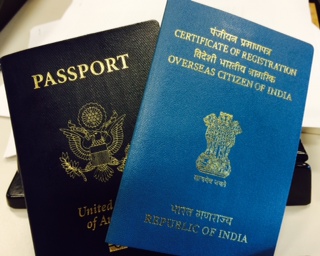
Today, I received my Overseas Citizenship of India certificate. With OCI status. I am entitled to most of the rights and privileges I once had as a citizen of India, except I can’t vote. I wished that I had been able to in this landmark Indian election.
I cannot say who I supported — I am a journalist, after all. But I can say this: I hope, for the sake of my homeland, someone steps in and cleans up government. I am done paying bribes and drowning in bureaucracy and dealing with inefficiency.
My story on a home for the dying in Varanasi, India, came out on CNN.com today.
I spent a week reporting in the fabled holy city and was fascinated by its spirituality much more this time than I was on previous trips. Part of it was because I was reporting on faith. But another part of it was that I think I have transformed over the years; my rebellion against organized religion has mellowed.
As I have grown older, I have lost people who were close to me. My parents, aunts, uncles, cousins and good friends. I was in shock after I returned from India in February to the death of my colleague Lateef Mungin. He was 10 years younger than me.
That kind of loss makes you think about the things that are important in life and also about what happens to us after we stop breathing.
The people I spent time with in Varanasi were, for the most part, steadfast in their beliefs, though there is one man in my story who may surprise you.
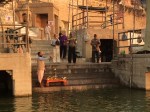
A body lies on the steps of Manikarnika Ghat in Varanasi, where funeral pyres burn day and night. Concepts of death are very different in many Indian communities.
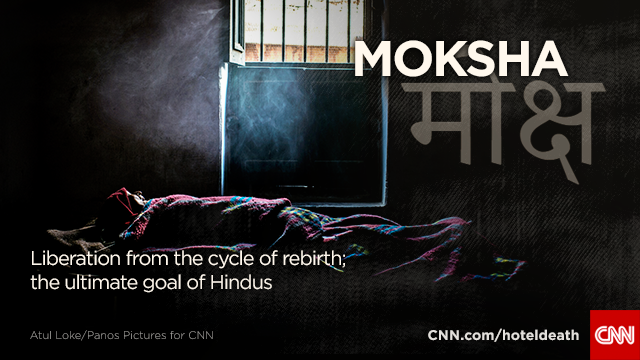
I’ve been immersed in writing about death after spending a week in Varanasi at a home where ailing, elderly Hindus go to end their lives. They want to die there because they believe dying within the boundaries of the ancient city of Kashi will mean moksha, or salvation for the soul.
The story — I will write more about that later — took me back to the deaths of my own parents in 2001. I cremated my father, Debabrata Basu, 13 years ago.
Every year, especially on March 24, I think about the events of that day. Of bringing his body home to our flat in Kolkata. Of going to Park Circus Market to buy garlands of marigolds and bouquets of white, fragrant Rajanigandhas (tuber roses). Of all the people who came to pay their last respects. Family. Friends. My father’s students and colleagues from the Indian Statistical Institute.
I think of how summer had already cut spring short that year. The temperature soared beyond 90 degrees as we made our way to the crematorium in Kalighat. I waited with my father’s body, under a hot sun. I felt exposed to the entire world, for seven hours. Time stood still then. I looked down at his gaunt face, his cold body. I touched his hand from time to time. Was it to make sure he really was gone? Physically, he was.
But his soul was free. He would be with me always, I thought.
I attended ‘Teef’s funeral at an African-American Baptist church in suburban Atlanta. Everything about it was so decidedly different than what I had seen at the cremation grounds in Kolkata and most recently in Varanasi. The way a body is laid out. They way we honor a person. They way we say goodbye.
In the last few days, death has again entered my life with the story of the missing Malaysia Airlines jet. I spoke with Mr. K.S. Narendran, whose wife. Chandrika Sharma, was on that flight. This is what he wrote to his friends last week:
I remain focused on what we have at hand by way of information, and stay with the knowledge that Chandrika is strong and courageous, that her goodness must count for something, somewhere. I carry firmly the faith that the forces of life are eternal, immutable and ever present to keep the drama ever moving. In the ultimate analysis, I am neither favored nor deserted. No one is.
I admired Mr. Narendran’s quiet strength and how he coped with the knowledge that his wife may never come back home. It was a stark contrast to the way many of us display our anxiety and grief.
We all have to come to terms with dying. We will all die one day. That is certain. But there is so much uncertainty about what happens afterwards, about what we believe happens to us after our physical presence on Earth has ended.
Do you believe in heaven? In hell? Do you believe we possess souls?
Hindus believe in rebirth. They see it as another cycle of testing for one’s soul. That’s why people go to Benaras to die. That’s why they take God’s name and hope for moksha that will put an end to that undesirable cycle. It is an alien idea for Christians, Jews and Muslims. But who’s to say?
I am not sure I will ever come to any concrete conclusions. But I do know this. I feel my parents’ presence within me. And that will never go away.
Get this: Starting on April 7, nearly 815 million Indians will begin casting ballots in this year’s parliamentary elections. Yes, 815 million!
That’s almost 100 million more than there were in the last election in 2009.
How to accommodate the huge number of estimate voters in the world’s most populous democracy? Polling is staggered over nine days: April 7, 9, 10, 12, 17, 24, 30 and May 7, 12. There are 930,000 polling stations and 11 million personnel — including security forces — will be deployed to facilitate the voting.
The world’s biggest election pits the ruling Congress Party against the Hindu nationalist Bharatiya Janata Party and comes at a time when India is at a profound point in history. Who will lead the nation as it figures out how to charge forward into the future.
The vote will be counted May 16. Balloting is electronic but God help the people in charge!
“Elections to world’s largest democracy pose immense challenges with respect to logistics and man and material management,” said R. Balakrishnan, India’s deputy election commissioner.
We Americans consider ours the greatest democracy in the world. But I firmly believe the task at hand in my homeland is enormous. And if things go smoothly, India should stand proud.
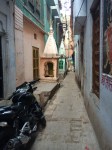
A temple along one of the many alleyways and lanes of old Benaras.
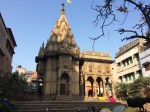
An old temple in the heart of the city.
Looking out from one of the temples along the river.
Varanasi or Benares, as the British called it, is known for a lot of things.
It’s one of the oldest continually inhabited cities in the world, the oldest, certainly, in India.
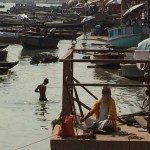
It is the holiest of seven holy cities for Hindus, known as Kashi in olden times. The might Ganges, flows through here and yes, thousands of people visit Benares every year. Hindus come here for obvious reasons. Foreigners flock here to take in the myriad rituals of Hinduism and walk the chaos of the city, now 3.5 million strong.
There are about 3,600 temples in Benares, I’ve been told. I walked through the old city last week and it felt as though there was a temple on every corner. Many of the ancient ones are gone, razed by Muslim invaders but some date back several hundred years. The city also claims 1,400 mosques.
I was mesmerized as I walked the narrow alleyways and snaking lanes of the old city. The smell of fresh cow dung mingled with motorbike exhaust and turmeric and cumin as I walked past homes and shops that all seemed stacked one on top of another.
Indians look down on Benares, a city that reminds me of how my native Kolkata was 30 years ago. Grimy, dusty, filthy with little order to the daily machinations of life. I, too felt that way about the city on my previous visits.
This was my third trip to Benares. I understand the magic of this city a little better now. I owe that to my superb guide Nandan Upadhyay, who a few years ago began running a tour company here. Nandan knows a lot about his hometown. If you are ever here, look him up. He has a website called Groovy Tours.
I’m posting a ton of photos with this dispatch. None capture the essence of the city, really. You have to not only see but smell, hear and touch Benares. And that’s not possible with a camera. Not even with a iPhone 5s.
I’d never been to Goa until last week. My cousin Rahul and his wife Shraya moved to Goa several years ago but I hadn’t had a chance to visit them on my rapid-fire trips to India before.
The western state in India is a haven for tourists who flock to its beaches and revel in a culture that is far more progressive than in other parts of the subcontinent.
At first, it was hard for me to believe I was still in India. I’d spent the first 10 days in India in Kolkata, where many of my friends and family still aspire to tradition and abide by cultural norms set decades ago. I love my hometown but sometimes, it can feel a bit oppressive.
Goa surprised me instantly. People seemed far more laid back in their bermuda shorts and sandals and t-shirts. It felt more like coastal Mexico or Nicaragua than India. It looked that way, too, because of the influence of Portuguese architecture.
It’s warm in Goa even in January and I was saved only by the ocean breeze that flows through Rahul and Shraya’s house.
They own a multi-level space atop a hill. Their house is teeming with all sorts of art (Shraya is an artist) and colorful paint and textiles. On the top level is a massive terrace, where we sipped a cool drink at sunset and watched darkness descend.
Over four days, I ate delicious food — fish is a staple in Goa, as is chorizo. The Portuguese settled here and brought with them their culture and religion. About 27 percent of the Goan people are Catholics.
On Friday night, Rahul took me to a birthday party for one of his relatives. The crowd was largely expat. I didn’t get to speak with them much but I gathered they liked it in Goa because here, they could afford to live the kind of artsy, beachy, easy-breezy, stress-free lifestyle that appealed to them.
I’ve posted other photos of my trip on Facebook. You can check them out there.
Now I am back in Delhi. Back at work. And Goa seems distant again, as it always had been. But it was a great break. I am thankful to Rahul and Shraya for their generosity. I see another trip for me in the future. Very soon, I hope.
In my childhood, there weren’t too many Bengali women who had made it big enough to attain celebrity status. But there was Suchitra Sen, goddess of cinema.
Her films, usually with Uttam Kumar, were wildly popular in Kolkata.
To me, Sen was the ultimate beauty. She had a certain Bengaliness about her. She was feminine but strong. She had a “no-nonsense gravitas to care out a persona that has never been matched, let alone surpassed in Indian cinema,” film critic Saibal Chatterjee told the BBC.
I just remember my older cousins talking about her. They referred to her with only her first name. Like Greta. Or Marilyn. Legends don’t require a surname. In fact, it’s been said that idols of Lakshmi (goddess of prosperity) and Saraswati (goddess of knowledge) were modeled after Suchitra. Now, that’s some star power.
In all, Suchitra acted in 52 Bengali films and seven Hindi films. The first movie of hers that I saw was “Kamal Lata,” based on a story by famed Bengali author Sarat Chandra Chattapadhya. I was riveted by her performance, made all that much intense by the power of black and white imagery. I gazed into Suchitra’s big eyes and wanted to be like her one day. Talented, smart, strong, beautiful.
Suchitra died today in Kolkata — at the same hospital where my mother died.
Thank you for the hours of entertainment but mostly for inspiration, Suchitra. Rest in peace.
The etching Panesar took off a gallery wall and gave me.
A headline in my hometown newspaper brought me to tears this morning. B.P. Panesar had died.
He was a renowned artist. Water color. Oil. Etchings. He was also made a name as mentor to Shakila, a poor village woman who gained fame for her collages.
He gave away his earnings as an artist to charity. He never married and lived for many years in one room at the YMCA in central Kolkata. He died in an old people’s home, still holding paint and brush.
Uncle Panesar and me when I was about a year old.
I knew him as Uncle Panesar. My father taught at the Indian Statistical Institute, where Panesar worked, and from the instant they met, they became fast friends. My father became an advcate for Panesar’s art. In time, he became a part of our family, especially in the years we spent living on campus in north Kolkata.
He loved to listen to my mother sing Rabindrasangeet and spend hours with my brother and me.
He held me as a baby, played with me when I was a child, encouraged me to paint as a teenager and inspired my creativity as an adult.
From early on, I found Uncle Panesar to be a calming force in my life. I’d peer into his eyes, under his thick bushy eyebrows and try to imagine what was swirling inside his head. What genius, I thought, to be able to produce such visual feasts.
I was especially enamored with Panesar’s collages made with magazine and newspaper cuttings, old pictures, bus tickets and other things people tossed in the trash. Panesar gave up his own collages to train Shakila. He was so taken with her talent. I was sorry at first until I went to visit Shakila and saw for the first time the mastery within that Panesar had helped awakened.
In the late 1980s, I visited Uncle Panesar at the Y. He had moved onto etchings by then and showed me his small studio. He invited me to go see his show at the Birla Academy. I was so taken with an etching of Mother Teresa — I’d volunteered at one of her organizations many years before — that when his show was over, Uncle Panesar took it off the gallery wall and presented it to me. It hangs by my dresser. I look at it as I begin each day. And think of all the good in the world.
I had hoped to see you in a few days in Kolkata. But you did not wait. You have flown away to a better place.











 Evil Reporter Chick