The New York Times published an interesting story today about bicycles in Amsterdam. In a city of 800,000 people, there are 880,000 bicycles. The Dutch have led the way in pedal power but as the story points out, and as I found out firsthand when I was there a couple of weeks ago, the bikes can make for chaos on the streets.
I almost got mowed down by one on Herengracht.
I opted not to fight to find parking places for my bike. Not to fight for space with other cyclists on crowded streets. Instead, I walked.
And did things you cannot do on a bike. Like meander through the city’s Zuid district and soak in the annual sculpture show. I got off Tram 16 and walked south on Minervalaan, stopping at sculptures made by artists from all over the world. Among them: China’s Ai Wewei and Nigeria’s Sokari Douglas Camp. In all, there were 66 pieces on display under the summer sun.
“In 2008, Cintha van Heeswijck took the initiative to draw greater attention to the urban expansion of the south of Amsterdam, known as the Plan-Zuid, designed by architect H.P. Berlage almost a hundred years ago. This world-class platform for sculpture adds a jewel to Amsterdam’s crown of leading cultural events.”
After my two-hour stroll, I agreed.
Read the New York Times bike story here: http://nyti.ms/10BPQcq
Michael and me at Camp Striker near the Baghdad airport in September 2005.
Michael Hastings died Tuesday in a car crash in Los Angeles.
The news hit me hard. He was 33. He was a great journalist. He was a friend.
Most people know his name for the Rolling Stone story “Runaway General,” the profile of Gen. Stanley McChrystal that exposed him as a loose cannon, chiding his civilian commanders in the Obama administration.
“Great reporters exude a certain kind of electricity,” said Rolling Stone Managing Editor Will Dana, “the sense that there are stories burning inside them, and that there’s no higher calling or greater way to live life than to be always relentlessly trying to find and tell those stories. I’m sad that I’ll never get to publish all the great stories that he was going to write, and sad that he won’t be stopping by my office for any more short visits which would stretch for two or three completely engrossing hours. He will be missed.”
Ben Smith, editor-in-chief of BuzzFeed praised Michael’s incredible instinct for a story. He also said this:
“Michael was also a wonderful, generous colleague, a joy to work with and a lover of corgis — especially his Bobby Sneakers.”
Michael was known for his aggressive reporting. He believed the wars in Afghanistan and Iraq were misguided and didn’t for a second let any U.S. official — whether it was McChrystal or Hillary Clinton — get away with an easy answer.
His fiancee, an aide worker, was killed in Iraq when Michael was a Newsweek correspondent. He wrote about that relationship in his first book, “I Lost My Love n Baghdad: A Modern War Story.”
I never met his wife, Elise Jordan. I cannot imagine her grief today.
As much as I respect his journalistic prowess — I leave it up to every media outlet to give him the proper reporter’s eulogy — the Michael I will cherish the most is the one I met in May 2005 at a hostile environment training put on by AKE in Virginia. I was there with AJC colleagues. He was there, I guess, on his own, determined to make a career for himself by going to the wars America was fighting.
He entertained us with his NYC white-boy rap — he was really good — and acerbic wit. Not bad, I thought, for a 28-year-old kid.
Three months later, Michael messaged me. “I am in Baghdad,” he said. “Going to Camp Striker tomorrow. I hear you are there. Lunch?”
So we ate standard military fare at the chow hall and shared stories about being embedded with the U.S. Army. He made me laugh when I hadn’t laughed in weeks. For that I will always be grateful.
An incredible young man robbed of life. An amazing journalist who will never again be able to write all the words that were within. Or expose the world for its sins.
Ezequeil Zeff (left) and Lautaro Rivas of Buenos Aires.
Empanadas at La Stego.
Indonesian yummyness.
I didn’t like them looking at me.
I thought I was in Amsterdam until I sat down to dine at Kantjil & de Tijger on Spruistracht. On the menu was an Indonesian feast: Pangsit Goreng, Ajam Sereh Pedis and Oteh Oteh. I ordered a sampling of savory stuff. Hadn’t eaten since breakfast and had walked all over the canal city. I was hungry.
Just as I’d finished dinner, a couple of guys sat on the other end of my outdoor table. We struck up a conversation.
They were in search of beef. Naturally — they were from Argentina.
Ezequeil Zeff, 30, and Lautaro Rivas, 46, had been in Amsterdam for a week. They were software guys from Buenos Aires. They liked Amsterdam but the Dutch, they said, were lacking soul. The people here needed a lesson in life from the Latinos. They might have coffee shops here but no tango.
The two Argentines had tired of bland food and come upon this Indonesian place for a little fire in the belly. They wanted meat, like any good carnivorous Argentine. I was worried. I’d eaten at the Pampas-style steakhouses in Buenos Aires. They are the finest in the world. I was worried these two ravenous Argentinians would be more disappointed in the meat dishes here than a Japanese person at Benihana. But they liked it. Whew.
Oddly enough, the next night I strolled into an Argentinian restaurant quite by accident and continued my South American adventure right here in Holland. The empanadas were deelish. So were te jump prawns. Just that they looked at me the entire time that I ate them.
Our first view was just five minutes after we got off the train from Copenhagen. There it was, in all its magnificent glory, though less ominous than I had imagined it perhaps because of this glorious day. There was hardly a cloud in the sky; the brisk breeze whipped my hair about my face as we walked toward the grand.
To be, or not to be: that is the question:
Whether ’tis nobler in the mind to suffer
The slings and arrows of outrageous fortune,
Or to take arms against a sea of troubles…
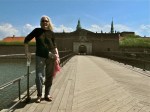
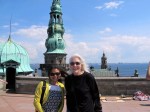
My companion for the day, journalist Jacqui Banaszynski, and I walked up to the castle, crossed the moat and looked out to the sea that separates Denmark from Sweden. How cold it must be here in the middle of January, we thought. An equally chilly history accompanied us through our tour. We learned of a fire that ravaged the castle, an attack and capture by the Swedes, of Bubonic Plague halving the nearby town’s population.
We climbed to the top and stood awed by the majestic views of sea and sky. And then descended on the stairs thinking of the madness, rage, grief, revenge and moral corruption Shakespeare so eloquently gave us in his play.
We didn’t have time to stick around for the Hamlet tour. Instead we walked back to the town of Helsingor, where we stopped for a drink at an Italian cafe in one of the town’s main streets. From bard to beer, Jacqui announced.
The last day of a 12-month deployment in Iraq for the 1st Battalion, 121st Infantry Regiment of the Georgia Army National Guard’s 48th Infantry Brigade. The long journey home started with an incredible thunderstorm over Baghdad.
Even at the height of Iraq and Afghanistan, the wars were but a rude blip in the minds of a majority of Americans. Our military is made up of those who volunteer their services. Most Americans are disconnected from the men and women who serve in uniform.
A smaller share of Americans serve in the Armed Forces now than at any other time in our history except for the period between the two world wars. Unless you have a loved one of friend in the military, unless you live by a military base, you probably don’t think much about the sacrifices of service members. Aside from the magnetic yellow ribbons that adorn cars, there’s not even many visible reminders that America has been at war for a dozen long years.
How many families are separated? How many children are growing up without daddies and mommies? How many lives are broken by wounds that cannot heal? How many lives, lost?
In 2010, on the 10th anniversary of the Afghanistan war, I traveled to Watertown, New York, to write a CNN story about a place I knew was constantly reminded. Fort Drum, home of the 10th Mountain Division, sits on the edge of Watertown. The division’s soldiers led the charge into Afghanistan and its many brigades and battalions have done multiple tours of both Afghanistan and Iraq.
Watertown is also my husband’s hometown of sorts. He was born in nearby Carthage but as a boy, he lived in Watertown for nine years. I had been visiting the area for a number of years and knew very well that war’s toll was greater here than where I live in Atlanta.
Up there, in the North Country as the locals call it, war makes unwanted, life-arresting visits; crashes into homes and entire neighborhoods just as assuredly as a January blizzard. If you like, you can read my CNN story.
In Watertown and in military homes across America, war is a constant. Let us make it a constant in our homes just for one day.
This is the closest I will come to emulating Frida. Ha.
If you live in the Atlanta area and have not seen the High Museum’s Frida & Diego exhibit yet, you are missing out. The show closes Sunday, so GO!
I became a fan of Frida Kahlo after reading Hayden Herrera’s biography in 1983. Fan might be an understatement. I should say I became obsessed with Friday. I went to Mexico City and spent hours in the garden of the Blue House in Coyacan, where Frida and Diego lived for many years.
I’d seen most of the paintings on display at the High before, but I never tire of seeing Frida’s work. The exhibit also includes numerous photographs.
In her life, Frida, of course, was overshadowed in every sense of the word by Diego Rivera. He was larger than life — already established as one of Mexico’s finest painters and commissioned to paint his murals in important places. I am glad to see Frida take her place next to him in this exhibit. As an equal, if not more.
“Oh, oh Telephone Line, give me some time, I’m living in twilight.”
That was Electric Light Orchestra singing a song about a man wishing his love would just pick up the phone. Back then, it was probably a phone that looked a lot like this one at the Grove Park Inn in Asheville, North Carolina.
I was so happy to see it, one among an entire row of them hanging on a wall. I didn’t really need to call the front desk but I did anyway. Just to pick up the shiny black hand-set and say: “Hello.”
I miss old-school telephones. I miss them at airports and in booths along the street. Sure, I use an iPhone. But I don’t enjoy chatting on end on a mobile device. I used to do that with a regular phone, one that was attached with its own umbilical cord to the earth.
To quote ELO again (what’s come over me?): “I just can’t believe … They’ve all faded out of view yeah yeah yeah yeah yeah. Doowop dooby doo doowop doowah doolang.
Public health pediatrician. Graduated from Howard University College of Medicine and the School of Public Health in Berkeley, California. She is president and CEO of Developing Families Center, Inc., a non-profit in Washington D.C. that serves low-income women of child-bearing and child-rearing age and their families. She has been recognized for her sensitivity and commitment to the complex needs of poor women, especially those of color. She’s been doing this sort of work for years — three decades to be exact.
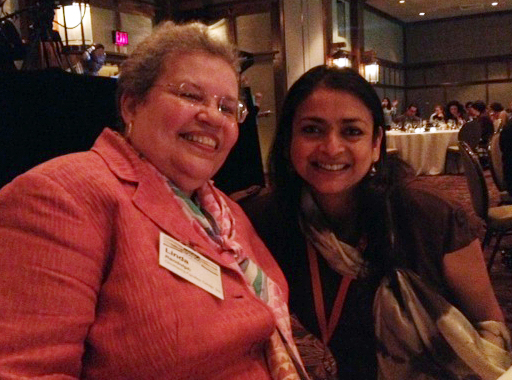
I had the privilege of sitting next to her at dinner one night last week at the America Healing conference, sponsored by the Kellogg Foundation. Randolph nibbled on a slice of prime rib and mashed potatoes. Somehow the conversation migrated from maternal outcomes to the day that Randolph will retire.
Linda Randolph and I had dinner together at a conference.
“What will you do?” I asked. “Will you stay in Washington?”
Randolph is a native of D.C.
I wasn’t expecting the answer I got.
“I’m going to move to New York and drive a taxi.”
Whoah. Seriously?
Randolph said there were few women who drove taxis in NYC. She wants another cabbie to glance her way and take a good look when she’s behind the wheel of a yellow cab.
And she’s gonna make sure it’s a taxi with manual transmission.
She loves to drive stick-shift. More than 40 years ago, when she was still young and impressionable, Randolph drove from New York to San Francisco with a friend. He was from Costa Rica and had never shifted gears. But never mind that. They took turns at the wheel: 4 hours each. They drove like the wind and made it to the Pacific in 3 and 1/2 days.
So that’s what Randolph looks forward to. Out performing badass cabbies in the city known for them. I guessed her cabbie days were fast approaching. But how long would she work as a driver? She’s 72 now. Didn’t she want a few years of rest and relaxation?
Well, she said, her mama lived to see 99.
“When she died, she didn’t have a wrinkle on her face.”
Here’s to you, Dr. Linda Randolph, full of life and and now a source of inspiration for me. Here’s to you and many good years as a taxi driver.
Hasan Zeya used to boast about how he was still practicing medicine into his early 80s. But at 84, he no longer is happy about his age. His daughter, Rena, passed away last week, days shy of her 52nd birthday.
“She did a bad thing. She cut ahead of me in the queue,” he tells me at her funeral Sunday.
Tears well in his eyes, though he keeps a brave front among the hundreds of people who have come to pay tribute to Rena. The weather, dreary and wet, matches the mood inside the inside Temple Kol Emeth.
Rena’s memorial was exactly how it should have been. A rabbi and grieving husband spoke of her incredible talent, compassion and ability to inspire. They spoke of a daughter, a wife, a mother, who gave her all to her family.
Rena worked for many years at CNN, a majority of her time spent as a leader at CNN International. The temple was filled with journalists who stood in awe of her.
Watch a birthday message from Dr. Zeya to Rena on her birthday last year:
Dr. Zeya tells me how his own father had been a journalist in India but discouraged his son from ever becoming one. It was hard work and no money. But maybe that’s where Rena got her passion.
As a little girl, Rena would make her parents watch as she pretended to be a news anchor. She would hide under the table and appear from behind the tablecloth to the deliver the news.
Rena came to America on her sixth birthday. Dr. Zeya had wanted a better life for his family and moved to North Carolina from a remote part of the Indian state of Bihar. His family hailed from the place where Mahatma Gandhi launched his civil disobedience campaign in India — there’s a scene in the Oscar winning film that shows Gandhi arriving at that train station.
Dr. Zeya tells me he was happy to leave what he called the “most backward place in India.” For a variety of reasons.
He tells me he loved that in Chapel Hill, he could shower with hot water spewing from the faucets. And that he did not have to sweat through the entire summer like we did in India when the electricity went out and the fans stopped for hours. I felt connected with him — and to Rena — in a whole different way.
I never really spoke with Rena much about her early childhood in India. My connections to our homeland, of course, were much stronger since my parents chose to return there many years ago. But in a strange sort of way, it was comforting to know now that Rena had experienced life as I had there. She was only a year and half older than me.
My deepest connection to Rena was that when I first met her more than 20 years ago, she was the only other Indian woman I knew in mainstream journalism in the United States. Now, of course, there are many successful South Asian women practicing great journalism. But back then, there were few. Rena knew that and encouraged women like me to keep pushing forward.
As I speak with her father, I realize where she got a lot of her spunk, though he insists that it was she who inspired him.
Dr. Zeya tells me he never wanted to color his children’s thoughts about big things in life. Like religion. He wanted Rena to make up her own mind. It was exactly how my father had raised my brother and me. He never allowed organized religion to infiltrate our home. He wanted us to figure it out for ourselves.
Sunday afternoon, Dr. Zeya sat in the temple to hear Rabbi Steven Lebow tell the audience what Rena had said to him when it became apparent she was going to die.
She told him she didn’t fear death — she never had in her painful two-year battle against lymphoma. She worried only about what would happen to her children, Sabrina and Adam, and to the love of her life, her husband, Rob Golden.
She also told Rabbi Lebow that she wasn’t religious, though she considered herself deeply spiritual. It was a statement that made her father proud.
We spoke of religious tensions in India. Dr. Zeya sipped Sprite and launched a conversation on Islam. He believes followers of that faith must rethink their path to the future. It was not a discussion I’d expected to have at Rena’s funeral and at first, I was caught by surprise.
But on the long drive back home on 1-75, I decided otherwise. My conversation with Dr. Zeya was exactly what Rena would have wanted. Smart, forward-thinking, outside-the-box, provocative, even, and totally unexpected at a funeral. She would have liked that her father initiated an intelligent conversation with her friends and colleagues.
The rain came down harder. It was as though the entire world was mourning the loss of Rena Shaheen Zeya Golden.
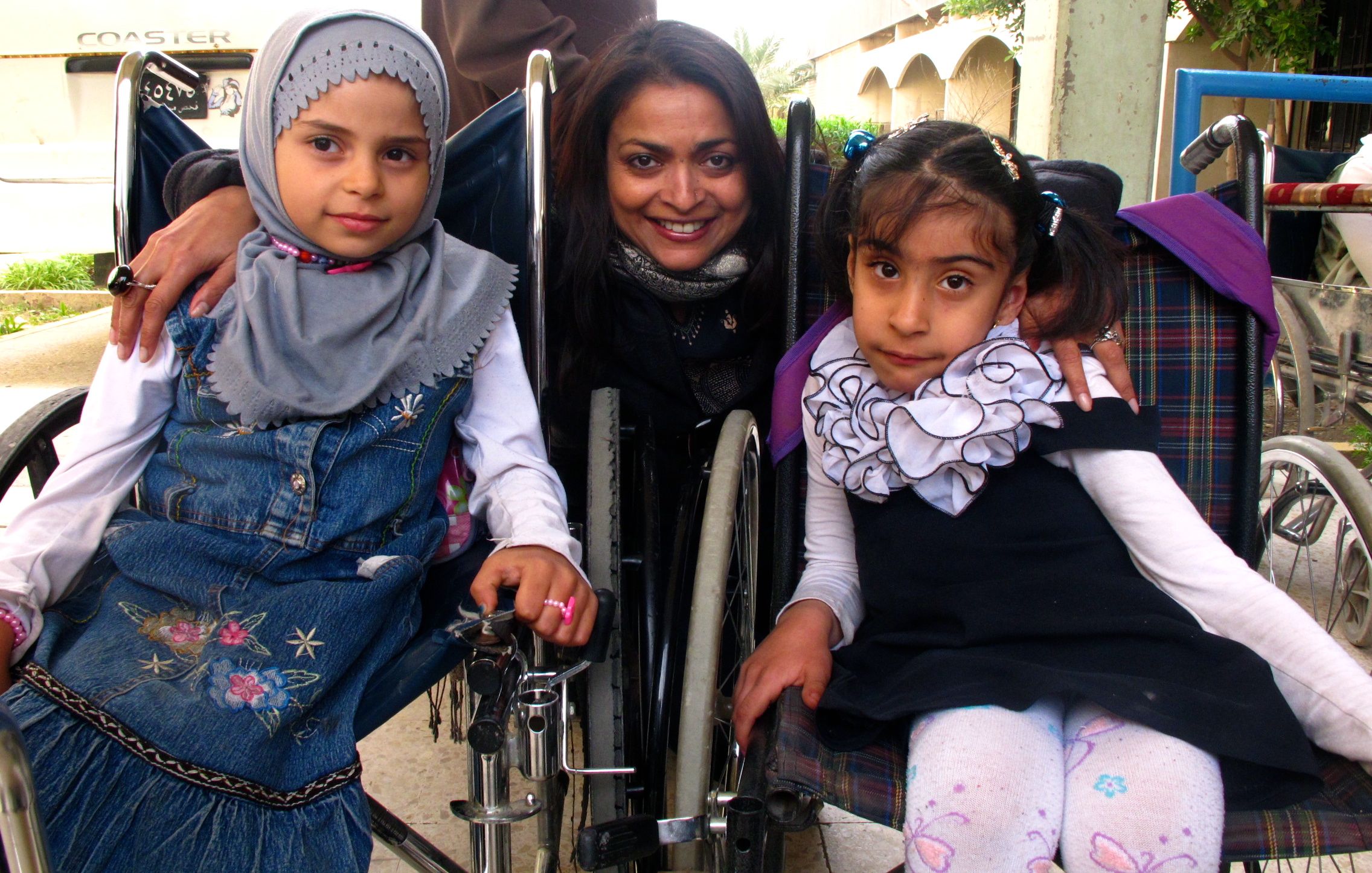
I went to school with Noor (right) during my visit to Baghdad and had this photo taken with her and Hajar, her best friend, who lost the use of her legs in a mortar attack.
My friend Joe Duran just called me after many months. I’d last seen him in November in Istanbul. Now, he was calling from his native Mexico, where he’d gone on vacation and also to sort through boxes of old things he stored at his house there.
“Moni, guess what I found?” he said.
I have no idea what’s about to come next.
“You know when you asked me about the tapes of Baby Noor? The raw tapes are all here in a box,” he said, coughing from the dust he’d whipped up.
I’d called Joe back in January asking if he had access to the footage he shot of Noor, the infant with spina bifida who American soldiers helped save by shuttling her out of her home in Abu Ghraib and sending her to Atlanta for surgery. Without the operations, she would surely have died.
I was an Atlanta Journal-Constitution reporter embedded with the Georgia Army National Guard unit that came upon Noor during a routine raid. I wrote about her for the newspaper and several days later, Joe arrived with camera in hand to file a story for CNN.
Our friendship was sealed in the throes of war. When I reconnected with Noor’s family in Iraq earlier this year, I called Joe about the footage. Turns out most of it was in the CNN system and I didn’t need his tapes. But it was good to talk to him about the stories we did back then.
“I can’t believe it’s been seven years,” he said.
I can’t either.
Except that I saw Noor again a few weeks ago.
I was not prepared to see a little girl who could speak and read and write. A girl who fancied pretty dresses and demanded her hair be embellished with colorful clips. She had grown so much.
I returned to Iraq to find her and tell the story of how she was faring all these years later, long after everyone in America who had been involved had lost touch with her.
It was strange that Joe called me out of the blue on the day before the story published on CNN.com.

 I opted not to fight to find parking places for my bike. Not to fight for space with other cyclists on crowded streets. Instead, I walked.











 Evil Reporter Chick