Crossfire


If you look at the map on photographer Shahidul Alam’s Web site, Bangladesh is a sea of yellow pinpricks — each virtual thumb tack pointing to a killing by the Rapid Action Battalion, a security force formed in 2004 to fight corruption in the South Asian nation.

The ruthless guardians of the nation stand accused by human rights groups of the torture and extra-judicial slayings of their fellow citizens.

Alam, a brilliant photographer and passionate defender of human rights, focused his heart and his camera on the state-sanctioned terror; on all the people allegedly caught in the “crossfire.”

In a collection of photographs catalogued as “Crossfire,” he shows us the hospital corridor, the rice paddy, the city wall, the rickshaw stand — all the places where they happened.

In his own words:

“The intention of this exhibit, was therefore not to present documentary evidence. There was plenty of that around and it had failed. The show attempts to reach out at an emotional level. I aim to get under the skin. To walk those cold streets. To hear the cries, see terror in the eyes. To sit quietly with the family besides a cold corpse. But every photograph is based on in-depth research. On actual case studies. On verifiable facts. A fragment of the story has been used to suggest the whole. A quiet metaphor for the screaming truth.”

Bangladeshi police prevented the public from viewing “Crossfire” by blocking the entrance to Drik Gallery in Dhaka. But Drik won its case in court and people can once again freely view Alam’s important work. It’s vital that people see through Alam’s lens. it’s vital for Bangladeshi democracy,

Check out Alam’s work on the New York Times site:
http://lens.blogs.nytimes.com/2010/03/31/behind-42/

And thanks to my friend John Trotter (another brilliant photographer) for bringing the court ruling to my attention.

Vanishing


It’s holy week for Christians and Jews. Easter. Passover.

I grew up in a place where it was holy week almost every month of the year. A bit of an exaggeration, I suppose, but India, with its myriad religions, bows down in prayer — often.

Hindus, Buddhists, Sikhs, Jains, Christians, Zoroastrians — and yes, Jews.

They were an integral part of India. Jewish families erected majestic buildings, launched landmark businesses. The synagogues were oases in the middle of mayhem. Their food defined fusion long before that word was attached to any American establishment. They came from the Middle East and found peace and tolerance in my homeland. And now they are vanishing. A dying breed on the subcontinent.

I wrote a story about the Jewish community in Kolkata for CNN. That it ran on the holiest of weeks compounded the sadness in my heart.

We fight wars in the name of religion. But it can also be the greatest display of our diversity. To lose that, can never be good,

Read about India’s Jewish community: http://bit.ly/aPY9tf

Tallahassee

I graduated from high school in 1979. Never been to any of my reunions. I earned a master’s degree in 1983. Never attended any college alumni functions either. But last week, I drove down to Tallahassee to see old friends from my first newspaper, The Florida Flambeau. (see post below)

A few of those people are my best friends and I see them often. Others, I had not seen in more than 20 years.

Some looked just the same. Some had changed quite a bit. It was lovely to see everyone again, though it served as yet another reminder of how fleeting time is; how fleeting our lives really are. Two decades, gone like that.

I got in my car on a sunny afternoon and drove past my old house, campus watering holes, restaurants, shops. Past Live oaks and Spanish Moss. On Park Avenue, Tennessee Street, Magnolia Avenue, Lake Ella, the Miracle Theater, Governor’s Square Mall, Chez Pierre, Maclay Gardens.

My father, a professor of statistics, settled our family in Tallahassee in 1976. We arrived there from Perth, Australia and cried for three months. A town in the Deep South was a tough adjustment after having lived in cosmopolitan cities around the world. But I ended up living 14 years of my life in Tallahassee. It became home.

It was where I grew to womanhood, married and divorced, committed all of life’s mistakes. It was the place that shaped me, helped make me whom I am.

There were memories swirling in my head that made that time feel like it was just yesterday. And yet, some sights felt so distant, as though it were almost someone else’s life.

The reunion weekend flew by. But now I have fresh memories of a time, a place and people to cherish — as life keeps whizzing by.

At Week’s End


In 1983, I began working for a newspaper called the Florida Flambeau. It was run by Florida State students mostly but was not affiliated with the university and had established itself as a strong, independent, progressive voice in the Tallahassee community. I had never taken a journalism class (there was no J-school at FSU). I only knew how to write academic papers and had just finished my Master’s thesis.

The Flambeau opened my eyes to a whole new world. My mentors there — Michael Moline, Eileen Drennen, Curt Fields, Michael McClelland, Steve Watkins (to name just a few) — taught me to ask tough questions and write with clarity and punch. Most of all, I learned that journalism was always about seeking truth. Our motto was to comfort the afflicted and afflict the comfortable. We wrote about the world around us — the university, the legislature, executions, migrant workers. We wrote about music and film that was edgy and off the mainstream radar and published a great entertainment section called At Week’s End.

This past weekend, some of us Flambeau alums attended a reunion in Tallahassee. Though we had our differences, though we screamed at each other, we have a bond that no one can ever take away.

We had more wrinkles and gray hair. Some of us were even grandparents. We’ve all moved on in life. Some are successful journalists — my dear friend Diane Roberts does commentary for major newspapers, NPR and the BBC. She is a respected author and a professor of English. Others are lawyers, artists, musicians, lobbyists.

But it was almost as though 25 years had not flown by. We were just as we were at the Flambeau. Almost. And I was very glad for it.

Here’s to all of you Flam alums. And to the next reunion!

A long journey


In the world’s largest democracy, men are still very much in control.

Even though we’ve had a woman as prime minister (Indira Gandhi) and the current president is also a woman (Pratibha Patil), women still lag way behind men in many ways. India has only 21 women in the 233-member Rajya Sabha or upper house of parliament. In the Lok Sabha or lower house, women represent 11 percent of the seats. That ranks India 99th in the world in female parliamentary representation – behind neighbors Pakistan and Bangladesh.

On Monday, which was International Women’s Day, the United Nations blamed a gender gap for the disappearance of 43 million women in India. Lost because of lack of health care, decent nutrition and proper education (only 55 percent of women are literate in India.

Gender bias leads to the killing of infant daughters. Brides are still burned to death in hopes of securing another dowry.

Those are obvious ways discrimination rears its ugly head. I can remember acts that were more subtle, yet insidious none the same.

The women in my mother’s generation cooked all the meals in the house but rarely sat with the men at the table. The men, of course, were served first; the women waited on them and then cleaned their mess.

Women on their periods could not enter a place of worship. I did not understand why when I was a teenager and wanted to join in on the puja festivities at my grandparents’ house. Now I am sure a man insisted on that rule.

My great aunt, who lived to a very ripe old age, was married and widowed when she was still in her teens. She lived a life of austerity, wrapped in white muslin, eating strict vegetarian food by herself on the floor of the kitchen. Somehow, she had been dishonored because her husband died on her. If she had been born a few years earlier, she might have had to plunge into her husband’s funeral pyre to save herself.

My own mother’s marriage was arranged. She left her own family to live with strangers. She gave up her own ambitions, her dreams in life to do what was expected of her. She was not a stalwart feminist. Nor was she one to complain about the way women were treated in Indian society. But I know, from all our quiet conversations, that she endured. And she told me many years ago that she would never wish the same for me.

Prime Minister Manmohan Singh recognized the uphill climb for women in India.

“Our women faced discrimination at home, there is domestic violence, they face discrimination in equal access to education and health care,” he said this week. “There are all these things. All these things have to end if India is to realise its full potential.”

A bill was introduced 15 years ago reserving one-third of parliamentary seats for women. The male-dominated Rajya Sabha finally passed the bill on Tuesday. It next goes to the Lok Sabha for approval.

There’s a long journey still ahead but the bill is a crucial first step to giving Indian women the voice they so richly deserve.

My mother died nine years ago. But I know she would have been proud of her homeland on this day.

The Hurt Locker: Ouch


I’ll be watching the Oscars on Sunday night, though this year, I am not as excited as I usually am. I’ve only seen two of the movies nominated for best picture: Up in the Air and The Hurt Locker.

The former is an entertaining movie even though George Clooney is George Clooney solely because he looks like George Clooney and not because of any Oscar-worthy talent.

The latter had the makings of a great movie, but the director lost me on the very first scene when the words “Baghdad 2004” flashed on screen and American soldiers were seen wearing the digital green combat uniforms. Those uniforms, of course, were not issued until May 2005. I know this because I was embedded with the 48th Infantry Brigade, the first unit to receive the re-engineered fatigues.

The camera panned wide to show a neighborhood in Baghdad that I instantly recognized as Amman, Jordan. There are no rolling hills in the Iraqi capital.

From there, other inaccuracies skewed my judgment of good filmmaking. I thought director Kathryn Bigelow perfectly captured the tension and adrenaline rush that goes with war, specifically with the job of a bomb detection specialist. But the lead character, played by Jeremy Renner, is too much of a cowboy. There’s no way an EOD team leader would be able to run through the streets of Baghdad in a t-shirt and cammos and make it back to the gates of Camp Liberty and be allowed in without stern questioning and punishment. There’s no way, a lone Humvee would leave the gates without a convoy and find itself way out in the Iraqi desert in a showdown with snipers.

My soldier friends agree with me that The Hurt Locker is rife with errors. So do a lot of EOD veterans who have been interviewed by various media outlets including my own, CNN.

I realize that the movie is a work of fiction. But the Iraq war is so fresh that I felt the film lost credibility by not getting things right. It wouldn’t have taken much to correct those errors.

So while The Hurt Locker beautifully captures the addiction to war and what happens to soldiers who return to lives that seem mundane, the movie missed the mark with me.

I cannot hope that it trumps its contenders Sunday night. For the sake of truth. That’s just the journalist in me, I suppose.

For Chile

This weekend, as Chile suffered the wrath of an enormous earthquake, I reread one of my favorite poems by Chilean poet Pablo Neruda.

Ode to Broken Things

Things get broken
at home
like they were pushed
by an invisible, deliberate smasher.
It’s not my hands
or yours
It wasn’t the girls
with their hard fingernails
or the motion of the planet.
It wasn’t anything or anybody
It wasn’t the wind
It wasn’t the orange-colored noontime
Or night over the earth
It wasn’t even the nose or the elbow
Or the hips getting bigger
or the ankle
or the air.
The plate broke, the lamp fell
All the flower pots tumbled over
one by one. That pot
which overflowed with scarlet
in the middle of October,
it got tired from all the violets
and another empty one
rolled round and round and round
all through winter
until it was only the powder
of a flowerpot,
a broken memory, shining dust.
And that clock
whose sound
was
the voice of our lives,
the secret
thread of our weeks,
which released
one by one, so many hours
for honey and silence
for so many births and jobs,
that clock also
fell
and its delicate blue guts
vibrated
among the broken glass
its wide heart
unsprung.

Life goes on grinding up
glass, wearing out clothes
making fragments
breaking down
forms
and what lasts through time
is like an island on a ship in the sea,
perishable
surrounded by dangerous fragility
by merciless waters and threats.

Let’s put all our treasures together
— the clocks, plates, cups cracked by the cold —
into a sack and carry them
to the sea
and let our possessions sink
into one alarming breaker
that sounds like a river.
May whatever breaks
be reconstructed by the sea
with the long labor of its tides.
So many useless things
which nobody broke
but which got broken anyway.

It’s never too late to be what you might have been


I met Mariot a few days after I arrived in Port-au-Prince. He was one of several drivers retained by CNN.

Mariot spoke English well, and often, on our long days out, we’d carry on conversations. About his life — before and after the earthquake. I quickly figured out that he was special.

His full name is Jean Mariot Cleophat. He was born in 1983 in Bainet, a town in southern Haiti. His father was killed in 2000 in a burglary; Mariot lived with his mother, a brother and two sisters in the Haitian capital.

Life was not easy before tragedy struck January 12. He never attended schools, he told me. When he was nine, his grandmother began teaching him to read and write. He is fluent in his native Kreyol. He learned French and said he wanted to perfect his English. One day, he said, he wanted to write a book in English, one that would make it on the New York Times bestseller list.

He told me he owned more than 2,000 books and once things had settled, he planned to dig under the rubble of his house to find them. It was the second time his family had lost their possessions. A hurricane wiped out their house in Gonaives in 2004. That’s what brought them to Port-au-Prince.

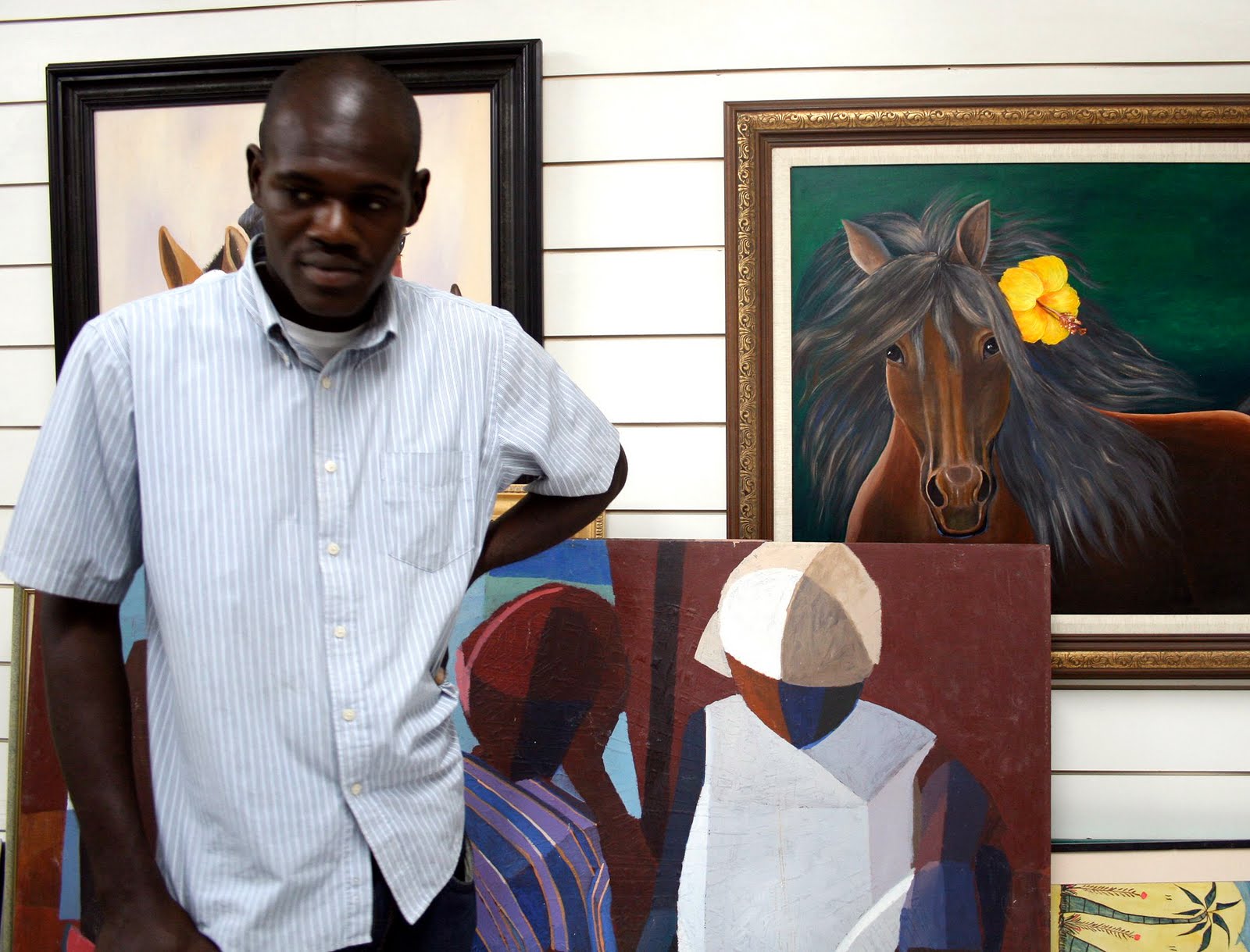
Mariot considered himself lucky to have landed a job, albeit temporary, with CNN. He liked acting as our guide, our translator. He met people he would have otherwise not met, saw places he had not seen before. In this photo of him, he is standing inside Gallerie Nader, one of the best known art galleries in Port-au-Prince.

He said he felt thankful to God that his family had survived the earthquake. He saw dead people in his dreams and when he was awake, he thought about the many friends he would never see again.

Still, he never gave up his will to succeed.

“It may be stormy now, but it can’t rain forever,” he wrote in an e-mail this week.

One day, as we drove back down to central Port-au-Prince on a winding hillside road, Mariot told me that reading was what sustained him through everything. He was upset that the library had collapsed and he could no longer check out books there. He liked history and philosophy. He read about Abraham Lincoln and Benjamin Franklin. He admired Mahatma Gandhi and asked me about my native India.

“It’s never too late to be what you might have been,” he said, quoting Gandhi.

“The past is behind you, learn from it,” Mariot continued. “The future is ahead, prepare for it. The present is here. Live it.”

“Do you know that quotation?” he asked.

I nodded my head, in awe that a Haitian man who had never gone to a single day of school could quote Gandhi this way. I don’t know that many Indians who could do the same.

Mariot dropped me at the Plaza Hotel and I knew he would be going back to his family, surviving in a makeshift tent nearby. I knew that he would arrive again the next morning, in a freshly laundered shirt and a big smile on his face.

SOS


There are things that one remembers about a place. Things that are clear and fresh, even many years later when memories of the most obvious have faded.

I find this to be especially true about tragedy. I have photographic recall of certain events and people in India, in Iraq — and now in Haiti.

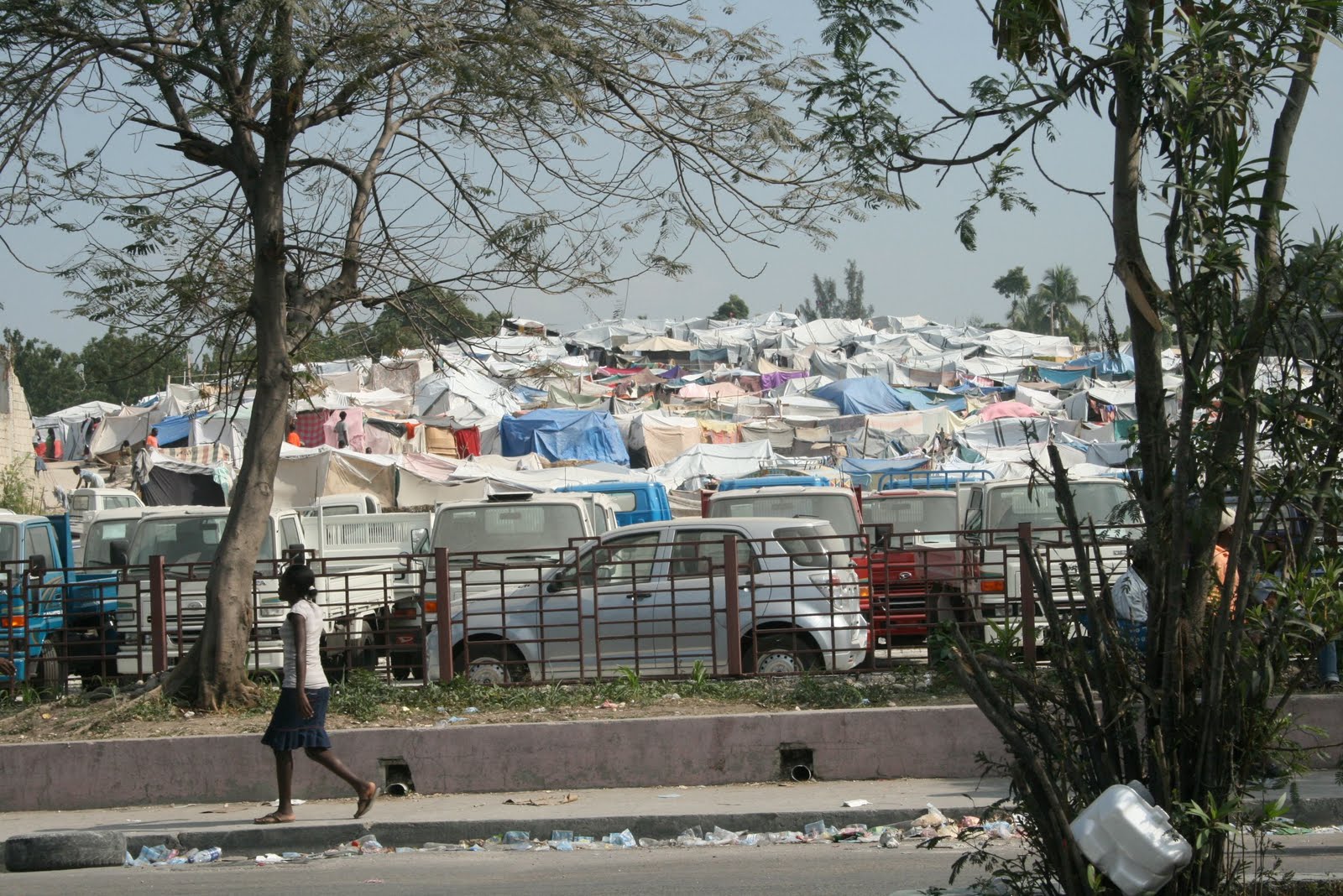
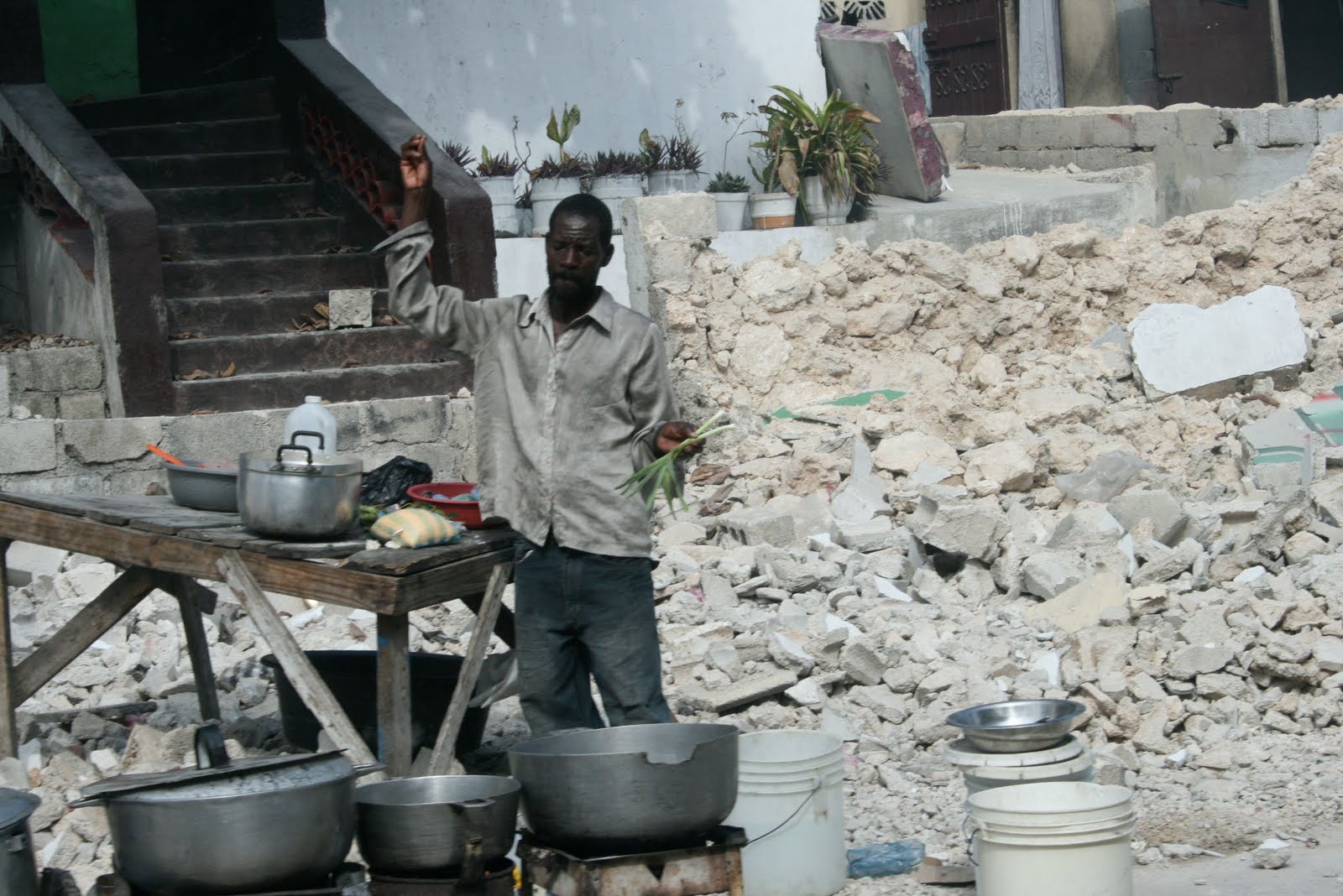
On my last full day, I drove around Port-au-Prince, trying desperately to finish a story. It was a city trying to rebound, the spirit of the people alive. Markets and shops were bustling. Some businesses had reopened. As had eateries and service providers. But then, the eye would fall on a vast makeshift settlement or a hill of rubble. And I was instantly reminded of the magnitude of suffering here and the equally enormous effort it will take to rebuild.

I went up to Petionville on that last day, weaving through city streets. A tree had started new life from the concrete chunks of a building that once stood tall. I looked at the young leaves and wondered how long it would survive before a bulldozer came.
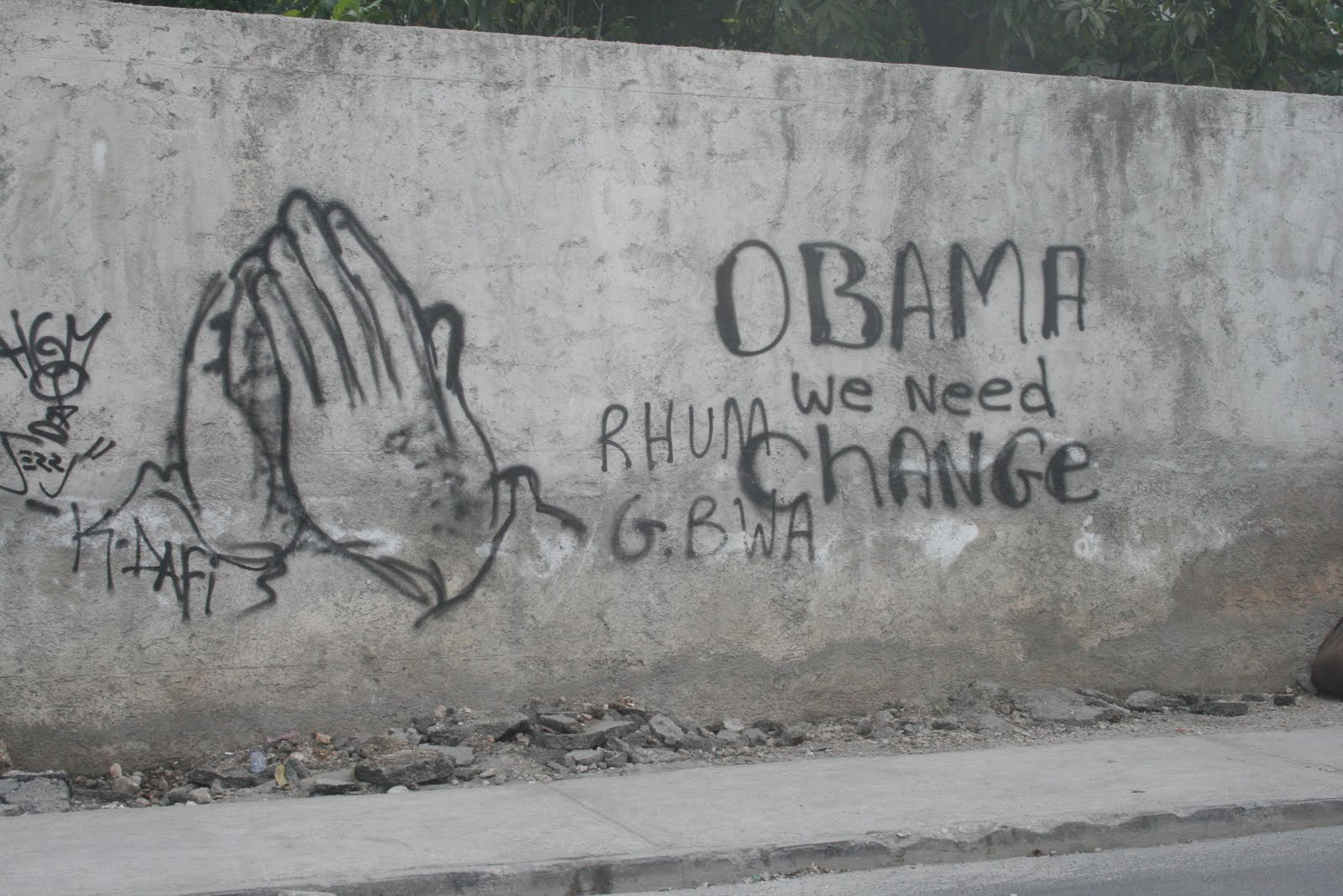
Nearby, a freshly spray painted sign on a wall: “Obama, we need change.”

Soldiers from the 82nd Airborne made their presence known, as did the United Nations, it’s hulking white tanks unadorned save two letters — U.N. — stopped on street corners. No wonder some Haitians felt this was another the start of another foreign occupation.

A man sat on the street with his family silver. A coffee set, a tray. Pure silver, he said. Money for the next month’s meals. No takers in sight, though. Why buy silver when you no longer have a home? But the furniture makers weren’t discouraged. They set about their freshly varnished dressers, tables and chairs. They might look just as good in tent city, behind four sheets instead of four walls in a hillside home.

The random nature of the destruction was curious. One house untouched, the next reduced to debris. I thought about walking the streets of Mexico City a year after the massive 1985 earthquake and every so often, I’d feel a gust of chilling air slap my face. The wind was swirling like ghosts around empty plots where once buildings had stood.

And still, all around Port-au-Prince, are signs asking for help. One off John Brown Avenue said: “SOS. We are hungry. We need water. Please help now. Go this way.”

Back to school


A Catholic school in the Port-au-Prince neighborhood of Sainte Marie resumed classes Wednesday. It was a vital sign of normalcy.

The kids need routine, they need to be with their friends. It’s a massive step toward recovery for the earthquake’s most vulnerable survivors.

Again, I cherished their smiles.