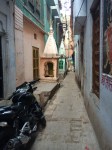
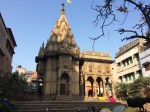
A temple along one of the many alleyways and lanes of old Benaras.
An old temple in the heart of the city.
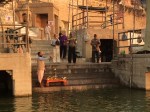
Looking out from one of the temples along the river.
Varanasi or Benares, as the British called it, is known for a lot of things.
It’s one of the oldest continually inhabited cities in the world, the oldest, certainly, in India.
It is the holiest of seven holy cities for Hindus, known as Kashi in olden times. The might Ganges, flows through here and yes, thousands of people visit Benares every year. Hindus come here for obvious reasons. Foreigners flock here to take in the myriad rituals of Hinduism and walk the chaos of the city, now 3.5 million strong.
There are about 3,600 temples in Benares, I’ve been told. I walked through the old city last week and it felt as though there was a temple on every corner. Many of the ancient ones are gone, razed by Muslim invaders but some date back several hundred years. The city also claims 1,400 mosques.
I was mesmerized as I walked the narrow alleyways and snaking lanes of the old city. The smell of fresh cow dung mingled with motorbike exhaust and turmeric and cumin as I walked past homes and shops that all seemed stacked one on top of another.
Indians look down on Benares, a city that reminds me of how my native Kolkata was 30 years ago. Grimy, dusty, filthy with little order to the daily machinations of life. I, too felt that way about the city on my previous visits.
This was my third trip to Benares. I understand the magic of this city a little better now. I owe that to my superb guide Nandan Upadhyay, who a few years ago began running a tour company here. Nandan knows a lot about his hometown. If you are ever here, look him up. He has a website called Groovy Tours.
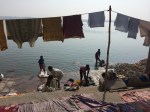
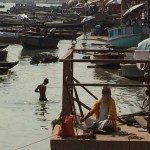
I’m posting a ton of photos with this dispatch. None capture the essence of the city, really. You have to not only see but smell, hear and touch Benares. And that’s not possible with a camera. Not even with a iPhone 5s.
I’d never been to Goa until last week. My cousin Rahul and his wife Shraya moved to Goa several years ago but I hadn’t had a chance to visit them on my rapid-fire trips to India before.
The western state in India is a haven for tourists who flock to its beaches and revel in a culture that is far more progressive than in other parts of the subcontinent.
At first, it was hard for me to believe I was still in India. I’d spent the first 10 days in India in Kolkata, where many of my friends and family still aspire to tradition and abide by cultural norms set decades ago. I love my hometown but sometimes, it can feel a bit oppressive.
Goa surprised me instantly. People seemed far more laid back in their bermuda shorts and sandals and t-shirts. It felt more like coastal Mexico or Nicaragua than India. It looked that way, too, because of the influence of Portuguese architecture.
It’s warm in Goa even in January and I was saved only by the ocean breeze that flows through Rahul and Shraya’s house.
They own a multi-level space atop a hill. Their house is teeming with all sorts of art (Shraya is an artist) and colorful paint and textiles. On the top level is a massive terrace, where we sipped a cool drink at sunset and watched darkness descend.
Over four days, I ate delicious food — fish is a staple in Goa, as is chorizo. The Portuguese settled here and brought with them their culture and religion. About 27 percent of the Goan people are Catholics.
On Friday night, Rahul took me to a birthday party for one of his relatives. The crowd was largely expat. I didn’t get to speak with them much but I gathered they liked it in Goa because here, they could afford to live the kind of artsy, beachy, easy-breezy, stress-free lifestyle that appealed to them.
I’ve posted other photos of my trip on Facebook. You can check them out there.
Now I am back in Delhi. Back at work. And Goa seems distant again, as it always had been. But it was a great break. I am thankful to Rahul and Shraya for their generosity. I see another trip for me in the future. Very soon, I hope.
In my childhood, there weren’t too many Bengali women who had made it big enough to attain celebrity status. But there was Suchitra Sen, goddess of cinema.
Her films, usually with Uttam Kumar, were wildly popular in Kolkata.
To me, Sen was the ultimate beauty. She had a certain Bengaliness about her. She was feminine but strong. She had a “no-nonsense gravitas to care out a persona that has never been matched, let alone surpassed in Indian cinema,” film critic Saibal Chatterjee told the BBC.
I just remember my older cousins talking about her. They referred to her with only her first name. Like Greta. Or Marilyn. Legends don’t require a surname. In fact, it’s been said that idols of Lakshmi (goddess of prosperity) and Saraswati (goddess of knowledge) were modeled after Suchitra. Now, that’s some star power.
In all, Suchitra acted in 52 Bengali films and seven Hindi films. The first movie of hers that I saw was “Kamal Lata,” based on a story by famed Bengali author Sarat Chandra Chattapadhya. I was riveted by her performance, made all that much intense by the power of black and white imagery. I gazed into Suchitra’s big eyes and wanted to be like her one day. Talented, smart, strong, beautiful.
Suchitra died today in Kolkata — at the same hospital where my mother died.
Thank you for the hours of entertainment but mostly for inspiration, Suchitra. Rest in peace.
The etching Panesar took off a gallery wall and gave me.
A headline in my hometown newspaper brought me to tears this morning. B.P. Panesar had died.
He was a renowned artist. Water color. Oil. Etchings. He was also made a name as mentor to Shakila, a poor village woman who gained fame for her collages.
He gave away his earnings as an artist to charity. He never married and lived for many years in one room at the YMCA in central Kolkata. He died in an old people’s home, still holding paint and brush.
Uncle Panesar and me when I was about a year old.
I knew him as Uncle Panesar. My father taught at the Indian Statistical Institute, where Panesar worked, and from the instant they met, they became fast friends. My father became an advcate for Panesar’s art. In time, he became a part of our family, especially in the years we spent living on campus in north Kolkata.
He loved to listen to my mother sing Rabindrasangeet and spend hours with my brother and me.
He held me as a baby, played with me when I was a child, encouraged me to paint as a teenager and inspired my creativity as an adult.
From early on, I found Uncle Panesar to be a calming force in my life. I’d peer into his eyes, under his thick bushy eyebrows and try to imagine what was swirling inside his head. What genius, I thought, to be able to produce such visual feasts.
I was especially enamored with Panesar’s collages made with magazine and newspaper cuttings, old pictures, bus tickets and other things people tossed in the trash. Panesar gave up his own collages to train Shakila. He was so taken with her talent. I was sorry at first until I went to visit Shakila and saw for the first time the mastery within that Panesar had helped awakened.
In the late 1980s, I visited Uncle Panesar at the Y. He had moved onto etchings by then and showed me his small studio. He invited me to go see his show at the Birla Academy. I was so taken with an etching of Mother Teresa — I’d volunteered at one of her organizations many years before — that when his show was over, Uncle Panesar took it off the gallery wall and presented it to me. It hangs by my dresser. I look at it as I begin each day. And think of all the good in the world.
I had hoped to see you in a few days in Kolkata. But you did not wait. You have flown away to a better place.
I just read a CNN-IBN report on the Devyani Khobragade episode that made me squirm.
“Devyani’s arrest,” the report said, “has rattled the Indian Diplomatic Corps.
“It is forcing the government to hit back at the U.S. According to Indian diplomats serving in the Western countries, paying lesser than what is actually on official papers is a common practice among the Indian diplomats. They claim that the salary fixed by the U.S. government is too high for the Indian diplomats.”
Indian diplomats say they cannot afford to pay $4,500 a month for domestic help. They say they, themselves, make just a little bit more than that a month.
What? Really?
In that case, diplomats should not be hiring live-in help.
They certainly cannot expect to treat domestic workers like they are often treated in India — underpaid and sometimes abused in other ways.
The row that has erupted over Khobragade’s arrest and strip search has turned into a Cold War-style standoff between two countries that have enjoyed warm relations in the past few years.
Many of my Indian friends are upset the United States that Khobragade was strip-searched. How dare America treat a diplomat like that? America would not stand for it if one of their own was treated this way. I see their point.
But my guess is that some Indian politicians may be taking a staunchly nationalist stance ahead of critical elections to drum up support for themselves. It pays for them to take a tough position against the United States.
Khobragade, meanwhile, has been transferred to the United Nations mission and can apply for diplomatic immunity. That’s not right if indeed she is guilty of a crime. She, like any other Indian in this country, should be held accountable if she broke the law.
It all seems very stressful as I prepare for an upcoming trip to India. I am stuck watching a political match between my homeland and the nation I now call home. Not good.
This tragedy has been forgotten by most people. It shouldn’t be.
It was 29 years ago on this night that tank 610 exploded at the Union Carbide pesticide plant in Bhopal. A milky fog that spread silently across the sleeping India city, spreading toxic gas in the densely populated slums nearby.
Within minutes, people poured into the narrow lanes and alleys. They grasped their throats as they gasped for air. Their eyes, mouths and bellies were on fire. They vomited blood and frothed at the mouth.
At first, some people thought the chaos was political — India’s prime minister, Indira Gandhi, had been assassinated weeks before and there had been rioting in the streets. But they learned soon enough that at five minutes past midnight on Dec. 3, 1984, 40 tons of poisonous methyl isocyanate gas had enveloped their city.
In areas near the plant, it was impossible to walk without treading on the dead.
Bhopal native Nadeem Uddin told me many years ago that he saw tents — colorful ones used in weddings — at a government hospital. They were filled with the dead. “I can’t explain to you how I felt,” he said.
Union Carbide said 3,800 people died that night. The Indian government said 12,000 people were killed. Health workers in Bhopal estimated at least 20,000 people have died from MIC-related diseases like lung cancer and tuberculosis. Another half a million people suffered illness or gave birth to deformed babies.
The legal wrangling goes on, even after 29 years as survivors of the world’s worst industrial disaster are fighting for financial compensation for their suffering.
In 1989, the Indian government agreed to a $470 million out-of-court settlement. In 2010, the survivors filed a petition with the Supreme Court demanding the case be reopened. They say the numbers of victims were underestimated.
Besides the compensation, a criminal case against Union Carbide in a Bhopal court and a class-action lawsuit in a New York district court are ongoing.
Bhopal’s mission continues to hold Union Carbide and its parent company, Dow Chemical, accountable. Some Indians have called the gas tragedy a holocaust.
“The company has been ordered to explain why its wholly-owned subsidiary, Union Carbide Corporation (UCC), has repeatedly ignored court summons in the ongoing criminal case concerning the 1984 Bhopal disaster, where UCC is accused of “culpable homicide not amounting to murder.
“Dow has always tried to claim it has nothing to do with UCC’s liability for Bhopal, but the court has today made it clear that Dow itself has a responsibility to ensure that UCC faces the outstanding charges against it. Dow can no longer turn its back on the tens of thousands still suffering in Bhopal.
“Almost three decades after the Bhopal disaster, victims and their families have yet to receive adequate compensation from UCC or the Indian government.”
Amnesty’s research shows that about 100,000 people continue to suffer from health problems. That’s today, almost three decades after tank 610 exploded.
A friend of mine in India said Bhopal was the most callous manifestation of corporate insensitivity. Had the victims not been poor Indians, Dow and Union Carbide would have been held more accountable. Look at what happened with BP on the Gulf Coast, my friend said. “How is it that no one was made to answer for Bhopal?”
I’m at work today, on Thanksgiving, surrounded by news that projects mankind in the worst sort of way — war, murder, rape. But I am also heartened by the best of humanity.
I am not with my family today but I am thinking of them. Some are still here in this world; others, including my mother and father, have passed away. They remain in my heart and fill it with love.
I am thinking today of two dear friends who each lost a parent this year, Valerie Boyd and Jan Winburn. I know this holiday season will be especially tough for them. But I know their mother and father’s spirit will warm their gatherings.
I looked through an old album last night and found this photograph of my father’s family. It was taken at my grandfather’s house, in the backyard, in Kolkata in 1970. I’m sitting in the front row, my parents, brother, aunts, uncles, cousins, grandparents and great aunt around me.
I wish we could all be together today. I am thankful for each and every one of them being a part of my life.
Maybe my friends here in America have never heard those names. But in India, they stand synonymous with investigative journalism.
Tehelka has lived up to its name, which means sensation in Hindi, since it entered the Indian media scene in 2000. Early on, the startup almost brought down the Indian government by exposing bribery in defense deals. Tehelka got the story by engineering a videotaped sting operation.
Several years later, in 2007, Tehelka dropped its biggest bomb when it exposed bloody riots in the state of Gujarat not as Hindu backlash but the state-sanctioned killing of Muslims under the state’s chief minister, Narendra Modi. Modi, by the way, is now a prime ministerial contender.
The magazine did not always employ orthodox methods of investigation and came under fire for stretching the limits of the law by using secret cameras and false identities. It defended itself by saying that uncovering the darker side of India would otherwise not be possible.
With Tehelka’s success, Tejpal, the magazine’s editor, skyrocketed to stardom. He was called the rock star of Indian journalism; someone who set a new bar for media standards in the subcontinent. Charismatic. Terribly smart. Curious.
Now, all of it hangs in the balance.
Tejpal admitted “misconduct” against a fellow journalist this week and stepped down from his post as editor-in-chief of Tehelka for six months to “atone” for his sins. The journalist, according to media reports, is alleging Tejpal sexually assaulted her.
“A bad lapse of judgment, an awful misreading of the situation, have led to an unfortunate incident that rails against all we believe in and fight for,” Tejpal said.
Some pointed out Tejpal’s language was inappropriate. It was almost as though he were writing about one of his fictional characters.
Tehelka’s managing editor, Shoma Chaudhary’s remarks didn’t go over well, either.
“There has been an untoward incident, and though he has extended an unconditional apology to the colleague involved, Tarun will be recusing himself as the editor of Tehelka for the next six months,” she said.
A statement from the Editors Guild of India said this: “There ought not to be any attempt to cover up or play down this extremely serious incident. Self-proclaimed atonement and recusal for a period are hardly the remedies for what the allegations show to be outright criminality.”
The Tehelka controversy has lit up Twitter and Facebook. That a media institution known for outing the worst of Indian society should be in the midst of a sexual abuse scandal is shocking to many. And Tejpal’s political enemies — he has many — have come out with sharpened knives. Arun Jaitley, the leader of the Bharatiya Janata Party, accused Tejpal and Chaudhary of “a private treaty” in what he called an attempt to suppress “a clear case of rape.”
Whoa. Let’s give Tejpal his due. We don’t know yet what the truth is here; whether Tejpal is guilty of his accuser’s actions.
I hope that if he is innocent, he will be reinstated and allowed to carry on with his journalistic endeavors, even though I believe his name will now forever be tainted.
But more than anything, I hope there is a fair and exhaustive investigation of what happened. Often in India, that does not happen.
And I hope that Tehelka will help lead the way in that effort. That is what the magazine stands for, after all — to do the right thing.
The Tejpal story hit a nerve with me for a number of reasons — CNN.com just published a story I reported from India in which I revealed my own rape. Sexual assault happens in all sectors of society. I have never worked full-time for an Indian media institution but I know from friends who have that abuse is widespread.
Reading about Tejpal all over the Indian media today, I came across an interview he gave to CNN-IBN in 2007, after the stinging story about Modi.
“It’s never personal, I keep saying that,” Tejpal said. “It’s not even finally about him. The story is about an extremely dangerous and poisonous school of thinking that is part of the national blood stream now.”
In this case, it is personal. Deeply so for the woman who alleges the assault. But it’s also the latter part of what Tejpal said.
In my 30 years as a journalist, I’ve written a lot about victims. Many sorts of victims. Of war. Murder. Illness. Natural disasters. And man-made ones.
I always try to be sensitive and to highlight the incredible resiliency of human beings.
I was lucky enough to have won a Dart-Ochberg Fellowship from the Dart Center for Journalism and Trauma. I learned many things during that fellowship; how to improve my own reportage about people who have suffered.
All that really hit home last week when CNN published a story I reported from India about a woman who was raped four decades ago. You can read the story here: The Girl Whose Rape Changed a Country.
In the story, I revealed that I, too, had been raped when I was 18. I broke a 33-year silence. I wrote about some of the reaction to the story and how it made me feel in a follow-up. I was reporter and victim all at once.
I so appreciate the outpouring of support from women from around the world. It’s been a very difficult few days, reliving a memory from my past — one that I had put away in one corner of my mind. I tried to forget. But you can never really forget. The good thing is that it is possible to move on.
This post is to thank those who reached out to me. And for my dearest friends who took the time to make sure I was doing OK. Thank you.
I’m moving on to the next story. But I will not be afraid anymore to write about rape.











 Evil Reporter Chick