The etching Panesar took off a gallery wall and gave me.
A headline in my hometown newspaper brought me to tears this morning. B.P. Panesar had died.
He was a renowned artist. Water color. Oil. Etchings. He was also made a name as mentor to Shakila, a poor village woman who gained fame for her collages.
He gave away his earnings as an artist to charity. He never married and lived for many years in one room at the YMCA in central Kolkata. He died in an old people’s home, still holding paint and brush.
Uncle Panesar and me when I was about a year old.
I knew him as Uncle Panesar. My father taught at the Indian Statistical Institute, where Panesar worked, and from the instant they met, they became fast friends. My father became an advcate for Panesar’s art. In time, he became a part of our family, especially in the years we spent living on campus in north Kolkata.
He loved to listen to my mother sing Rabindrasangeet and spend hours with my brother and me.
He held me as a baby, played with me when I was a child, encouraged me to paint as a teenager and inspired my creativity as an adult.
From early on, I found Uncle Panesar to be a calming force in my life. I’d peer into his eyes, under his thick bushy eyebrows and try to imagine what was swirling inside his head. What genius, I thought, to be able to produce such visual feasts.
I was especially enamored with Panesar’s collages made with magazine and newspaper cuttings, old pictures, bus tickets and other things people tossed in the trash. Panesar gave up his own collages to train Shakila. He was so taken with her talent. I was sorry at first until I went to visit Shakila and saw for the first time the mastery within that Panesar had helped awakened.
In the late 1980s, I visited Uncle Panesar at the Y. He had moved onto etchings by then and showed me his small studio. He invited me to go see his show at the Birla Academy. I was so taken with an etching of Mother Teresa — I’d volunteered at one of her organizations many years before — that when his show was over, Uncle Panesar took it off the gallery wall and presented it to me. It hangs by my dresser. I look at it as I begin each day. And think of all the good in the world.
I had hoped to see you in a few days in Kolkata. But you did not wait. You have flown away to a better place.
I just read a CNN-IBN report on the Devyani Khobragade episode that made me squirm.
“Devyani’s arrest,” the report said, “has rattled the Indian Diplomatic Corps.
“It is forcing the government to hit back at the U.S. According to Indian diplomats serving in the Western countries, paying lesser than what is actually on official papers is a common practice among the Indian diplomats. They claim that the salary fixed by the U.S. government is too high for the Indian diplomats.”
Indian diplomats say they cannot afford to pay $4,500 a month for domestic help. They say they, themselves, make just a little bit more than that a month.
What? Really?
In that case, diplomats should not be hiring live-in help.
They certainly cannot expect to treat domestic workers like they are often treated in India — underpaid and sometimes abused in other ways.
The row that has erupted over Khobragade’s arrest and strip search has turned into a Cold War-style standoff between two countries that have enjoyed warm relations in the past few years.
Many of my Indian friends are upset the United States that Khobragade was strip-searched. How dare America treat a diplomat like that? America would not stand for it if one of their own was treated this way. I see their point.
But my guess is that some Indian politicians may be taking a staunchly nationalist stance ahead of critical elections to drum up support for themselves. It pays for them to take a tough position against the United States.
Khobragade, meanwhile, has been transferred to the United Nations mission and can apply for diplomatic immunity. That’s not right if indeed she is guilty of a crime. She, like any other Indian in this country, should be held accountable if she broke the law.
It all seems very stressful as I prepare for an upcoming trip to India. I am stuck watching a political match between my homeland and the nation I now call home. Not good.
This tragedy has been forgotten by most people. It shouldn’t be.
It was 29 years ago on this night that tank 610 exploded at the Union Carbide pesticide plant in Bhopal. A milky fog that spread silently across the sleeping India city, spreading toxic gas in the densely populated slums nearby.
Within minutes, people poured into the narrow lanes and alleys. They grasped their throats as they gasped for air. Their eyes, mouths and bellies were on fire. They vomited blood and frothed at the mouth.
At first, some people thought the chaos was political — India’s prime minister, Indira Gandhi, had been assassinated weeks before and there had been rioting in the streets. But they learned soon enough that at five minutes past midnight on Dec. 3, 1984, 40 tons of poisonous methyl isocyanate gas had enveloped their city.
In areas near the plant, it was impossible to walk without treading on the dead.
Bhopal native Nadeem Uddin told me many years ago that he saw tents — colorful ones used in weddings — at a government hospital. They were filled with the dead. “I can’t explain to you how I felt,” he said.
Union Carbide said 3,800 people died that night. The Indian government said 12,000 people were killed. Health workers in Bhopal estimated at least 20,000 people have died from MIC-related diseases like lung cancer and tuberculosis. Another half a million people suffered illness or gave birth to deformed babies.
The legal wrangling goes on, even after 29 years as survivors of the world’s worst industrial disaster are fighting for financial compensation for their suffering.
In 1989, the Indian government agreed to a $470 million out-of-court settlement. In 2010, the survivors filed a petition with the Supreme Court demanding the case be reopened. They say the numbers of victims were underestimated.
Besides the compensation, a criminal case against Union Carbide in a Bhopal court and a class-action lawsuit in a New York district court are ongoing.
Bhopal’s mission continues to hold Union Carbide and its parent company, Dow Chemical, accountable. Some Indians have called the gas tragedy a holocaust.
“The company has been ordered to explain why its wholly-owned subsidiary, Union Carbide Corporation (UCC), has repeatedly ignored court summons in the ongoing criminal case concerning the 1984 Bhopal disaster, where UCC is accused of “culpable homicide not amounting to murder.
“Dow has always tried to claim it has nothing to do with UCC’s liability for Bhopal, but the court has today made it clear that Dow itself has a responsibility to ensure that UCC faces the outstanding charges against it. Dow can no longer turn its back on the tens of thousands still suffering in Bhopal.
“Almost three decades after the Bhopal disaster, victims and their families have yet to receive adequate compensation from UCC or the Indian government.”
Amnesty’s research shows that about 100,000 people continue to suffer from health problems. That’s today, almost three decades after tank 610 exploded.
A friend of mine in India said Bhopal was the most callous manifestation of corporate insensitivity. Had the victims not been poor Indians, Dow and Union Carbide would have been held more accountable. Look at what happened with BP on the Gulf Coast, my friend said. “How is it that no one was made to answer for Bhopal?”
I’m at work today, on Thanksgiving, surrounded by news that projects mankind in the worst sort of way — war, murder, rape. But I am also heartened by the best of humanity.
I am not with my family today but I am thinking of them. Some are still here in this world; others, including my mother and father, have passed away. They remain in my heart and fill it with love.
I am thinking today of two dear friends who each lost a parent this year, Valerie Boyd and Jan Winburn. I know this holiday season will be especially tough for them. But I know their mother and father’s spirit will warm their gatherings.
I looked through an old album last night and found this photograph of my father’s family. It was taken at my grandfather’s house, in the backyard, in Kolkata in 1970. I’m sitting in the front row, my parents, brother, aunts, uncles, cousins, grandparents and great aunt around me.
I wish we could all be together today. I am thankful for each and every one of them being a part of my life.
Maybe my friends here in America have never heard those names. But in India, they stand synonymous with investigative journalism.
Tehelka has lived up to its name, which means sensation in Hindi, since it entered the Indian media scene in 2000. Early on, the startup almost brought down the Indian government by exposing bribery in defense deals. Tehelka got the story by engineering a videotaped sting operation.
Several years later, in 2007, Tehelka dropped its biggest bomb when it exposed bloody riots in the state of Gujarat not as Hindu backlash but the state-sanctioned killing of Muslims under the state’s chief minister, Narendra Modi. Modi, by the way, is now a prime ministerial contender.
The magazine did not always employ orthodox methods of investigation and came under fire for stretching the limits of the law by using secret cameras and false identities. It defended itself by saying that uncovering the darker side of India would otherwise not be possible.
With Tehelka’s success, Tejpal, the magazine’s editor, skyrocketed to stardom. He was called the rock star of Indian journalism; someone who set a new bar for media standards in the subcontinent. Charismatic. Terribly smart. Curious.
Now, all of it hangs in the balance.
Tejpal admitted “misconduct” against a fellow journalist this week and stepped down from his post as editor-in-chief of Tehelka for six months to “atone” for his sins. The journalist, according to media reports, is alleging Tejpal sexually assaulted her.
“A bad lapse of judgment, an awful misreading of the situation, have led to an unfortunate incident that rails against all we believe in and fight for,” Tejpal said.
Some pointed out Tejpal’s language was inappropriate. It was almost as though he were writing about one of his fictional characters.
Tehelka’s managing editor, Shoma Chaudhary’s remarks didn’t go over well, either.
“There has been an untoward incident, and though he has extended an unconditional apology to the colleague involved, Tarun will be recusing himself as the editor of Tehelka for the next six months,” she said.
A statement from the Editors Guild of India said this: “There ought not to be any attempt to cover up or play down this extremely serious incident. Self-proclaimed atonement and recusal for a period are hardly the remedies for what the allegations show to be outright criminality.”
The Tehelka controversy has lit up Twitter and Facebook. That a media institution known for outing the worst of Indian society should be in the midst of a sexual abuse scandal is shocking to many. And Tejpal’s political enemies — he has many — have come out with sharpened knives. Arun Jaitley, the leader of the Bharatiya Janata Party, accused Tejpal and Chaudhary of “a private treaty” in what he called an attempt to suppress “a clear case of rape.”
Whoa. Let’s give Tejpal his due. We don’t know yet what the truth is here; whether Tejpal is guilty of his accuser’s actions.
I hope that if he is innocent, he will be reinstated and allowed to carry on with his journalistic endeavors, even though I believe his name will now forever be tainted.
But more than anything, I hope there is a fair and exhaustive investigation of what happened. Often in India, that does not happen.
And I hope that Tehelka will help lead the way in that effort. That is what the magazine stands for, after all — to do the right thing.
The Tejpal story hit a nerve with me for a number of reasons — CNN.com just published a story I reported from India in which I revealed my own rape. Sexual assault happens in all sectors of society. I have never worked full-time for an Indian media institution but I know from friends who have that abuse is widespread.
Reading about Tejpal all over the Indian media today, I came across an interview he gave to CNN-IBN in 2007, after the stinging story about Modi.
“It’s never personal, I keep saying that,” Tejpal said. “It’s not even finally about him. The story is about an extremely dangerous and poisonous school of thinking that is part of the national blood stream now.”
In this case, it is personal. Deeply so for the woman who alleges the assault. But it’s also the latter part of what Tejpal said.
In my 30 years as a journalist, I’ve written a lot about victims. Many sorts of victims. Of war. Murder. Illness. Natural disasters. And man-made ones.
I always try to be sensitive and to highlight the incredible resiliency of human beings.
I was lucky enough to have won a Dart-Ochberg Fellowship from the Dart Center for Journalism and Trauma. I learned many things during that fellowship; how to improve my own reportage about people who have suffered.
All that really hit home last week when CNN published a story I reported from India about a woman who was raped four decades ago. You can read the story here: The Girl Whose Rape Changed a Country.
In the story, I revealed that I, too, had been raped when I was 18. I broke a 33-year silence. I wrote about some of the reaction to the story and how it made me feel in a follow-up. I was reporter and victim all at once.
I so appreciate the outpouring of support from women from around the world. It’s been a very difficult few days, reliving a memory from my past — one that I had put away in one corner of my mind. I tried to forget. But you can never really forget. The good thing is that it is possible to move on.
This post is to thank those who reached out to me. And for my dearest friends who took the time to make sure I was doing OK. Thank you.
I’m moving on to the next story. But I will not be afraid anymore to write about rape.
Me, reporting in Maharashtra. My friend Vivek took this photo. He was the photographer on the story.
I have reported difficult stories before. It was never easy to tell tales of tragedy from places like Iraq. But a piece that published on CNN.com today is the hardest story I’ve ever told.
Because it became very personal. Because it was raw.
The producer, the photographer, the cameraman who went with me to Maharashtra for this story had no idea how I was feeling. Even I did not know, really, the emotions that would surface and then haunt me as I returned home from India and began writing the story.
But in the end, I felt it would be disingenuous not to reveal a horrible truth about my own life.
I hope you will read the story on CNN.com. Here is the link:
As always, I have indebted to my editor, Jan Winburn. She edited the story with her usual brilliance and grace. But most of all, she believed in me. Again.
I hope rape survivors will be inspired by the quiet strength of Mathura. I know that I am.
Last year was the milestone year. The big 50. I felt OK about it. 50 is the new 40, my older friends told me. I celebrated with a big party. My brother came from Canada, my cousin from New York. My sisters-in-law traveled great distances, too. Then everyone went home and life resumed, no different, really, than before.
Today is different.
Not that suddenly, I feel old. Or that there is no hoopla this year.
Today is different for one very important reason.
My mother suffered a massive stroke in 1982. On my birthday. She was 51.
That day changed our lives in so many ways. You can imagine all the obvious ways: my mother was in a coma for days in the Intensive Care Unit at Tallahassee Memorial Hospital and when she regained her senses, the left side of her body no longer worked. There were months and months of physical therapy for my mother. And even more months of adjustment for me and my family while we learned how to take care of an invalid, infirm woman.
She’d also lost a lot of her cognitive abilities and the mother I adored was suddenly gone. She was there in person, physically. But the woman I knew died on that day.
Over the next 19 years that she lived, I learned to relate to my mother on a whole new level. In the end, when my father also cruelly lost his cognitive abilities to Alzheimer’s, my mother became like my daughter. She’d ask me what she should wear, what she could eat. If anyone asked her a difficult question, she’d consult me before answering publicly. We exchanged roles.
My mother died in May 2001. I had to deal with her dying all over again. Except this time, there was nothing left of her at all. She was gone.
I’ve always feared turning 51. I feared it even more after I learned I was prone to hypertension — my mother’s blood pressure had soared to obscene levels before the stroke.
So on this day, I contemplate my mortality. And want desperately to make time stop so that I can have the opportunities to accomplish all that is left on my long, long list of things to do, places to see. It’s not that I want to be young again — I greatly value the wisdom time and experience have given me. Just that I feel the days whizzing past like speeding bullets.
Like everyone else, I want to feel that I did something good for this world. Now there are fewer days left for me to achieve that.
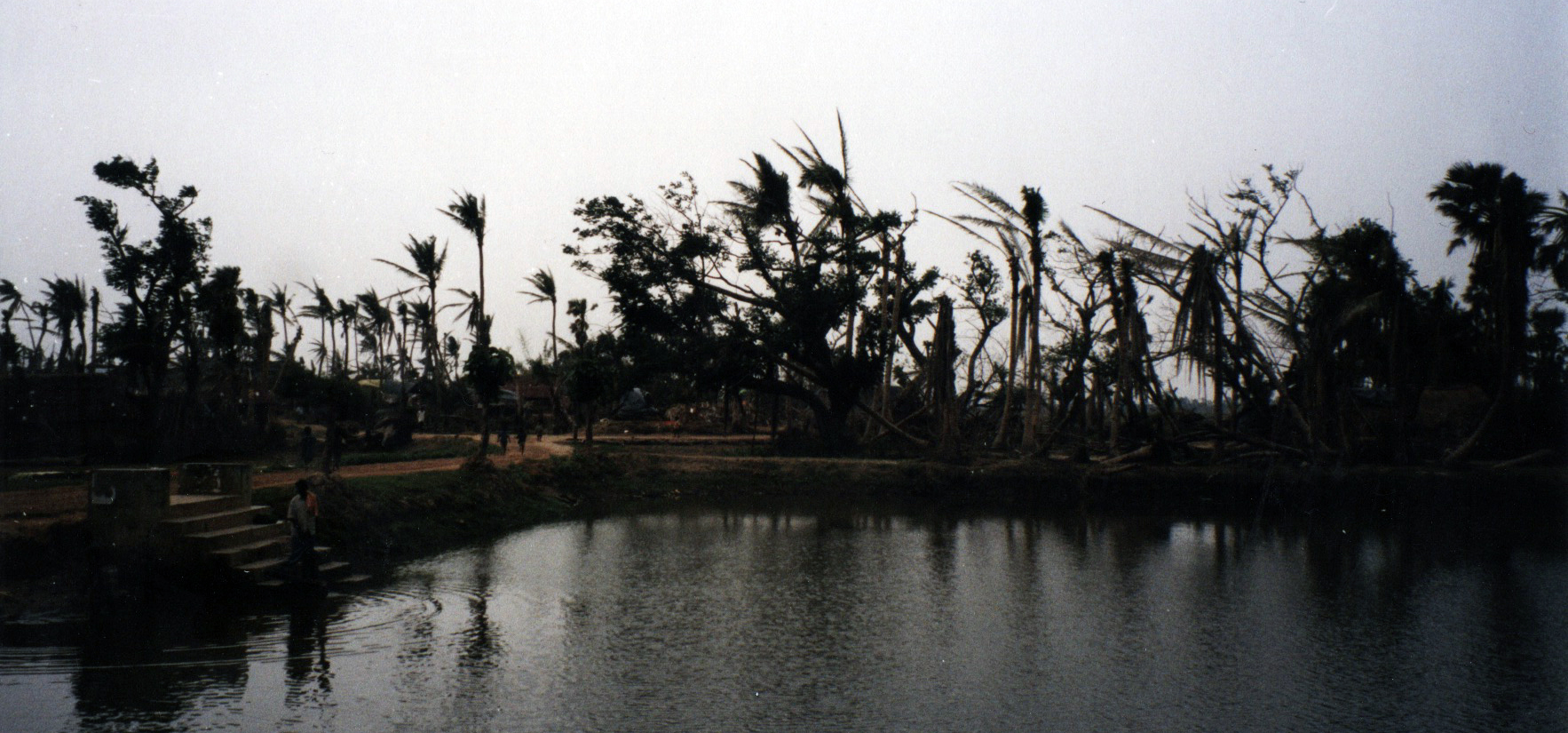
People lost everything they had in Ersama, Orissa in the 1999 “super-cyclone.”
Thinking of the 12 milion Indians who are bearing the brunt of Cyclone Phallin. Here is a piece I wrote for the Atlanta Journal-Constitution in 1999, after the last deadly cyclone in the state of Orissa.
November 25, 1999
Bhubaneshwar, India — I had been to Orissa before, lured by its ancient Hindu temples and pristine beaches.
This time, I was not a tourist.
I was there to witness a tragedy of enormous proportions. A “super cyclone” had visited the state just days before my trip. And it had changed the face of Orissa.
The plane ride from Calcutta to Bhubaneswar, Orissa’s capital, took 50 minutes. Indian Airlines Flight 7544 from Calcutta steadied itself after a steep climb into a clear November sky. We were more than halfway there when the captain announced, “We are flying over Paradwip. It’s to our left.”
On Oct. 29, the cyclone, having churned across the Bay of Bengal, came ashore at Paradwip. Wind and sea had spared little. I had read newspaper accounts about the devastation, and so had everyone else on the plane.
The very mention of Paradwip had nearly all the passengers on the right side of the cabin up from their seats. We craned our necks to peer out the windows and see firsthand what we already knew.
From 15,000 feet, the landscape resembled a blueprint for destruction. A vast sheet of silver-blue iridescence cut into the green mosaic of rice paddies and farmlands. Helicopters skimmed over the flooded land below us. Perhaps they were making air drops of food to cyclone victims.
Suddenly, the plane was filled with comments, sighs and emotions. Curiosity. Uncertainty. Fear.
As the aircraft descended, I saw the massive steel bridge over the Mahanadi River that I had crossed by train only months before on my way to the beach at Gopalpur. Then Orissa had seemed so lush, so serene, so idyllic. Now it was a series of mangled fields and broken trees, bare of bark and branches.
In the chaotic arrival hall at Bhubaneswar’s small airport, people held up placards to connect with arriving relief workers, journalists, government officials and medical teams. Boxes full of bottled drinking water rotated on the luggage carousel. People had come prepared to face the shortages. I wondered whether our six bottles of water would suffice.
Outside, the hoards of white taxis that normally await arriving tourists were in short supply. Instead, a line of four-wheel drive vehicles crowded the curb. Several bore the Red Cross symbol.
It wasn’t a long ride to the Hotel Shishmo, which had recently undergone minor renovation. I remembered it as being shoddier on my last trip to Bhubaneshwar, four years ago. It was the only thing I saw this time that looked better.
Eugene, my colleague and guide, and I wanted to grab a quick lunch before venturing into the city. At the hotel restaurant, we were told that the only thing available was a limited buffet, since many of the kitchen staff had returned to their villages to check on their families. The mediocre meal cost twice what it would have in Calcutta, but there wasn’t another restaurant open for miles.
Bhubaneswar, which was a relatively new but disheveled town before the storm, looked utterly dismal. Its dirty roads were even dirtier. Its nondescript architecture seemed uglier. Many of its tall palms stood no more. A confusion of electric lines dangled overhead as our taxi negotiated pools of mud and slush around the city’s shantytowns.
For the people who live in these slums, life had already been unimaginably difficult. Now it was plain unimaginable.
Still, the urban shantytowns were better off than the thousands of small hamlets and villages that fell prey to the cyclone. Tens of thousands of people died; no one knows exactly how many. Millions more were left with nothing to their names but the wet dirt on which they were standing.
These were India’s poorest, most vulnerable people, and they had been left in their mud huts to ride out one of the fiercest storms in the subcontinent’s history. A man in a nearby hospital had held onto the trunk of a palm tree through 36 hours of rain and wind. He survived but he had no flesh left on either arm.
On the way to Kendrapara the next day, we stopped for breakfast at the Indian equivalent of a truck stop. We were told there would be no more food available beyond that point. We sat in a dark, dingy dining hall — there was no electricity — and filled our stomachs with sand-laden rice cakes and vegetable curry. We planned to never eat there again.
But we did — out of necessity. And 10 exhausting hours later, the same rice cakes and curry seemed gourmet fare.
We thought about the villagers with whom we had spoken, and of how they had mobbed relief trucks for food and were surviving on one scanty meal a day. One man showed us his stash of rice carefully wrapped in a towel. He had gathered the grains from the road when a bag of supplies had burst.
In Paradwip and Ersama, names now synonymous with death, we had watched a young woman wash herself in a pool of water while a few yards away, another young woman’s body, bloated and rotting, floated along the bank. We saw the charred remains of human beings at mass funeral pyres, and we inhaled death. We looked into the eyes of a child who will grow up without his parents — and without hope.
After seeing all that, conversation in our taxi stopped for a long time. I found myself clutching my bottle of water and not wanting to look anymore.
But the images still burned in my mind. I left Orissa two weeks ago; soon I will return home to Atlanta, leaving India far behind. And this time, a very different Orissa will smolder in my memory.




 Love that we celebrate strength in a form of a woman. If only all women in India held such lofty status. Happy Durga Puja, everyone.
  Evil Reporter Chick