Every reporter will tell you that good editors are difficult to come by. Out of those handful, a rare breed is one who is not only a strong wordsmith and advocate but one who shows the kind of sensitivity needed to produce powerful human dramas. Non-fiction that reads like pure poetry.
I had the privilege of working with one such editor and decided I would nominate her for the Mimi, an award named after Mimi Burkhardt, an editor at the Providence Journal who died unexpectedly a few years ago.
Her obit said this:
“Reporters loved to have Mimi as their editor because they knew she would always make their stories better,” said Carol J. Young, deputy executive editor and longtime friend. ‘When she worked with reporters, especially on projects, she became as involved in the topic as they were. She kept in constant touch as they reported, she felt their angst as they wrote, and, when the project was over, she shared their pleasures of seeing it in print.’ One such project produced a story in 2003 when writer Kate Bramson reported the traumatic ordeals of a teenage girl raped by a classmate in Burrillville. The resulting story, “Rape in a Small Town,” won a $10,000 award from the Dart Foundation.”
Bramson helped set up an award named after Mimi. It is given every year to an editor who navigates through stories of trauma with the utmost caring. It is designed for an editor who thinks outside the box and supports his or her reporter all the way through the process, unafraid to stand behind unconventional tactics and to stand up for the work of his or her staff.
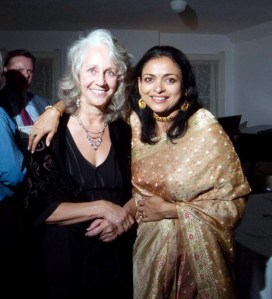
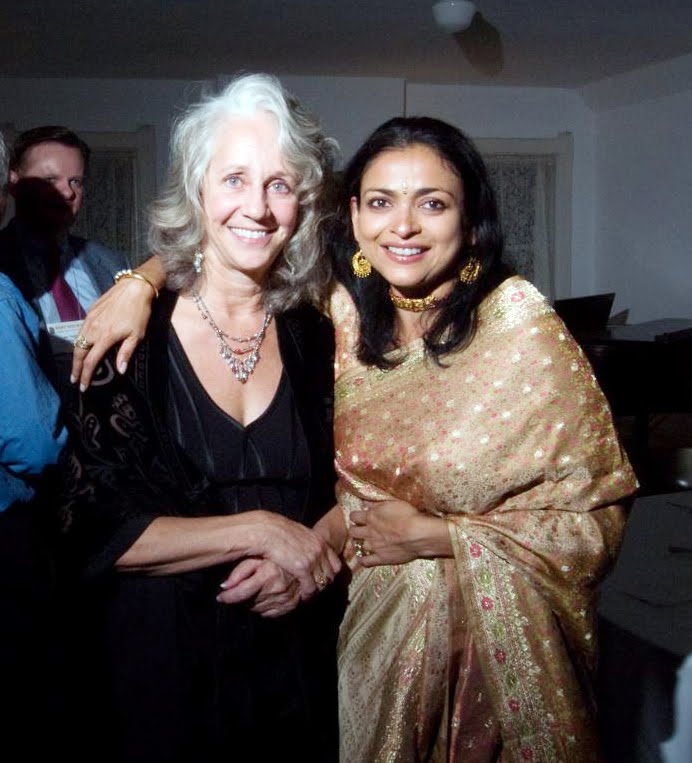
This year, Jan Winburn, my editor at the AJC, won the Mimi. We just returned from the award ceremony in Indianapolis (that’s Jan and me at the Mimi dinner). I am thrilled.
Here, then, is the nominating letter, which my former colleague Michelle Hiskey and two of Jan’s reporters at the Baltimore Sun, Lisa Pollack and Mike Ollove helped write. It will provide a better understanding of what a strong editor ought to be. And it will make us yearn for the days that newspapers regularly embarked on such projects.
Dear Judges:
We nominate Jan Winburn for the 2009 Mimi Award.
The reasons why she deserves this recognition are deep and varied. In all our collective years as working journalists, none of us can recall having worked with another editor with a better understanding of how to navigate the emotional landscape of assignments involving tragedy and trauma.
We honestly believe that no better editor exists.
Jan’s exceptional body of work is testament to the rare dedication and unique skill that she brings to stories of struggle, suffering, recovery and resilience.
What is most amazing is that often, these stories are inspired by ordinary news. You know the kind – the six-inch story buried on page eight of the local section that informs readers of an unexpected death of a child or a fatal accident. Jan has the uncanny ability to read such a story and recognize the value in delving deeper.
Other editors might reflexively reject an idea because of preconceptions. But Jan always perceives possibilities for unexpected opportunities for understanding the human heart.
Last year, I traveled to Iraq for a seventh time to write about a young Army chaplain who was responsible for the welfare of a thousand infantrymen. Jan immediately recognized the potential power of this story when other editors failed to see its merits.
Why spend so much time and effort to tell a story we can get from the wires? The editors questioned whether there was any new ground to be uncovered. They wondered if readers were suffering “Iraq fatigue.”
But Jan immediately saw the power in the chaplain’s tale. Here, in the heart of the Bible belt, the young Army officer provided the paper with a chance to explore the intersection of God and guns on the battlefield.
My reporting told Jan that the chaplain was under tremendous pressure. He had to stay steely strong to administer to soldiers who were both physically and emotionally scarred by war. He
had to deal with everything from death and grisly injuries to homefront issues of failing marriages and domestic violence.
I returned from a frightening trip to Iraq only to find Jan had broken her right arm. Jan invited me to come to her house, where we sat at the breakfast bar with notebooks and ideas until we were able to form the backbone of what she imagined as an eight-part series.
Once a draft had been written, Jan went into battle herself, as she always does for her reporters. She knew that in this day and age of newspaper journalism, an eight-part serial narrative would be a hard-sell.
She told the editors at work: Don’t say ‘no’ without reading what we have. Defeat me on content, not on newspaper philosophy.
Jan worked tirelessly for weeks to ensure that my efforts would not go to waste. She believed in the story and was not willing to compromise on content.
That’s the reputation Jan has built.
Many years ago, she worked with Baltimore Sun reporter Mike Ollove on a story he proposed about a couple, Mitch and Cookie Grace, of Altoona, Pa. Their only child, an athletic, college-educated daughter, was accused with her husband of a senseless, grisly double murder in Ocean City, Md.
Other editors instinctively included the Graces in the understandable revulsion of the crime. Why, they wondered, should we devote any attention to those associated with the alleged killer. But Jan realized that these parents loved their daughter as much as any parents and had devoted themselves to her upbringing in every way. The tragedy of their story was that all that love and commitment on their part did not keep their child from a final series of disastrous choices.
Many readers surprised themselves by sympathizing with Mitch and Cookie.
Once again, the story upended preconceptions and normal expectations. Such stories do not happen without an editor brave enough to journey down difficult roads. Jan has shown that she has the courage, curiosity and strength to do so, again and again.
The rewards for those attributes have been scores of stories that readers consistently find provocative and ultimately enriching.
We learned from Jan about the indelible link between reporting and writing: that successful narratives are not just the stuff of pretty writing (as some editors believe). Instead the power lies in intensive yet delicate reporting that yields intimate anecdotes and details that allow Jan’s reporters to write with authority from another person’s view.
Jan taught us how to approach a potential story subject in the most sensitive and honest way possible; how to get a reluctant source to feel comfortable sharing his or her story; how to pull readers into stories that they don’t even think they care about.
Jan’s talents come across clearly in “The Umpire’s Sons,” a story written by Baltimore Sun reporter Lisa Pollak, which won the 1997 Pulitzer Prize for feature writing.
The previous fall, a ballplayer for the Baltimore Orioles made national headlines for spitting on an umpire as they argued over a call. The ballplayer, commenting on the incident later, opined that the umpire’s skills had diminished after losing his son to a degenerative, often-fatal nerve disease. Almost parenthetically, many of the news stories added one other detail: the ump’s second son was suffering from the same disease.
When Lisa flew out to Ohio to interview the ump and his wife, the expectation was that she would interview them for a few hours, then fly home and write up a short piece. But Jan confirmed what Lisa suspected after her first conversation with the umpire: With more interviews and research, she might be able to tell a narrative that helped readers better understand what it was like for this family to lose one child and then desperately try to save another.
Jan not only had a vision for the story, but she was a
crucial resource as Lisa worked, helping her figure out what material was needed to bring the story to life, how to focus hours of material and how to structure the story to keep readers engaged. When other editors wondered, ‘what was taking so long,’ Jan ran interference, convincing the powers-that-be that time wasn’t going to waste, that they needed to get everything right and make the story as clear and concise as possible.
Jan is known for going the extra mile for her reporters. In fact, editors at her last job at the Atlanta Journal-Constitution chided her for not being “managerial” enough. For always putting her reporters and their work first.
Sometimes, that has meant that Jan has gone beyond her role as editor. She is a dear friend to us all. My own mother died in 2001 and Jan has stepped into the role of a surrogate mom at times when I have needed advice or reassurance. Or simply, a big hug. She called me every day when I was in Iraq if for no other reason than to let me hear a friendly voice in the middle of war.
She has been that kind of essential companion as well for my friend and colleague Michelle Hiskey,
In 2007, Michelle wanted to write a difficult first-person essay about her relationship with her father. He’s a professional golfer, and taught Michelle well enough to earn a college scholarship. The initial story was to be about parents teaching their skills to their children.
Jan took over the story, and knew — because of her friendship with Michelle — that Michelle’s relationship with her father was complicated. Jan always pushes her reporters to open the door we often don’t want to open.
Michelle gulped and said yes. In the midst of great change and stress in our industry, she wanted to grow and improve as a writer but she didn’t think this story was in her. She felt naked. Exposed.
All summer and into fall, she worked on it, then put it down. It seemed too hard, too risky. When she turned in a draft that had the most difficult episodes glossed over, Jan gave it back and said, “Go deeper. I know there’s more there.”
She gave Michelle the security she needed to press on by promising that the story would not run without her father’s prior reading. Michelle knew she could trust Jan. This is not a typical promise made to a source, but this wasn’t the typical story. It had the potential to split her own family, and Jan navigated this delicately. In retrospect, Michelle understands that Jan believed the story could help heal her family.
The unrequited search for Michelle’s father’s approval motivated readers to send their stories of never measuring up. Michelle thought she was alone in her story. But she wasn’t. Jan is able to pull out universal desires and fears in the stories she helps tell. We all have a rock in our lives we don’t want to turn over. Jan helps us do just that and see what’s underneath.
Jan Winburn is a friend, a mother, a tireless advocate. Most of all, she is an editor who pushes relentlessly for the integrity of stories and invests time in shaping the talents of journalists. If the purpose of the Mimi Award is to recognize a journalist committed to telling human-scale stories with the utmost empathy and verisimilitude, you would be hard-pressed to find a more able practitioner.
We heartily nominate Jan with the hope that you will give her the recognition she so richly deserves.




 Evil Reporter Chick