![]() |
| Yulia Tymoshenko in her signature braids. Photo from The Guardian. |
They are the home team, after all. Who knows? Maybe their fans will boost them past powerhouse Spain. Ha!

Random thoughts in war and peace
![]() |
| Yulia Tymoshenko in her signature braids. Photo from The Guardian. |
They are the home team, after all. Who knows? Maybe their fans will boost them past powerhouse Spain. Ha!
I’d seen Ron several days before, at Piedmont Hospital. I hadn’t even fully stepped into his room when he looked up from his bed. “Ah, Moni Basu and Kevin Duffy!” He recognized us instantly and we had a delightful two-hour conversation about things past and present.
At one moment, after Alex showed up and we began talking about India, the talk veered to Varanasi, an ancient, holy city on the banks of the Ganges River. Many Hindus hope to have their last rites performed there; their ashes scattered in the murky waters; their souls dancing free.
“Perhaps we should talk about something else,” Alex finally said.
It was the kind of laugh that echoed through the hallways and was instantly recognizable. It was comforting, like a mother’s embrace. And reassuring — it made me feel that everything would be all right.
Ron edited my stories occasionally when we both worked on the National Desk. I remember how he tightened up my prose, took out unnecessary words. Verbiage was baggage, he told me. It just weighed readers down.
Everyone knows what a master Ron was with words. At Piedmont, I meant to tell him what a mentor he had been to me. But the right moment never seemed to arise that afternoon. Surely, I would have other opportunities.
Two weeks later, when I entered Room 34 at Hospice Atlanta, I knew I would probably not get to say much to him. He was weak and frail. And sleepy from the drugs.
His longtime friend and journalist Ann Woolner was there that afternoon, as was his sister, Angela, and niece Stephanie.
I sifted through the photos. Some were colour and some not. Some were indentified, others not. It didn’t really matter. I saw in them a man who was always true to himself and to those he loved.
Ron’s mother, Bertha, had saved all his early clips from the Summerville newspaper, the Red and Black and the AJC. Angela had painstakingly collected them in a scrapbook. I flipped through the pages and marveled at Ron’s ability to write with wit, with grace and always with clarity and honesty.
Again that day, the conversation turned uncomfortably to death. I suppose that’s what people talk about when the end of a life seems inevitable. So many arrangements to be made, loose ends that need sewing up.
Ron himself had recognized his circumstance and told Alex: “I don’t want all this to get too complicated… I’d prefer to just go out like an old Indian and walk off into the woods.”
Now, as we spoke of Ron and his life, we did so in the third person. Ron lay still on the bed, his eyes closed. Before I left, I held his hand and said goodbye. Ann told him she loved him.
“Dad,” said Alex. “Your visitors are leaving.”
Ron opened his eyes for a moment and nodded his head.
The next morning he died. His close friend Joni was with him.
When I heard the news the next day, a dark cloud descended upon me in the midst of the CNN newsroom. I wanted to run home. Or at least, run to my car so I could cry without notice.
It was as just as we had spoken that day about Varanasi. And it gave me great comfort to think that Ron’s soul will shimmer everywhere, like the eternal waters of the Ganges.
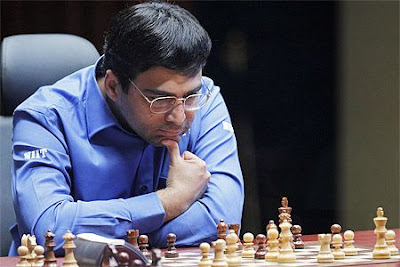
| Check mate: When is the last time a chess player commanded rock-star status? |
This is the information available on the Vietnam Reform Party’s page on blogger Ho Thi Bich Khuong. Few in America have probably heard of her. But this is her third arrest. She has been tortured in detention, according to Human Rights Watch.
She was found guilty of violating article 88 of Vietnam’s penal code, designed to deflect criticism of the Communist government. The state said she “blackened” Vietnam’s name and belonged to human rights groups led by “reactionaries.”
She publishes detailed accounts of the repression and harassment she and her family have faced, and writes about the suffering of poor rural farmers and of human rights defenders, said a statement from Human Rights Watch.
In November 2010, she visited the families of people killed by police in a land rights protest and questioned the authorities’ silence on the case. After that, she wrote about violence against Mennonites at Christmas. Three weeks later, she was arrested, said Human Rights Watch.
“Vietnam should be grateful that people like Ho Thi Bich Khuong call attention to local abuses,” said Phil Robertson, deputy Asia director of the global rights monitor.
“They give the government an opportunity to investigate and show commitment to the rule of law,” he said. “When the government instead clamps down on the media and locks up independent bloggers, it simply encourages further corruption and abuse of power.”
Human Rights Watch honored Ho Thi Bich Khuong with a Hellman/Hammett award in 2011. The group said it wanted to give an international platform to those who Vietnam will not allow to be heard.
Vietnam launched a crackdown on freedom of expression in 2009. Since then, dozens of political and human rights activists have been handed long jail terms, rights groups say. Vietnam now ranks 172 out of 179 countries on the Reporters Without Borders press freedom index.
It’s a disturbing trend we don’t hear much about in the Western media. We ought to, especially when we are so focused on the Arab Spring and the great risks people take to get information out to the rest of the world from places like Syria, Yemen and Bahrain.
A Vietnamese court will hear Ho Thi Bich Khuong’s appeal tomorrow. It’s unlikely she will be released. She may be silenced for now, but her voice, I am sure, will resonate for as long as there is injustice in her homeland.
![]() |
| Bobbie and Wallace Edwards |
![]() |
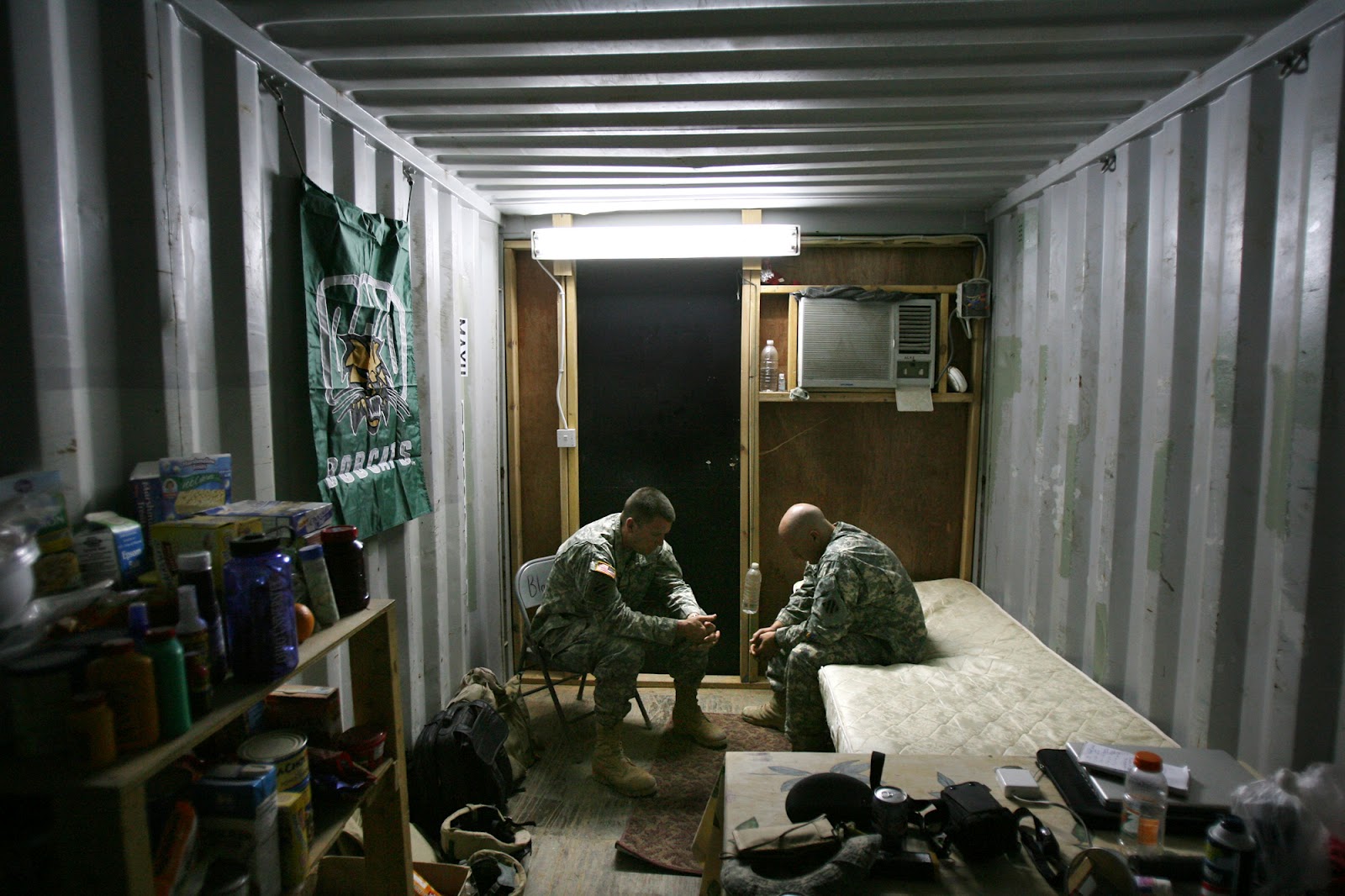
| Chaplain Darren Turner counsels a soldier at a combat outpost in Arab Jabour, March, 2008. Photo by Curtis Compton/AJC |
![]() |
|
Darren and Heather Turner in Clarkesville, Kentucky,
Feb. 2012. Turner tried to help his soldiers save their marriages
but ran into trouble in his own.
|
![]() |
| Jonathan Frid as Barnabas Collins in the 1960s “Dark Shadows.” |
In the late 1960s, we lived for a while in a rented house on Adams Circle in Albuquerque, New Mexico. Every afternoon, I walked home from Whittier Elementary and plopped myself down on the living room couch, waiting anxiously for Baba to return home from university.
My father was a brilliant man, a mathematical thinker who has a statistical theorem named after him. But, like all of us, he had his guilty pleasures. One of them was “Dark Shadows,” the vampire soap opera starring Canadian actor Jonathan Frid as Barnabas Collins.
Baba sat on the couch with me and the two of us were mesmerized by the gothic, black and white images flashing before us on our Zenith television screen. Intrigue. Love. Lust. Death and, of course, life after death.
That was the part that I could not stand. Every time Barnabas got ready to sink his fangs into a young maiden’s juicy neck, I’d slither off the couch, get behind it for protection and watch sporadically. Or I’d announce to Baba that I had to go to the bathroom right then.
One time I was so frightened that Baba held me on his lap. “These scenes are not real,” he said. “They’re just make-believe on TV.”
But he’d go right on watching, transfixed on Barnabas’s ghostly white skin and the crimson streaming out of his mouth.
Jonathan Frid died in Hamilton, Ontario, last week. He was 87, a year younger than my father, who died in 2001.
He didn’t live to see his character resurrected in director Tim Burton’s remake of the classic vampire story. This time, Barnabas will appear to us in the handsome form of Johnny Depp.
I wish Baba were still here. I’d take him to the theater to see “Dark Shadows.” And when the lights went dim and no one could see, I’d hold his hand tight and wait for Barnabas to bite.
![]() |
| Tree-lined Miccosukee Road |
![]() |
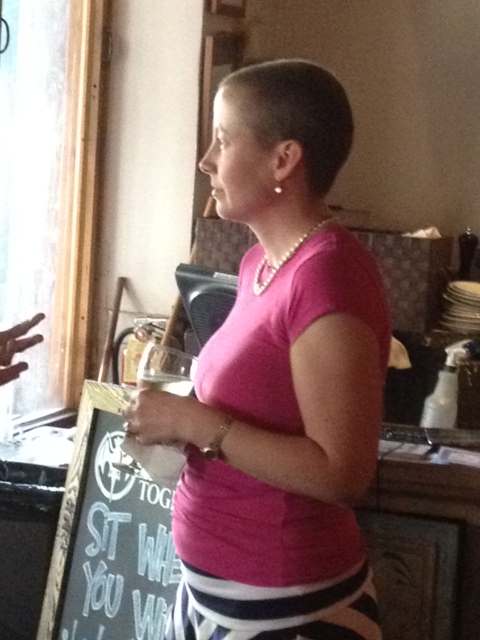
| Wendy at Cafe 640 |
Last September, my friend Wendy was diagnosed with invasive ductal carcinoma. Breast cancer.
Her mammogram nine months earlier was clear.
“That’s how fast it can happen,” she wrote on her blog, “which is why I’ve already been pretty open and honest about my story.”
I saw Wendy Thursday at a gathering to celebrate her last day of radiation. She announced that her doctor had declared her “cancer free.”
She looked beautiful as always when I saw her. A big smile on her face, her positive energy filling the entire cafe.
If only everyone dealing with illness could see her, I thought. How inspired they would all be.
![]() |
| Photographer Curtis Compton and me in the back of an MRAP. Arab Jabour, Iraq. 2008 |