Istanbul

My journey began with work — a seminar for journalists who cover international security and terrorism issues. I was one of the lucky ones chosen to attend the event in Istanbul. If you’ve never been to that city, go! It’s ancient and new, beautiful and plain, Muslim and not, East and West.

Istanbul’s striking landscape and architecture reflecting myriad empires is why most people visit, of course. Tourists yearn for a cruise along the Bosphorus and a visit to the old city, home to the Hagia Sophia and the Blue Mosque.

I did all that, amazed by the wonders of history and geography. But it was all the new people I met that made my visit memorable. So many courageous and brilliant journalists and scholars determined to bring truth to the world. About the carnage in Syria, the revolutions of the Arab world, the militancy of Pakistan.

I appreciated their breadth of knowledge. I learned in their company and also laughed. We had a good time during our many meals together. I especially liked the food at Antiocha, a tiny restaurant near the Pera Palace Hotel. The staff was not prepared for 16 of us descending on them at once but waiter Nureth Kesig accommodated us as though we were royalty. Nearby, at Asmali Cavit, we were shown the fresh catch of the day: bonito from the Black Sea and blue fish from the Bosphorus.

I saved Saturday to visit my cousin’s daughter, Soma, her husband, Bishan and cutie pie daughter Aditi (check out pictures on my Facebook page).  They were kind enough to take me by ferry to the Asian side of Istanbul, which I probably would not have seen otherwise. It was much less touristy there. Soma and Bishan took me for lunch to Ciya, their favorite. The restaurant’s brochure boasts of a menu from “the kitchen memories of forgotten dishes, lost tastes and wiped-off cultures.” We had lamb kebaps, a variety of mezze and pilav. Delicious.

Thanks again, Shoma and Bishan for a lovely afternoon.

One especially poignant moment for me: My CNN colleague and friend Joe Duran took me to visit the house he inherited from Margaret Moth, the fearless camerawoman who blazed a trail for women in television journalism. She was shot in the face during the Bosnian war and, yet, did not let her injury deter her from returning to war zones.

Her house, a bit outside Istanbul, is like a museum of all her possessions — antique furniture, floor to wall shelves filled with books and closets full of Victorian dress collections. Joe and Margaret were the closes of friends and after she died, he began living in that house a few days a week. The rest of the time, he lives in an apartment much closer to the CNN bureau in bustling Taksim Square.

I felt Margaret’s spirit in the house. It was as unique as she was. Beautiful and dark in some places.

So much to reflect on from my trip to Istanbul. A woman I admire, family I love, a bevy of new friends and new knowledge about the world.

The BIG 50

Suddenly, I noticed every wrinkle on my face.

I am turning 50 this week.

Whoa. Seriously? The big 50? Seems like yesterday that I was bragging about not being 40 yet.

Not that I am freaking out.

My 20s were maniacal. My 30s, wondrous in discovery. My 40s were terrific — sorry to be leaving them. But I am truly looking forward to the 50s. My friends who have all turned officially old before me tell me that this is the best decade yet.

OK, yes, I am freaking out.

It’s not that I feel old. But there are just way too many reminders now of how life is passing me by.

Yes, there are the wrinkles on my face that suddenly — after I was reminded I had only a few more days left in the 40s — turned wretchedly prominent in the bathroom mirror.

And every strand of gray hair stood up straight, begging for a good dose of dark, brown hue. Praise be to my stylist Jaime Booth, who for years, has been trusted upon to ensure that my hair, at least, won’t give me away. (I’ve already made my pre-birthday appointment).

Barbie turned 50 three years before me. How come she still looks good?

Then there are the back aches and knee pains and other physical ailments that just don’t bother younger people.

Time races by with me wanting to make the most of every minute because suddenly, I have contemplated my own mortality — way too much.

The worst, though, are the reminders from others. Those are the ones that hurt.

Like soldiers I interviewed who said I was attractive enough but old enough to be their mother. Ouch.

Many of my colleagues can say that, too, in the CNN Digital newsroom, where most are young and energetic and full of ideas that involve smart phones and social media. What would they think if they knew my first news story was banged out on a 1930s Remington typewriter? Have they even heard of rubber cement and hot type?

They complain when technology fails them and they are not connected every single second. I think of how I grew up in India without television, without phone service at times.

I remember how to write a letter and post it and wait eight months for a response to return from the other side of the Atlantic.

To them, everything about me is as antiquated my parents were to me. To them, anti-apartheid protests, big hair and then-grounbreaking “The Cosby Show” as old and distant as the 1940s were to me.

I also have a yin and yang relationship with the AARP card I got when my husband turned 50 seven years ago. I whip it out at hotels, car rental places and the movies. The discounts are grand but how come no one says: “Wow. You don’t look old enough to carry an AARP card!”

They used to say that. I swear.

A few weeks ago, I renewed my Georgia driver’s license. Thank you to the lady behind the counter who found it hard to believe I was born in 1962. I am forever indebted to your kindness. Or maybe, it was just blindness.

I also detest moments when I inadvertently date myself.

I remember the day Martin Luther King was killed. And lesser events like when Skylab fell. I couldn’t tell if a co-worker knew what I was talking about. She just gave me a vacant stare.

Or how about when I sat on rickety wooden bleachers at the Florida State Universitybasketball gym and saw Prince perform with Vanity 6? He was nothing then. Nothing.

That’s how old I am.

I’ve heard folks say: 50 is the new 40. I don’t think so.

50 is, well, still 50. For me, it’s the true start of middle age. And the bridge to old age.

But I am better armed for this new era of my life than I was for any other. I am an improved judge of people. I’ve learned when to trust and when to walk away. I also have the comfort of walking through life with a boatload of experience. Sure wouldn’t want to be that green and naive at navigation again.

I have a lot to look back on. But I still have a lot coming my way. And I am excited.

So call me old if you like.

I say: Happy 50th Birthday to me. Bring it on!

Obama’s big night

I was thinking about the words of Joe Senato, who eight years ago at this time was an undecided voter from Berkley, Massachusetts.
After hearing the keynote speech delivered by a guy who was the odds-on favorite to win a U.S. Senate seat from Illinois, Senato was impressed.
“He is a prolific speaker,” Senato said. “But more importantly, he wasn’t like Jesse Jackson or Al Sharpton. He wasn’t divisive. If he doesn’t get a place in a Kerry administration, well, he should.”
Well, there was no Kerry administration, of course.
But Barack Obama did reach the hallowed halls of the Capitol. And then, just four short years later, he was sitting in the Oval office.
Obama has a tough job tonight when he delivers a speech that I think is far more important than the one I heard at the 2004 Democratic National Convention in Boston. The one that caught the attention of Senato and an entire nation. The one that launched Obama Fever.
This year, so much more is riding on Obama. He’s up for a second term in an election that promises to be close.
One criticism — among many — of Obama is that he has been a president who divided the nation and drove home differences between Americans in terms of class, race, ethnicity. I heard that from a commentator talking about that during the convention this week and it made me think of what Senato had said.
Obama’s message eight years ago was this:
”There’s not a black America and a white Americaand a Latino America and Asian America, there’s the United States of America.”
His fellow Democrats saw a future president.
What will he say tonight that will win back those who lost faith in him?
We’ll have to wait and see.
But Obama’s got another problem after last night. He’s got to top Bill Clinton.
Now, that’s a tall order.

Firenze

The Duomo — the main cathedral in Florence — seemed to glow at night.

Florence was warm in July. Very warm. But it didn’t matter. It was a relief to escape the tourist frenzy of Venice and arrive in this Tuscan city of amazing architecture and food. Today’s post marvels at the architecture.

Atop Duomo with all of Florence below us.

My brothers-in-law Jimmy and Peter and I climbed to the top of the Duomo, the main cathedral in central Florence.

There was no warning when we bought our entrance ticket as to how steep a climb it would be the top of the cuppola.

Everest, I thought at the time, might be easier. Ha. But it certainly was not a journey for the faint of heart.

More than 400 narrow winding steps later, we walked out into the fresh air, all of Florence below us. http://www.operaduomo.firenze.it/monumenti/mappa/duomo.asp

It was truly magnificent under a cloudless sky, the Tuscan hills beyond us.

Ponte Vecchio.

It was equally interesting to cross the Ponte Vecchio, the medieval stone arch bridge over the narrowest part of the Arno River.

A central Florence market.

Once the shops on the bridge were all occupied by butchers. These days, it’s a dazzling array of gold and jewelry shops, art dealers and stalls hawking souvenirs for tourists.

We strolled the Piazza della Signoria, the main plaza in Florence, teeming with larger-than-life statues including Michaelangelo’s David — the original is in the Galleria dell’Academia. http://www.florence-museum.com/?gclid=CPTJ8ePnhbICFQWCQgodtQsA5g

Every street and plaza in Florence offered visitors something to gaze at, something to wonder about. We stopped and peered into shops that sold incredible Florentine leather nd handcrafted paper.

And coming up in my next post: the food. Heaven to be in Tuscany, I think. Incredibly fresh food and bottles of Chianti.

Why did i return to Atlanta?

The main plaza.

A new world

On a gondola with Lynn (far left), Jim and Jean.

Lynn and Jean had never been to Europe before this summer. Britain, France, Italy. A whole new world opened to them, vastly different from East Aurora, a suburb of Buffalo.

Lynn at Piazza San Marco.

From food to dress to language, everything was unfamiliar. The girls took it all in stride.

I caught up with them and their father (my husband’s brother, Jim) in Venice. 

At first, Venice doesn’t seem the most kid-friendly place. But Lynn and Jean were enamored with the world of gelatos, pizzas and yes, cappuccinos (yes, the girls love their coffee, especially with lots of sugar).

Animals at a mask shop.


We took two gondola rides but it was more fascinating to walk the back streets of Venice — winding alleys and lanes connected by small bridges over the canals. We wondered about the lives of people who lived there — it was such a different way of life.

There are no cars, of course, in Venice. Only boats. The fisherman bring in their fresh catch from the sea. People get around by water taxi and private boats. The garbage man hauls trash by hand-pulled cart and takes it to a barge that transports it out. You probably don’t ever want to fall into the water here. Who knows what’s in it. 

The beauty of Venice charmed the girls. They were thrilled to sit at canalside trattorias and bars and return to America with memories of a lifetime.

A Venice mailbox.
The charms of outdoor trattorias.
Discovering Venice with nieces.


Magnificent and unexpected

Piazza San Marco.

I continue in this post my journey through Italy. Too quick, too hurried, but fascinating all the same.

(I dream of the day when I am not beholden to an employer any more and I can travel at will.)

The train ferried me from Verona back to Venice on a warm Sunday afternoon. I was curious to see, at last, the city of palaces built on a mosquito-infested swamp. What were they thinking?

Along the Grand Canal.
The train rolled into the Santa Lucia station and when I stepped out, I finally saw what Venice’s founders envisioned. What they built is truly magnificent, no other city in the world can compare. In fact, the entire city is listed as a UNESCO World Heritage site.

Next, I boarded a water taxi at Ferrovia and 14 stops later along the Grand Canal, I’d reached my destination: San Marco. My hotel was a step away and just around the corner from the main plaza in Venice.

I was meeting two of Kevin’s brother’s here. Yes, I know. A strange thing to go on vacation with your husband’s brothers. But their trip was planned and how easy was it just to tag along? Kevin did not have enough vacation time to make it work.
More about the family in my next post.
Chatting with John and Sue Maso at dinner.

The first night, my brother-in-law Peter and I found a cute trattoria not far from the hotel. We were tired and hungry and filled up on spaghetti with seafood.

Next to us was a couple from Perth, Australia. She’d asked us if our food was good before ordering.
“Delicious,” I said. “Where are you from?”
“Perth.”
“Oh, really?” I said. I lived there for a bit way back in the seventies.”
John and Sue Maso, it turns out, were on a multi-nation adventure. Their days in Italywere to be extra special. John’s parents were from Vittoria Veneto. But the family moved to Australiaafter World War II.
Johns’s father returned four times from Australia. On each of his first three visits, the pope died. It was an omen. The fourth time, he died. That was in 1991.
Veneto was on John’s bucket list. He had to go back to see it, meet family, he explained.
Bangladeshi Shipu Mollah served us our dinner.

I could see he was excited and nervous all at once. He savored his steak as did Sue her spaghetti and seafood.

We laughed and talked some more about Italy. They had enjoyed their day trip to the island of Murano, where glass blowing is an art honed to perfection.
Then it was time to pay the bill. Our waiter Shipu Mollah was young, handsome and I could tell from his speech, very Bengali.

He’d come to Venice from Bangladesh, looking for work.

What I did not know at that moment was that in the three days I was to spend in Venice, I would speak more Bengali than I have in six months in Atlanta.

All the men who sold gimmicks and toys and souvenirs to the tourists were Bangladeshi, as were many of the waiters and shopkeepers. Syad Shamim Ali told me he arrived only a year ago in March — from Libya.
Of course, I thought. I remembered when I had written about Bangladeshi laborers clamoring to get out once Moammar Gadhafi’s rule seemed uncertain.
They’d been transported to the borders at Tunisia and Egypt. Many spent days and nights in the open before they were able to board a ship to take them away.
Life was different in Venice, they told me. Of course it would be after war in Libya and the abject poverty of home. But they did not speak of cathedrals, palaces or aquamarine lagoons.
All they saw were the thousands and thousands of tourists. They were lifeblood.
The Bangladeshis missed their families, their homes — some had not returned in years. But it was possible to make a few dollars. There were a few possibilities here.
Their words would hang over me during my time in Venice.
In between the pricey gondola rides and bottles of Valpolicella, I thought of them, trying to just make it. Life in Venice was certainly no vacation. Not for them.
The basilica and tower at San Marco.


Goldless again


Used to be the Olympics mirrored the Cold War – a head-to-head battle for medals between the United States and The Soviet Union.
 
Now, it’s between the USA and China. In London, American might won out with 104 medals versus China’s 84.
 
I suppose the Olympic medal counts give you a good idea of which nations are world powers. The United States, China, Russia, Great Britain, Germany, Japan, Australia, France…Brazil is up there in the top 20. But, um, where is my homeland?

Keep looking down the list. Keep going. Down, down, down. There, just below Croatia is India with six medals – none gold.

Saina Nehwal


So why is the world’s largest democracy and the second most populous nation unable to win? Can India not do better than six medals with its 1.2 billion people?

Please don’t think that Indians don’t make good athletes. They have shown they can win big in sports like cricket and hockey.

Perhaps the dearth of medals can be explained by a lack of state-run athletics programs in the vein of China’s or those of the former USSR. Half of India’s population still lives in abject poverty. They cannot afford to send children to expensive training camps on their own.


But what about India’s new middle class who now have disposable income or those who have accumulated enormous wealth in the last two decades?  
 
Here’s where I think the culture comes in. Indian parents are way too preoccupied with education. Every parent’s dream is to see his or her child come first in class and get into one of the best colleges in the land.
 
There is no time for sports. Not serious sports, anyway.
 
And even if there were, it’s too much of a gamble.
 
What if little Rita spent her entire life perfecting the art of balancing on a 4-inch beam and then fell under the Olympic spotlight? What would she be left with?
 
American kids still have a life, they still are able to go to college. But for Rita, the opportunities do not exist unless she is a star student. There’s just way too much competition for slots in schools – too many people, not enough facilities.
 
Abhijit Kunte, a chess grandmaster who runs a nonprofit to help groom athletes, told the New York Times that it should fall to Indian schools to inspire and train boys and girls. He suggested Indian schools follow the U.S. model.
 
But the Times reported that the Indian government did not spend a single rupee in the last two years on the promotion of sports in schools and colleges.
 
Sad, because champion athletes are admired in India. The best in their fields climb to superhero status — starting with the giants of cricket like Sachin Tendulkar down to Saina Nehwal, who won a bronze in badminton in London.

But I suspect many parents think like mine did. They prefer that their children graduate suma cum laude from college than come first in the 200-meter freestyle.

Well, perhaps at least until they are on the stand with gold around their neck. 

Here’s to Rio.


Shonakaka

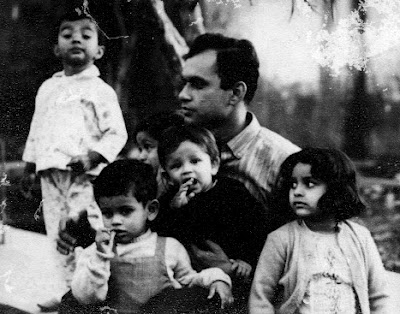
Shonakaka with me,  (from right), my cousin Jayanta, my brother, Shantanu,
my cousins Sudip and Suman at our grandfather’s house  in Kolkata. Circa, 1968.
The last time I saw Shonakaka, I knew he was ill.
Gone was the mirth; his enormous zest for life reduced to a meager smile. At a family gathering in New Delhi last December, he could hardly eat a thing.
Shonakaka was suffering from renal failure and had to be most careful about what he put in his belly, especially foods high in phosphorous. His son — and my cousin — Ronny was not pleased his father had put a heaping spoon of daal on his plate.
If you knew Shonakaka at another time in his life, you would hardly believe my words.
He was always the boisterous one; the one who loved to eat, drink and make merry. “Live life king size,” he always said. At my cousin Suman’s wedding in California, Shonakaka danced atop Suman’s brand new Acura Integra.  We laughed, amazed at Shonakaka’s energy, though, perhaps, Suman was a tad worried about dents and scratches on his shiny car.
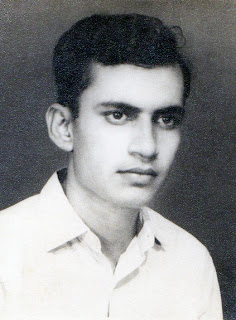
Shonakaka as a young man.
Unfair then that at a fairly young age, Shonakaka was forced to adopt a curtailed regimen and give up things that he loved. Cruel even.
He was my father’s youngest sibling. Kaka means father’s younger brother in Bengali. And Shona means gold or someone very precious. It used to be the norm to have a naming convention so as to avoid calling elders by their first names. That was considered disrespectful.
Shonakaka was born Ranjan Kumar Basu on July 8, 1942 in Lucknow, the capital of Uttar Pradesh. He was 18 years younger than my father and grew up as the baby in a family of five boys and three girls.
Now, within the span of a few months, that generation of my father’s family is down to just a brother and sister still living. Everyone else, including my father, is gone.
Many of my friends in America may not understand the pull of an uncle or aunt.
I was raised in an extended family system in which my grandfather’s house was occupied at various times by various members of the family. That meant Shonakaka often stayed in one of the many bedrooms in the house.
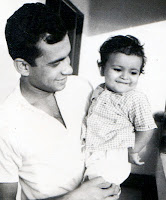
Shonakaka holding me. I was about a year old.
When I was a baby, he made me cry and took a photograph of me wailing. Just to be contrary, he said. Why should I be happy in every shot?
From his travels abroad, he brought us back chocolates and other goodies that were non-existent in India in the 1960s and early ‘70s. He regaled us with stories of his travels – each adventure made grander with Shonakaka’s unique infusion of enthusiasm and zeal.
Once, he started growing chickens on the roof. My brother and I raced up the stairwell every morning to see how many eggs we could retrieve. And in the backyard, he built a tank to farm tilapia so we’d have the freshest fish.
Shonakaka (center) at a dinner at my parents’ house
in Kolkata in the late 1990s.
It was understood that Shonakaka would fix the menu for family weddings and other festive events. I’ll always have images in my head of my two youngest uncles breaking into a pot of syrupy sweets before they even made it into the kitchen.
After he married my aunt, they lived for a while on the ground floor of the family house. It was there that my cousin Bideesha — Ronny’s elder sister — was born. I often babysat her with my brother and our housekeeper, Shantidi, when Shonakaka and Kakima went out with friends.
Shonakaka was not far from home when he was attacked on the streets with acid and lived the rest of his life with scars. But he always rose above his woes. He never let anything interfere with living life to its fullest.
Until recently, when his health began to fail him.
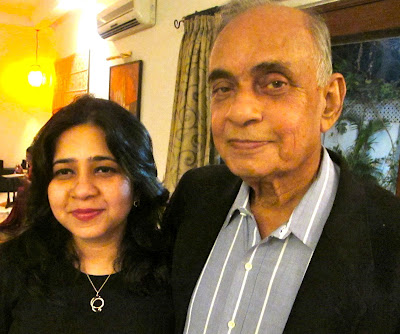
Shonakaka with his daughter, Bideesha, in Delhi last
December. That was the last time I saw him.
I’d not seen him in a couple of years when we met last December. He was not even 70 yet but looked frail. He’d lost weight and suddenly, he appeared to me just like my grandfather. At the time, my aunt in California was in her last days of battle with cancer. It was then that I realized how those I loved in India were going away, how I was losing the links that kept drawing me back all these years.
The finality of death brings with it a host of regrets. I always hear people say, I wish I had done this and I wish I had done that. Yes, I have my regrets regarding Shonakaka. I wish I had visited more in recent years. I wish we had talked more on the phone. But I am glad for what I had with him. Glad that I made the trip to Delhi to see him in what turned out to be the very last time.
And that he was still smiling then.

Romeo, Romeo, wherefore art thou? At the arena in Verona, of course

The Arena in Verona’s Piazza Bra
I’d been up for many, many hours – too many to count, I think, after a day of work at CNN, a trans-Atlantic flight and a train ride from Venice.
But when I finally stepped foot in Verona and realized I could watch Romeo and Juliet performed at the Arena di Verona, perhaps the most famous outdoor opera venue, I felt a second wind. http://www.arena.it/en-US/HOMEen.html
Dinner with Mary Foster Batten

Before heading out, I had dinner with Mary Foster Batten, a fellow visitor from Ireland whom I’d met at the lobby of the Hotel Novo Rossi. 

We shared pizza with prosciutto and funghi and glasses of fine Valpolicella. And fine conversation. And then I was off to the Arena.
I took my seat, high above the stage, under fragments of columns that have stood since AD 30. It’s a remnant of Roman glory, like the Coliseum in Rome. Except the Verona Arena is still vibrant, still a place where thousands go to watch.
I took my seat high above the stage in a Roman
arena that was 2,000 years old.

No more gladiators and fights to the death. But mellifluous music.

As in the voice of Polish soprano Aleksandra Kurzak in the role of Juliet and American tenor John Osborn as Romeo.  And so it began. Lucky for me that I knew so many lines of Shakespeare’s tragedy. “Oh Romeo, Romeo! Wherefore art thou Romeo? Deny thy father and refuse thy name; Or, if thou wilt not, be but sworn my love. And I’ll no longer be a Capulet.
A bust of Shakespeare
in central Verona

There were no translations offered at the Verona Arena, no sub-titling. I might have been lost had it not been for a story so familiar. A couple in front of me bought a libretto. But as the sun faded, darkness befell our seats, the only lights reflecting off the stage and from the stars above.

Juliet’s statue
at the real house of
Capulet
I was told that the opera’s start depends on the sun’s timetable. On this magnificent July evening, the first notes sounded at 9:15 p.m. It ended at near 1 a.m., by which time I was awake purely on the fumes of excitement.
The next morning, after a breakfast of prosciutto e meloni, I ventured out into Verona, eager to see the house of the real-life Capulets and the famous verandah where Romeo and Juliette’s love for one another was sealed.
At an old castle overlooking the river in Verona
It is, of course, somewhat of a tourist trap. But I looked at Juliet’s statue and gazed upward at the walls of the massive house and began to understand why Shakespeare was inspired to write his tale.
 
Next stop: Venice


Some like it hot

Hot. Hotter. And hottest.


First it was 103. Then 106. Today, 104.


Wednesday’s forecast of a high of 93 looks absolutely delightful.


The extreme heat gripping Atlanta and other cities across the Midwestern and Eastern United States has been deemed dangerous, especially for people without air-conditioning.
I heard a woman on the radio this morning who said the temperature in her house had risen to 95.


Made me think of my parents flat in India. On an early May day, before the monsoons had arrived, the temperature read 101 in my room. It was nothing unusual in Kolkata, where temperatures can climb to above 40 degrees celsius (in the 100s in fahrenheit) quite regularly. At least in my room, there was a ceiling fan whirring so fast that I’d get dizzy watching the blades.


I suppose we all get used to things. My niece, a born and bred Canadian, could walk through snow in sandals and think nothing of it. Some of my friends in Kolkata cannot even imagine what it feels like to have frozen stuff fall from the sky. Or how people up North make fun of us Southerners for not knowing how to navigate icy roads. And how we in turn feel no pity for them in summer sizzle.


I am usually thankful to live in Atlanta, where extreme weather is a rarity. But this weekend, I am staying inside. Glad to be reading the Sunday New York Times, watching the Euro finals and cooking dinner — all in the comfort of air-conditioning.


Guess that Indian tolerance to heat has finally worn off.