On this day, remember

The last day of a 12-month deployment in Iraq for the 1st Battalion, 121st Infantry Regiment of the Georgia Army National Guard's 48th Infantry Brigade. The long journey home started with an incredible thunderstorm over Baghdad.
The last day of a 12-month deployment in Iraq for the 1st Battalion, 121st Infantry Regiment of the Georgia Army National Guard’s 48th Infantry Brigade. The long journey home started with an incredible thunderstorm over Baghdad.

Even at the height of Iraq and Afghanistan, the wars were but a rude blip in the minds of a majority of Americans. Our military is made up of those who volunteer their services. Most Americans are disconnected from the men and women who serve in uniform.

A smaller share of Americans serve in the Armed Forces now than at any other time in our history except for the period between the two world wars. Unless you have a loved one of friend in the military, unless you live by a military base, you probably don’t think much about the sacrifices of service members. Aside from the magnetic yellow ribbons that adorn cars, there’s not even many visible reminders that America has been at war for a dozen long years.

How many families are separated? How many children are growing up without daddies and mommies? How many lives are broken by wounds that cannot heal? How many lives, lost?

In 2010, on the 10th anniversary of the Afghanistan war, I traveled to Watertown, New York, to write a CNN story about a place I knew was constantly reminded. Fort Drum, home of the 10th Mountain Division, sits on the edge of Watertown. The division’s soldiers led the charge into Afghanistan and its many brigades and battalions have done multiple tours of both Afghanistan and Iraq.

Watertown is also my husband’s hometown of sorts. He was born in nearby Carthage but as a boy, he lived in Watertown for nine years. I had been visiting the area for a number of years and knew very well that war’s toll was greater here than where I live in Atlanta.

Up there, in the North Country as the locals call it, war makes unwanted, life-arresting visits; crashes into homes and entire neighborhoods just as assuredly as a January blizzard. If you like, you can read my CNN story.

In Watertown and in military homes across America, war is a constant. Let us make it a constant in our homes  just for one day.

On Memorial Day.

Catching up with Baby Noor

noorschool
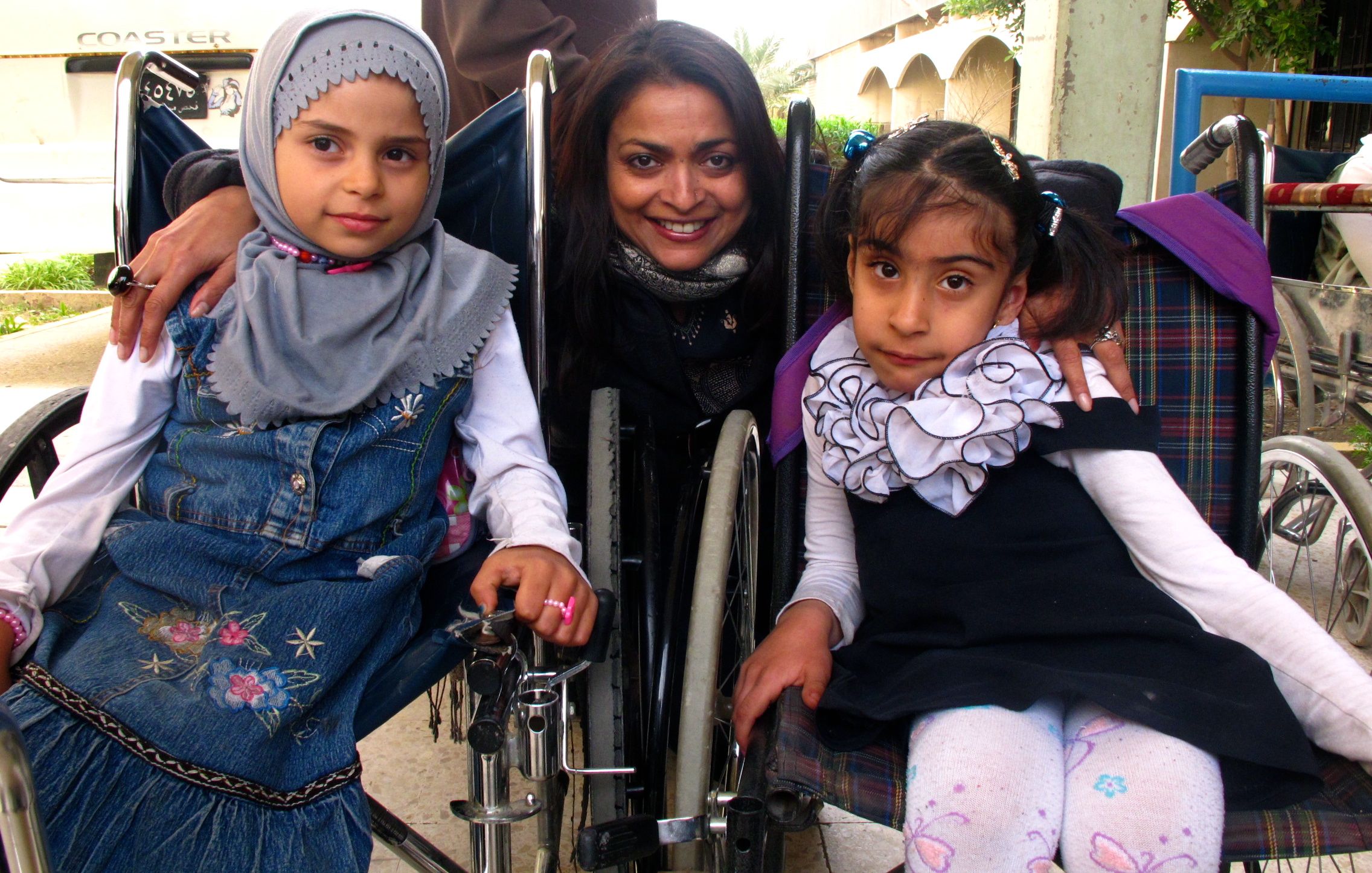
I went to school with Noor (right) during my visit to Baghdad and had this photo taken with her and Hajar, her best friend, who lost the use of her legs in a mortar attack.

My friend Joe Duran just called me after many months. I’d last seen him in November in Istanbul. Now, he was calling from his native Mexico, where he’d gone on vacation and also to sort through boxes of old things he stored at his house there.

“Moni, guess what I found?” he said.

I have no idea what’s about to come next.

“You know when you asked me about the tapes of Baby Noor? The raw tapes are all here in a box,” he said, coughing from the dust he’d whipped up.

I’d called Joe back in January asking if he had access to the footage he shot of Noor, the infant with spina bifida who American soldiers helped save by shuttling her out of her home in Abu Ghraib and sending her to Atlanta for surgery. Without the operations, she would surely have died.

I was an Atlanta Journal-Constitution reporter embedded with the Georgia Army National Guard unit that came upon Noor during a routine raid. I wrote about her for the newspaper and several days later, Joe arrived with camera in hand to file a story for CNN.

Our friendship was sealed in the throes of war. When I reconnected with Noor’s family in Iraq earlier this year, I called Joe about the footage. Turns out most of it was in the CNN system and I didn’t need his tapes. But it was good to talk to him about the stories we did back then.

“I can’t believe it’s been seven years,” he said.

I can’t either.

Except that I saw Noor again a few weeks ago.

I was not prepared to see a little girl who could speak and read and write. A girl who fancied pretty dresses and demanded her hair be embellished with colorful clips. She had grown so much.

I returned to Iraq to find her and tell the story of how she was faring all these years later, long after everyone in America who had been involved had lost touch with her.

It was strange that Joe called me out of the blue on the day before the story published on CNN.com.

Here is the link to the story:

http://www.cnn.com/interactive/2013/03/world/baby-noor/index.html?hpt=hp_c1

Iraq. Now and then

I stand inside the Al Warda supermarket in Baghdad’s Kerrada neighborhood staring at boxes of dates, but my mind races back to another time.

I used to shop here in 2003, when I shared a room at the nearby Al Hamra Hotel with photographer Bita Honarvar. We were tired of eating the canned beans and rice the hotel served in the restaurant and opted instead for chick peas, lavash bread, yogurt, Turkish biscuits and Iranian sour cherry juice at Al Warda.

Al Warda is still the luxury it was in 2003.

Back then, Iraqis felt a sense of euphoria at the fall of Saddam Hussein.

I wandered around Baghdad, writing about how satellite dishes were sprouting faster than weeds do in Atlanta — after years of darkness, Iraqis now had access to the outside world. Ra’ed Hameed told me how he’d secretly bought a satellite dish on the black market in 1999 and kept it well hidden in his house, waiting for the day he could set it up, the day when television stations beamed in from other countries would no longer be banned. He was ready, he said, to watch “those racy German movies” he’d heard about.

There were a host of new newspapers. And political parties. And real hope that a free and strong Iraq could rise from the bloodshed.

But as the U.S. occupation began, life in Baghdad deteriorated. IED — improvised explosive device — became a part of the vocabulary. Iraqis started dying every month as did American men and women in uniform. A Sunni insurgency against the Americans raged and eventually, sectarian strife between Sunni and Shiite gave rise to fears of a bloody civil war.

I last went to Iraq in 2008, as a newspaper reporter embedded with a 3rd Infantry Division battalion. Five long years later, it was emotional for me to be back in Baghdad.

There is no Hamra Hotel anymore. It closed for good after a second bombing on a January afternoon in 2010.

Electricity is still scarce — on every street I can see the jumble of wiring that connect homes to private generators when the power goes out.

Parts of Baghdad look just as shabby as they were the last time I was here. Tired from the neglect and damage that decades of conflict bring. in Kerrada, near Warda, life seemed to be springing back with new shops, restaurants and even the landscaping of public places. I see crews hard at work putting in place fresh concrete in one of Baghdad’s squares made famous by Mohammed Ghani Hikmet’s sculpture, Kahramana and the Forty Thieves.

I watch Waleed make fresh samoon bread at Zeitoon Ovens. My friend Mohammed buys six loaves for $1 and we sit at a nearby tea shop with our syrupy Iraqi chai and hot, doughy bread. Life seems normal. Almost.

I visit the Mansour Hotel, where a suicide bomber penetrated layers of security and blew himself up in the lobby in 2007. It’s all shiny and new now. I see women in pancake makeup sipping tea with their friends and overweight businessmen in suits who remind me of Saddam’s thugs who spied on people at the Al Rasheed Hotel. I take the hotel elevators all the way up to the top for a spectacular view of Baghdad rising along the banks of the Tigris. I’d seen Baghdad from a Black Hawk but never feasted on the scenery like this.

From high up, everything seems so serene, so peaceful. I can’t see the garbage and the rubble. I can’t see the sadness and suffering.

Of course, no American soldiers are left here but relics of the years of occupation are hard to miss. The U.S. military left behind a few Humvees and armored personnel carriers that are now painted in white and blue. Concrete blast walls surround the International Zone and other places with high security. In some places, Iraqis have painted tem in cheerful colors. They were no more softer to look at, really. The myriad checkpoints around Baghdad are all manned by Iraqi police now. They are a bottleneck for traffic but necessary in a city where bombings are still common. Perhaps at a checkpoint or a Shiite market or eatery. Or in the central city, as was the case Thursday when four massive explosions rocked an area not far from the fortified Green Zone.

I don’t have to wear a flak jacket or helmet anymore but the truth is that at any moment, things could go pear-shaped. That’s a term I remember former Aussie special forces guys uttering at a hostile environment training I attended in 2005.

I hope not to use that phrase on this trip to Iraq.

Back to Baghdad

At the Roman ruins in Jerash, Jordan.

I felt small standing amid the Roman ruins in Jerash.

I marvel at the building accomplishments of people who lived so long ago; they intended to make structures last. How many slaves gave their lives in constructing magnificence not even an earthquake could fully take away?

I think of how I’d stood in this exact place more than a decade ago, when war seemed imminent in Iraq and I was in Jordan, waiting for a visa to fly into Baghdad. Just as I was now.

Time seems fleeting – and not.

Back in December of 2002, no one knew for sure what would become of Iraq. How George Bush would invade, drop bombs, send the world’s most powerful military in to destroy Saddam Hussein.

No one knew what would come next – a de-Bathification program that purged Iraq institutions of knowledge and expertise and left an occupying U.S. force with the daunting task of running a nation.

No one knew how American soldiers and Iraqi civilians would fall. One after another. In roadside bombings, firefights and attacks from an enemy that was often unseen. Or how Iraq would fall into chaos; Sunni fighting Shiite to the point that everyone assumed the worst of a civil war.

I stand under a cloudless sky in Jerash. It is late February but the chill that is normal for this time of air is gone. It is warm. The sun, bright. Like in Baghdad.

I will be there soon, 10 long years after the first time I visited.

saddam-hussein-picture-21Saddam’s face was everywhere then, a constant reminder of the consequences of stepping outside the boundaries of subservient Iraqi life. I remember clearly when I walked down the jetway from the Royal Jordanian plane at Saddam International Airport. “Down With the USA!,” it said. There was no mistaking where I had just arrived.

I was frightened and alone as I navigated my way through the maze of Iraqi controls for the foreign media. I was even afraid to close my eyes at night in my twin bed on a sixth-floor room at the Al Rashid Hotel. I knew someone was watching. Or listening. Or both.

On that trip, I met good people who had given up on life after years of conflict and punishing sanctions that robbed Iraq of material goods and normalcy of life.

A doctor who had no access to modern medicine, current journals or technology. A professor who sat under empty bookshelves – he had sold them all to feed his family. And a bookseller who hoped to make a living hawking outdated computer science books along with “the Great Gatsby” and “War and Peace” on the sidewalks of Al Mutanabi Street.

Where were they all now, I wondered? How their hopes must have risen an plunged like the tides of the oceans. I know I will probably not find them again now – after a decade of war, a decade of convulsion.

But I cannot wait to see Baghdad again. The way it was without American tanks and Humvees. I am anxious to see how the Iraqi capital is faring a decade after the war began and forever changed the course of Iraqi history.

I leave Jerash, my face pressed against the car window, all the way back to Amman. Soon I will be in Iraq, where I spent so many months of my life covering the war. In the midst of tragedy, I came to know a land that I loved in a way that is not always understandable. Perhaps it was because I saw the very best of humanity in conditions that were the worst.

Now I am eager to be there again.

WAR & Fashion

Carnage: Afghanistan, Iraq, Syria.

Catwalk: Armani, Balenciaga, Yves Saint Laurent.

War is ugly. Fashion is beautiful. War projects the worst of humanity. Fashion displays sartorial splendor in its highest.

War is fraught with danger, even for journalists and especially for photographers who must get up close to their subjects to frame an image.

Fashion is far less perilous, though photographers must also get intimate with their subjects on and around the runways.
There are photographers who shoot both: battlefields and runways, guns and glamour. At first, photographing war and fashion appear as incongruous acts that are difficult to reconcile. Until, perhaps, you take a deeper look.

Check out this provocative project on CNN. It was our Director of Photography Simon Barnett’s idea. I got to interview some very cool people for the story.  http://www.cnn.com/interactive/2013/02/world/war-and-fashion/index.html

Terezin

On my last full day in Europe back in Novemeber (yes, I meant to write this eons ago), I hopped on a bus in Prague for an hour ride northwest to Terezin.

Joseph II built the city in 1780 and named it after his mother, Maria Teresia. It served as a fortress to protect Prague from invaders.

But during World War II, the Germans occupied the city. Adolf Hitler told the world that Terezin had been built for the Jews for their own protection. There was even a Nazi propaganda film made there that showed how happy the Jews were to be taken to Terezin. The Nazis even invited the Red Cross to visit Terezin after which the organization determined that the Jews were being treated well.

In reality, nearly 200,000 men, women and children were forced to the ghetto in Terezin. Many were taken from there to concentration camps and likely death.

The Czechs have tried to preserve the town’s history with a Ghetto Museum and tours through the town. I could feel the ugliness the moment I stepped off the bus in the town square. Yes, there were sure giveaways that it was the 21st century like the Stella Artois signs advertising a bar. But I could easily see how Terezin must have been in 1942.

The streets were largely empty. I guessed the houses must have gotten fresh coats of paint since the war but they stood as they were then, inanimate witnesses to acts of brutality.

This was a town of 5,000 people when the Germans drove the locals out. At the height of the war, 55,000 Jews were sent here. We saw in the museum exhibits how disease and starvation were rampant.

Still, many felt lucky to arrive at Terezin. This was not a Nazi extermination camp like Auschwitz-Birkenau or Treblinka. But many were sent there from Terezin.

Perhaps that’s why the town haunted me. That so many human beings sought refuge here and harbored hope in their hearts that they may live.

Just outside the town, in the old fortress, the Gestapo took over an existing a prison. I stood in the commandant’s office and stared at the sign in the courtyard: “Work makes you free.”

Here was a town with such an ugly past that I think many Czechs who were driven out to make room for the Jews, never returned. Why would they?

As the bus back to Prague meandered out of town, I pondered once again the breadth of inhumanity in this world. And why we should never forget places like Terezin.

A brutal rape, then outrage. What next for women?

India-protestors-1200

When I was home in Kolkata several years ago, I climbed aboard a crowded public bus to go across town. The experience was far from pleasant.

It was hot and crowded. The bus was filled with the stench of body odor. I could feel the sweat of others on my bare arms as I clawed my way to the front door to get out at my stop.

But all of that could be borne in some way or the other. This was the price of getting from south Kolkata to its financial center in Dalhousie Square on a ticket that cost me all of 5 cents.

But there was another memory that came hurtling back in the last few days as I read the news of a 23-year-old woman attacked and raped by a gang of men on a moving bus.

Men on the bus pinched me and groped me and there was nothing I could do. My right arm was up, holding onto the grab bar for dear life as the rickety bus bumped its way over gaping pot holes.

I could not move in that packed bus. I could not hit them back. I was helpless.

But that was just the way it was. Not one person around me thought to do anything about it.

What happened to me happens to women all over India. Every day.

I’ve been stared at on the streets. Or heard catcalls and whistles.

In every instance, I was violated. But I was lucky.

Many times, the attacks are violent. In the December 16 rape of the Delhi woman, the circumstances were unimaginable. Her assailants gang-raped her and dumped her battered body off an expressway. Her injuries were so horrific that part of her intestines had to be removed in hospital.

The shocking nature of this crime galvanized Indians to take to the streets to express their outrage.

But I believe that anger was a long-time coming.  It stemmed from years and years of hearing about rapes and other forms of violence against women in which victims are blamed and perpetrators face little or no punishment.

I believe that Indians were finally finding a mass, united voice by which to say: We have to change the way we think about women and the way we treat them.

Kavita Krishnan, the secretary of the All India Progressive Women’s Association, got it right in a speech that was posted online:

There is barely a woman here who has not at some point fought for her dignity on the streets of Delhi, or in its buses. There is not one amongst us that has not found herself alone in such a situation. When we do this, we are told that we are inviting trouble; that we are asking for it.

The Indian government has promised stricter safety measures on buses. It can also, perhaps, make policy changes that will make reporting and convictions in cases of violence against women easier.

But ultimately, there has to be changes in the Indian mindset that affords women the dignity they deserve.

Here’s what journalist Shoma Chaudhury wrote on Teleheka.com:

Rape is already the most under-reported crime in India. But beneath that courses a whole other universe of violence that is not even acknowledged. It’s not just psychopathic men in a rogue white bus who can be rapists: it’s fathers, husbands, brothers, uncles, friends. Almost one in every two women would have a story — perhaps told, perhaps untold — of being groped, molested or raped in the confines of their own homes. If they dare speak of it at all, they are told to bury and bear it. Take it as a part of life. To name an uncle who has been molesting a minor niece would be to shame the family. And marital rape — that stretches the very imagination. It’s a mark of our bestial ideas about women that even judges often suggest that rape survivors marry their rapists to avoid the hell of life as a single woman rejected by society.

It’s clear, say Indian women’s rights activists, that passing laws is not enough.

Legislation might give a sense of change, said Ratna Kapur, a professor at Jindal Global Law School, when in fact, very little is being done. This is what she wrote in The Hindu newspaper:

To confront the hatred that is now manifesting itself in the most egregious ways is to move forward as a society. We need to think about how we can handle women’s equality in ways that are not perceived as threatening. That demands greater responsibility on the part of parents as well as society not to raise sons in a way in which they are indoctrinated with a sense of superiority and privilege. There is also a need on the part of young men to be actively involved in their schools and communities in advocating women’s equality rights.

I am horrified by what happened in New Delhi.

I am heartened that so many people hit the streets in outrage.

I can only hope that from this brutal crime will come the beginning of a safer future for women.

A violent world

I visited my friend Archna yesterday. She, like so many others I know, was distraught over the Newtown shootings.

What was happening to the world?

We embarked on a conversation about many things.

Was the world more cruel in medieval times? No, Archna said. Back then at least you knew you were going to be killed. There were fights and public executions but were there 20-year-old bursting into schools and murdering young children?

Maybe there were.

Maybe we just live in a world of heightened awareness and non-stop information sharing. Mt employer, CNN, has been broadcasting live from Newtown since Friday.

What was the answer to preventing another massacre like this? School security guards should be fully armed, Archna said. I don’t know about that. Yes, she agreed. Perhaps that might lead to more bloodshed.

She doesn’t think stronger gun control is the answer. Look at the crazy guy who knifed 22 children in China?

Maybe the answer was better health care access so that mentally disturbed people could seek the help they need.

I could tell that she, like all of America, was grasping for solutions.

There is so much violence in the world, she said. I told her about massacres in Syria and Congo and other places, where young children die every day.

Why was the world letting Bashar al-Assad do this to his own people?

With all those questions, I left her at the new branch of her restaurant Bhojanic. We were both thinking the same thing, I believe. What gave us the right to be so happy, to lead such trouble-free lives in a world that contains so much sorrow?

Nine years

The United States invaded Iraq nine years ago. On this anniversary, more violence.


A string of deadly car bombings rocked Iraq Tuesday. Forty-three people died; 206 others were injured. The dead included a pregnant woman in Fallujah when bombs exploded around a house belonging to a police officer.


Authorities blamed al Qaeda in Iraq, though no one claimed responsibility. The attacks came a week before an Arab League summit in Baghdad, the first such high-level diplomatic meeting since the United States made its exit in December.


Six years ago, on the third anniversary of the war, I was in Baghdad with a Georgia brigade about to return home after a grueling yearlong tour. They had seen the worst of the fighting and constantly wondered what they had accomplished. At night, they said, they lay in their cots and tried to think of tangible ways they had made a difference. Often, they came up empty.


That was the frustration of American soldiers who could not distinguish battle lines nor chalk up clear victories in their war.


The Iraqis I knew kept asking when it would get better. Why was the greatest nation on earth unable to provide basic security for Iraqis? Why did they invade if they could not make things better? 


By 2006, the frustrations had set in so deep that I even heard some Iraqis say they longed for the days of Saddam Hussein. At least they could send their children to school without worrying about a bomb exploding under their feet.


Now, it has been nine years. The bombings have not stopped.


Levels of violence are certainly down from the height of the near civil war following the 2003 invasion. But the dominance of the Shiites has left minority Sunnis feeling threatened and weak — and ripe for recruitment by terrorist groups.


The United States succeeded in regime change in Iraq but today I am not sure what the future looks like. The last American soldiers crossed the border into Kuwait last December, leaving behind them a nation in flux. There is still no formal government and plenty of ethnic tension. There is still no peace and an omnipresent threat of all-out civil war erupting.


Today, I think of the Iraqi people and wish them prosperity and peace. I also think of all the American men and women who served in uniform. I hope their efforts will not be in vain.

Last U.S. soldiers leave Iraq

It was hard writing about the close of the Iraq war from so far away.Deadly Iraq war ends with exit of last U.S. troops
http://www.cnn.com/2011/12/17/world/meast/iraq-troops-leave/index.html#cnn