One of the quietest, most peaceful places in the heart of Kolkata is Mother House.
Goddess of strength
Thousands of deities are on their way to the banks of the Ganges in West Bengal today. The immersions have to be finished by Wednesday in the capital, Kolkata.
Ma Durga, the goddess of strength, returns to Ma Ganga, the holiest of rivers.
In the next few hours, murtis or images made from clay, wood, paper mache, bamboo, straw, shell and sand will begin dissolving in murky river waters.
Durga Puja, the biggest Hindu festival in my home state, is culminating this week.
When I was young, Durga Puja was the highlight of my year. Like an American kid looking forward to Christmas.
The five-day festival usually falls in September or October, depending on the position of the stars. We were off from school for several weeks. The streets were filled with fun and food. We wore new outfits for each day of the puja and went from pandal to pandal (temporary structures that housed the images) to see which one was the biggest, the baddest.
Hindu mythology tells the tale of Durga this way: Only a woman could kill the demon named Mahishasur. So the gods got together and each gave a virtue and skill to create the ultimate warrior, the goddess of strength. They gave Durga 10 arms so she could carry weapons in each to slay the Earth’s evil.
And so she did.
As I grew older and Kolkata became more congested, Durga Puja became somewhat of an inconvenience. The crowds, the road closings, the heat, the rain, the mud and muck of the dwindling monsoons. Last year, I almost missed my flight back to Atlanta because it took so long to weave through city streets to get to the airport.
The 15 million people of Kolkata all seem to be out together during Durga Puja. The constant banging of the dhol (drums) and blaring Bollywood music deafens my ears. At the end of every street, on every corner and in the neighborhood parks and schools, clubs fight for best in show. Who will win the prize for the most attractive Durga display? Some images are realistic. Others abstract. Some simple, others so ornate they would make Marie Antoinette gasp.
And when the five days of worship are over, throngs of people parade down the streets behind a lorry carrying their neighborhood Durga to the Ganges, so she can return to the heavens.
Whether you get into the Hindu puja spirit or not, there is something awesome about seeing millions of people fall at the feet of a woman to worship her strength, especially in a country like India, where women still have a long way to go to gain equal standing with men.
Last year, I was walking home from the bank and I stood and watched workers put the finishing touches on their Durga display. The beautiful and mighty woman, steely in body and soul (and loaded with weapons to boot!).
I stared into the eyes of the image. And felt her strength recharge me.
Check out this Web site for more information on the ceremony, rituals and story behind Durga:
Another one rides the bus

Finally. Someone in my beloved hometown came up with a brilliant idea: a bus tour of Kolkata.
That may seem like a given to us here in America. We’ve all been on the duck tours of various cities or climbed to the top of a double decker for a tour along the Thames or boarded a bateau along the Seine. But there seems to be a dearth of organized tours in places that need them the most. And I put Kolkata at the top of the list.
Chaotic. Disorganized. A maze of human congestion.
No map can be of service. No GPS can possibly see every unnamed, snaking lane.
This is a city where directions are given thusly: You get off the main road, then go a few blocks. You will see Annapurna Sweets on the right and immediately after, there is a small lane. Take that until you see a house with blue window grills and turn left. Then stop at the corner snack stall and ask for Rajada. Hop on a rickshaw with him and he will bring you to our house. Third floor, West-facing. It will say Chatterjee on the mailbox.
Ooof, as goes the Bengali expression for frustration.
And this is a city foreigners are supposed to navigate? A city where even my 84-year-old aunt gets lost (and not because her memory is failing, either).
There are no street signs. Only cows and taxis and buses and rickhsaws and stray dogs and people. And people. And people. And cars. And cars. It took me three hours to travel four miles once. This is not a city where walks are pleasant.
My husband, Kevin, got ripped off in a taxi in New Delhi once. The man travelled less than a mile and was charged for 10 times that. And Delhi has street signs. Sort of.
Do you see where I am going with the moral of this story?
India is an unforgiving place for foreigners. Not only are most cities unnavigable but you can’t trust a soul to take you where you want to go without shelling the big buckeroos. Or rupees, in this case.
So, finally.
The government of West Bengal has come up with the idea of a government-guided tour of the city I so dearly love.
“The non-AC bus, which took streetchildren on a joyride on Monday, will start from the department of tourism office on Shakespeare Sarani daily at 8am. For a Rs 200 ticket (minus food), it will take passengers as far as Belur Math and Dakshineswar temple while covering routine city spots like Indian Museum and Mother House,” says the poorly-phrased Telegraph story. Mother House, of course, refers to Mother Theresa.
Key wording here: “non-AC.” Beware the “Oh Calcutta” heat. But at least the bus will take you from place to place without worries of getting lost or being penniless. All for Rs. 200. That’s less than $5, y’all.
Why it took so long for this brilliant idea, I do not know. But I have a feeling other big changes are in store for my hometown. More on that later.
Taxi!

We’re used to bandhs in Kolkata. Bandh means close or stop in Hindi and usually refers to a labor strike of some sort. Kolkata, of course, is the heartbeat of West Bengal state, ruled by the Communist Party of India (Marxist) for more than three decades. The communists like labor strikes and we have plenty of them in my beloved hometown.
The latest has not so much to do with politics but the environment.
The operators of private buses and taxis have gone on strike to protest a government order to ban commercial vehicles more than 15 years old. It’s a pollution-curbing measure in a city where children grow up never knowing blue skies and where nails and nostrils turn black with a walk of a few city blocks.
I am glad the government is finally thinking of pollution. Kolkata is already unbearable in its sweltering heat and humidity that makes the walls peel. Then there’s 18 million people fighting for inches of space.
The dust coupled with pollution makes it tough for non-Kolkatans to enjoy the city.
But with the ban on smoke-spewing vehicles slated to take effect on Aug. 1, 60,000 taxis and 10,000 buses are standing idle. Hordes of people have no way to get from place to place.
One doctor who still makes house calls told the BBC that he could not get to his ailing patients.
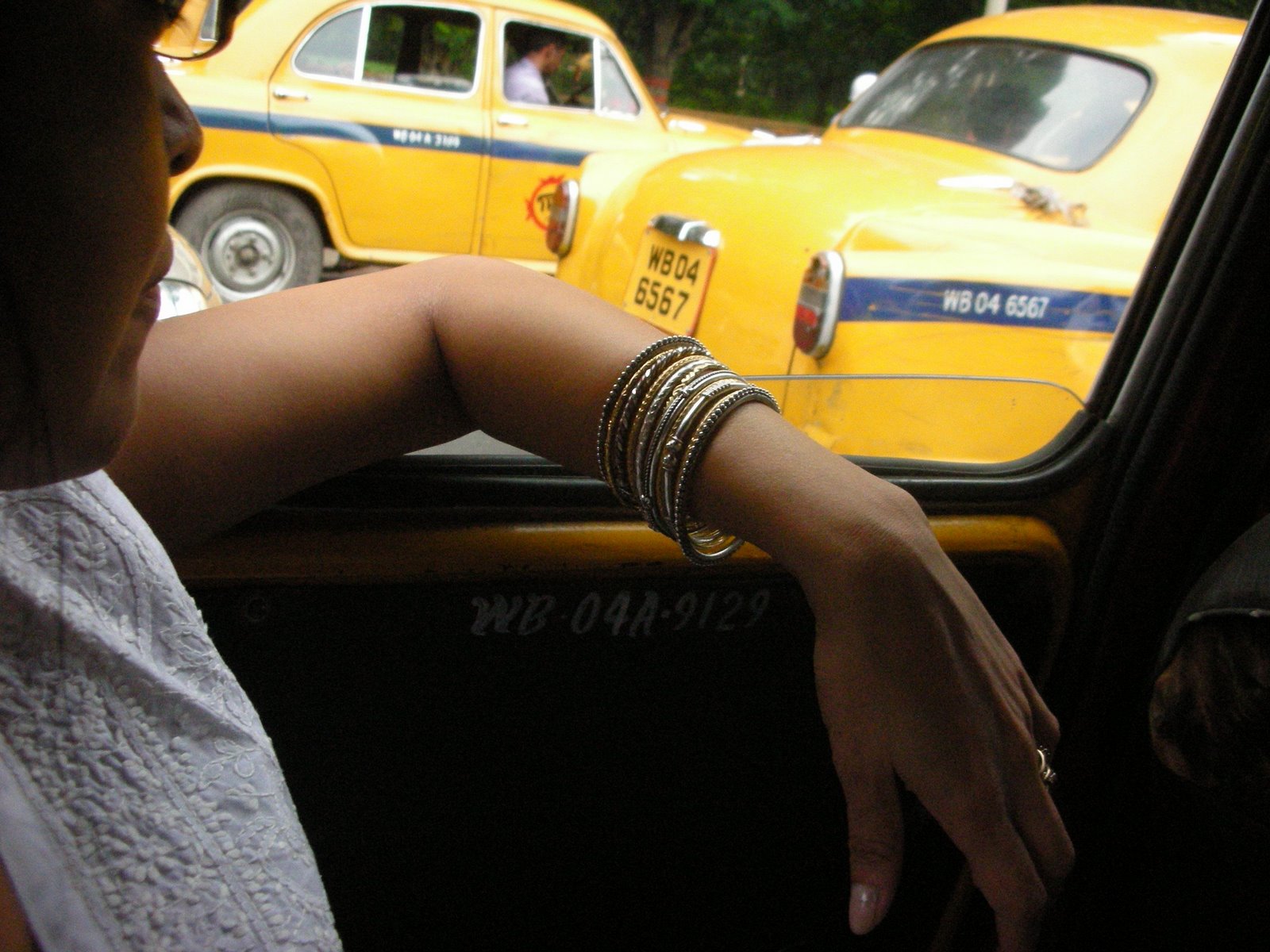
I, for one, cannot imagine Kolkata without its taxis – some black and yellow, others, plain yellow, all rickety, grimy, aging Ambassadors. They bounce down pot-holed streets and wreak heavily either of cheap incense or the driver’s fast-burning bidi.
Taxis are everywhere in Kolkata. And quite affordable for the middle classes.
The drivers say they cannot afford to buy new vehicles and switch from diesel to greener fuels. Nor can they seem to get loans in the economic downturn.
Such are the dilemmas of living in a poor nation.
I’m not sure what the solution is. I shudder to think what Kolkata would look like without pollution controls. But nor can I imagine standing on a congested corner, perhaps on Ballygunj Circular Road and Gariahat Road, and yelling: “Taxi!”