An ugly and jarring reminder

klansign

There it was, posted on a light pole outside my house — a flier that made my heart skip a few beats.

“The KKK Wants you. The Loyal White Knights Neighborhood Watch.”

I’ve seen several of these fliers around in Atlanta intown neighborhoods. Two others were posted in front of homes I know are owned by people of colour.

I called the Southern Poverty Law Center — which tracks hate crimes — yesterday to find out whether this was a sign of Klan resurgence. The intel folks there assured me there was nothing to worry about. Turns out that the KKK is trying to capitalize on the current immigration crisis with a recruiting drive. Apparently the group has been spreading their message of hate in other states as well.

I called the two numbers listed on the flier. One call went to the Richmond, Virginia, area. The other, to North Carolina.

Both times, I got a recorded message. The first was a diatribe against immigrants that urged shoot-to-kill orders along the Mexican border. The second was a racist rant against black people. Niggers, it said, have IQs barely above mental retardation.

I have lived in the South for a majority of my life. I know well the brutal history of racism.

As a brown woman from another country, I have felt racism’s sting many a time. I’ve been called a sand nigger, a camel jockey, an injun. I’ve had readers of my stories tell me to go the hell back to the dirty, stinkin’ place I came from. They’ve called me Osama lover. Some have even sent me death threats.

But something about these fliers made me stop dead in my tracks.

I spoke with my friend, Valerie Boyd, about it last night. We talked about how — despite the hatred, bigotry and discrimination that still exists in American society — we were (fortunately) never victims as our parents were.

Val’s parents grew up in a Jim Crow South. My parents grew up under the British Empire. The movie theater near my mother’s childhood home had two drinking fountains. One was for Europeans, the other for Indians and dogs.

We talked about how the Klan burned crosses in the front yards of black people. The fliers, Val said, were the crosses of our generation.

I am by no means making any comparison here. But that’s how it felt when I first saw the “KKK” in front of my house. I felt the Klan was sending me a message: We know who you are and where you live. And we don’t want your kind here.

The Southern Poverty Law Center assured me I should not be scared by this routine canvassing attempt. But to me, there is little that is routine about what I heard on the recorded messages. They were another reminder to me of how far America still has to go.

Even with a black man in the Oval Office, even with America on the verge of transforming into a minority-majority nation, racism is alive and well.

Perhaps it will take many generations to eliminate racism. Until then, it behooves us all to talk about ugly things in the open, to make sure the brutality of the past is never repeated.


A Romeo and Juliet love story from Iraq

Mike and me in Baghdad in early April, 2006. He believed in love. I wonder if he still does.
Mike and me in Baghdad in April, 2006. He believed in love. I wonder if he still does.

I met Mike when sectarian strife exploded in Baghdad in 2006. That was not his real name, of course, but it was what he went by in his job as a translator for American soldiers.

Mike and I spent several evenings chatting at a coffee shop on the vast Camp Liberty complex. He was a smart well-spoken man with Antonio Banderas looks. He told me about his life in Iraq before the war. He taught computer science at a small Baghdad college and ran a photo processing shop.

He told me about the hope he’d held in 2003 after the ouster of Saddam, after which he worked as a security guard for Kellogg, Brown & Root. Eventually he found a job as an interpreter for the U.S. Army.

But things did not progress the way he’d expected and his homeland seemed on the verge of civil war.

The Georgia Army National Guard unit I was embedded with was then patrolling the streets of southwest Baghdad. Sometimes, Mike would peer out the sliver of a bullet-proof window in the back of a  Bradley Fighting Machine and look for a small stucco house on one of the main thoroughfares.

Over coffee one day, I asked him why he stared so intently through the glass.

“Asra,” he said.

“Asra? Who is that?” I asked.

She was the woman he adored. They shared dreams. Of going to Sulaimaniyah to see snow for the first time in their lives. Of getting married, having children.

He bought American shampoo for her from the PX at Liberty. She had long, thick hair, he told me.

Sometimes, he broke Baghdad’s curfew and snuck into Asra’s house late at night. They knew they could not be seen together.

But he could no longer do that. They knew their love could bring them serious trouble.

Mike was Shiite and Asra, Sunni.

Mike was unwanted as a Montague in the house of Capulet.

Mike wished Asra would stand on her balcony when the Bradley thundered past her house. But she didn’t step outside anymore. It wasn’t safe.

A month earlier, the bombing of a Shiite mosque in Samarra worsened the sectarian violence in Baghdad. I remember seeing bodies strewn on the streets of the capital. I could see that many had been tortured or mutilated or shot in the head, execution-style. Revenge killings soared. Neighborhoods in which Sunni and Shiite lived side by side went one way or the other. Thousands of Iraqis were driven from their homes.

I have been thinking of Mike a lot lately as I watch the Islamic State of Iraq and Syria (ISIS) insurgents battle towards Baghdad. I fear there will be all-out sectarian war. Sunni against Shiite. Blood spilled on the very soil where the division began with the killing in 680 AD of Muhammad’s grandsons in Kerbala.

We may never know modern-day Iraq again. I can see how borders might get redrawn. I am not necessarily opposed to that – the lines, after all, were drawn by the British to serve colonial interests and Iraq was, in many ways, an artificially assembled nation. But it is heartbreaking to see the carnage.

ISIS makes al Qaida look friendly. There have been reports of crucifixions, mass executions and beheadings. The atrocities make Iraq look like Yugoslavia on speed. That’s how Middle East politics expert Gareth Stansfield described the situation in a recent National Geographic interview.

I wonder if Mike and Asra were ever able to be together, start the family they wanted. I don’t have any way of contacting him anymore. I wish I did.

He told me once that it made no difference to him that Asra was Sunni, though her family didn’t see it that way. He saved a huge chunk of his American paycheck every month to build a house for Asra and himself in a Baghdad neighborhood that was then still very mixed.

He knew he was fighting the odds. He told me it would take a miracle to realize his dreams in a country fraught with war. But he wasn’t going to give up — he still believed in love.

I wonder if he still feels that way.

Remembering Ramadi as Iraq suffers again

Ramadi looked apocalyptic when the Sunni insurgency raged there in 2006.

I fought off tears as I read Sunday’s New York Times. The news from Iraq was horrifying.

A vicious civil war seems imminent as fighters from the Islamic State of Iraq and Syria (ISIS) point their guns toward Baghdad.

They are men who make al-Qaeda look like nice guys. And the Taliban, wimps.

They have taken over much of Nineveh province — Mosul, Iraq’s second largest city, and Tal Afar. They are now taking aim at Samarra and threatened to destroy a historic Shiite shrine there. An attack on that shrine in 2006 unleashed sectarian bloodshed. Entire neighborhoods in Baghdad and other places were ethnically cleansed.

I remember how hard it was after that to make amends.

I was in Anbar province when the Sons of Iraq program was just getting off the ground. It began with Sunni Sheik Sattar al-Rishawi who helped launch the Anbar Awakening, a movement to stop the extreme violence that had gripped Iraq’s only Sunni-majority province.

I patrolled with 1-9 Infantry soldiers who dubbed one neighborhood in Ramadi "the heart of darkness."
I patrolled with 1-9 Infantry soldiers who dubbed one neighborhood in Ramadi “the heart of darkness.”

Cities like Fallujah and Ramadi looked apocalyptic. I don’t think I saw a single building in Ramadi that had been spared from bullet holes.

I walked the streets of a Ramadi neighborhood called Melaab with Able Company of the 1st Battalion, 9th Infantry Regiment. The soldiers called the place “the heart of darkness.”

When I asked residents what it was like to live there, they glided their right index finger across their throats. Sunni insurgents brazenly beheaded people in public and distributed videos of the executions.

Ramadi, back then, was the perhaps most dangerous place on Earth. And it was widely believed that the sheiks of Anbar were supporting the insurgents.

Then they began withdrawing that tacit support. I sat with Sheik al-Rishawi’s brother, Ahmed, to understand why his family and others had come around to helping the Americans establish peace.

He showed me his camels (see the photo at the top of my blog), sipped sweet chai and told me the people were just weary from that kind of extreme violence. His own father and brothers were killed by Al Qaeda in Mesopotamia.

He invited U.S. commanders into his palatial home and talked strategy with them. Such friendships had seemed improbable just months ago but the sheiks were determined to bring peace.

From that movement came the Sons of Iraq. Insurgents who once pointed their guns at Americans and their Shiite brethren began to help keep the killing out of their territories. During the so-called surge in U.S. troops, the Sons of Iraq program was in full swing. The Americans paid them $10 a day to keep terrorism at bay.

When the Anbar Awakening first took hold, an uneasy calm came to Ramadi. I went to a polling station where people were voting in a city council election. Amazingly, there was no gunfire that day.

Outside, Capt. Jamey Gadoury, commander of 1-9 Inftantry’s Charlie Company, took his helmet and flak jacket off. We shared lamb and rice with community leaders and members of the Iraqi police.

There were three ways to deal with insurgents, Gadoury told me as he tore a piece of bread and scooped up a chunk of meat. “You either want to kill them, make them go away or get them on your side.”

“So what happened to the Sunni insurgents here?” I asked.

Gadoury stopped chewing and grinned, as though he were onto some awful secret.

“You’re eating with them, ” he told me.

I looked around and suddenly lost my appetite.

I think of my days in Anbar now as I read the tragedy unfolding in Iraq. All that ingenuity to befriend the enemy and make peace. Where did it all go?

Many have blamed Iraqi Prime Minister Nuri al-Maliki for stirring Iraq’s cauldron of ethnic strife. Others have blamed President Barack Obama for withdrawing U.S. troops prematurely.

I won’t go into all the reasons I think that violence has come back with a venomous vengeance — I’ll save that for a later post.

I will only say this: my heart is broken.

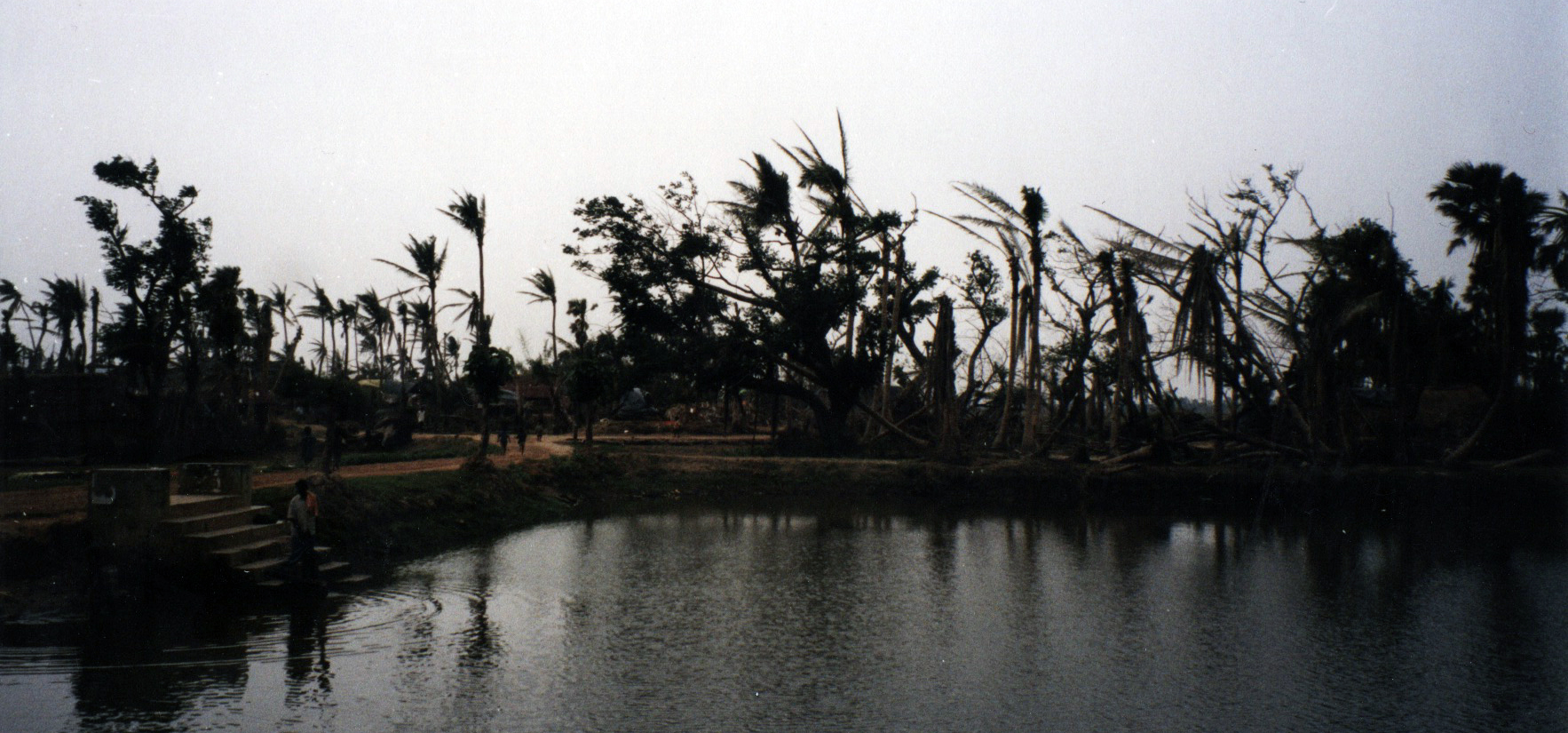
India cyclone ravaged memories as well as land

People lost everything they had in Ersama, Orissa in the 1999 "super-cyclone."
People lost everything they had in Ersama, Orissa in the 1999 “super-cyclone.”

Thinking of the 12 milion Indians who are bearing the brunt of Cyclone Phallin. Here is a piece I wrote for the Atlanta Journal-Constitution in 1999, after the last deadly cyclone in the state of Orissa.

November 25, 1999

Bhubaneshwar, India — I had been to Orissa before, lured by its ancient Hindu temples and pristine beaches.

This time, I was not a tourist.

I was there to witness a tragedy of enormous proportions. A “super cyclone” had visited the state just days before my trip. And it had changed the face of Orissa.

The plane ride from Calcutta to Bhubaneswar, Orissa’s capital, took 50 minutes. Indian Airlines Flight 7544 from Calcutta steadied itself after a steep climb into a clear November sky. We were more than halfway there when the captain announced, “We are flying over Paradwip. It’s to our left.”

On Oct. 29, the cyclone, having churned across the Bay of Bengal, came ashore at Paradwip. Wind and sea had spared little. I had read newspaper accounts about the devastation, and so had everyone else on the plane.

The very mention of Paradwip had nearly all the passengers on the right side of the cabin up from their seats. We craned our necks to peer out the windows and see firsthand what we already knew.

From 15,000 feet, the landscape resembled a blueprint for destruction. A vast sheet of silver-blue iridescence cut into the green mosaic of rice paddies and farmlands. Helicopters skimmed over the flooded land below us. Perhaps they were making air drops of food to cyclone victims.

Suddenly, the plane was filled with comments, sighs and emotions. Curiosity. Uncertainty. Fear.

As the aircraft descended, I saw the massive steel bridge over the Mahanadi River that I had crossed by train only months before on my way to the beach at Gopalpur. Then Orissa had seemed so lush, so serene, so idyllic. Now it was a series of mangled fields and broken trees, bare of bark and branches.

In the chaotic arrival hall at Bhubaneswar’s small airport, people held up placards to connect with arriving relief workers, journalists, government officials and medical teams. Boxes full of bottled drinking water rotated on the luggage carousel. People had come prepared to face the shortages. I wondered whether our six bottles of water would suffice.

orissa1Outside, the hoards of white taxis that normally await arriving tourists were in short supply. Instead, a line of four-wheel drive vehicles crowded the curb. Several bore the Red Cross symbol.

It wasn’t a long ride to the Hotel Shishmo, which had recently undergone minor renovation. I remembered it as being shoddier on my last trip to Bhubaneshwar, four years ago. It was the only thing I saw this time that looked better.

Eugene, my colleague and guide, and I wanted to grab a quick lunch before venturing into the city. At the hotel restaurant, we were told that the only thing available was a limited buffet, since many of the kitchen staff had returned to their villages to check on their families. The mediocre meal cost twice what it would have in Calcutta, but there wasn’t another restaurant open for miles.

Bhubaneswar, which was a relatively new but disheveled town before the storm, looked utterly dismal. Its dirty roads were even dirtier. Its nondescript architecture seemed uglier. Many of its tall palms stood no more. A confusion of electric lines dangled overhead as our taxi negotiated pools of mud and slush around the city’s shantytowns.

For the people who live in these slums, life had already been unimaginably difficult. Now it was plain unimaginable.

Still, the urban shantytowns were better off than the thousands of small hamlets and villages that fell prey to the cyclone. Tens of thousands of people died; no one knows exactly how many. Millions more were left with nothing to their names but the wet dirt on which they were standing.

These were India’s poorest, most vulnerable people, and they had been left in their mud huts to ride out one of the fiercest storms in the subcontinent’s history. A man in a nearby hospital had held onto the trunk of a palm tree through 36 hours of rain and wind. He survived but he had no flesh left on either arm.

On the way to Kendrapara the next day, we stopped for breakfast at the Indian equivalent of a truck stop. We were told there would be no more food available beyond that point. We sat in a dark, dingy dining hall — there was no electricity — and filled our stomachs with sand-laden rice cakes and vegetable curry. We planned to never eat there again.

But we did — out of necessity. And 10 exhausting hours later, the same rice cakes and curry seemed gourmet fare.

We thought about the villagers with whom we had spoken, and of how they had mobbed relief trucks for food and were surviving on one scanty meal a day. One man showed us his stash of rice carefully wrapped in a towel. He had gathered the grains from the road when a bag of supplies had burst.

In Paradwip and Ersama, names now synonymous with death, we had watched a young woman wash herself in a pool of water while a few yards away, another young woman’s body, bloated and rotting, floated along the bank. We saw the charred remains of human beings at mass funeral pyres, and we inhaled death. We looked into the eyes of a child who will grow up without his parents — and without hope.

After seeing all that, conversation in our taxi stopped for a long time. I found myself clutching my bottle of water and not wanting to look anymore.

But the images still burned in my mind. I left Orissa two weeks ago; soon I will return home to Atlanta, leaving India far behind. And this time, a very different Orissa will smolder in my memory.

Phir bhi dil hai Hindustani

One reason I miss India terribly: my pishi (aunt).

“When did you get home?” a friend asked me yesterday.

“Last night,” I replied.

“It must feel good to be back,” she said.

The pause on the phone was long enough to be awkward.

“Yes,” I said. I wanted the conversation to end.

But what was home? That word has always been problematic for me. I have always straddled two continents, two cultures, a feat that becomes hard at times like this.

My closest friend Eugene in Kolkata and I used to discuss for long hours what being home meant. Was it in Atlanta, where I have lived for 23 years, where I work, where I laugh and love? Or is it in my native India, where I am not an “other” or a minority, where I can bask in my Indianness, where I am in my element like I can never be in America?

After my parents died in 2001, going “home” to India became emotionally exhausting. Kolkata was not the same without my Ma and Baba waiting for me at our flat on Ballygunj Circular Road. Some of my trips after that were short — I was but a tourist on a fleeting journey. Others were punctuated by weddings and funerals and other events that made them extraordinary.

This time, it was different.

Another reason I miss home: the incredible food.
Another reason I miss home: the incredible food. This is Sunday lunch at my aunt’s house in Delhi.

I spent a lot of time with my father’s sister, my pishi, in Kolkata and his brother and his wife in Delhi. My uncle and aunt are the only two of my father’s seven siblings who are still living. Three of my aunts and uncles died in painfully rapid succession in the last year and a half.

I felt a need to soak up my family as much as I could.

I was also on assignment for CNN for part of the time I was home. I found it refreshing to report on my own people for a change and to work alongside Indian journalists.

Now, I am back at my desk at CNN Center in Atlanta. I look at the sun and think that it also shone over India today, many hours earlier. I smell India in my notebooks and clothes and long to make that long plane journey back.

I am an American by nationality and in many ways, by identity. Yet my heart remains Indian. Phir bhi dil hai Hindustani. 

Can A White Guy Lead An Organization Founded For Journalists of Color?

Can A White Guy Lead An Organization Founded For Journalists of Color?.

via Can A White Guy Lead An Organization Founded For Journalists of Color?.

Vivek Singh

vivek

I just returned from a short trip to a part of central India that was previously unfamiliar — Gadchiroli District in the state of Maharashtra. I was there to report a rape story for CNN and traveled with CNN cameraman Sanjiv Talreja and producer Harmeet Shah Singh.

Photojournalist Vivek Singh also accompanied us. He’s a freelancer based in Delhi and we’ve used his work on CNN’s photo blog. I edited the text that ran with an amazing gallery about rising tensions between Bodo tribespeople and Bengali Muslims in northeastern India. It was refreshing to see journalism from India that goes far beyond the breathless and sensational stuff that is common in the media here.

Vivek’s work is hauntingly beautiful. Powerful. Sometimes stark in black and white. It’s difficult to take your eyes off his images. I was lucky he was able to make it to Gadchiroli with us.

Check out Vivek’s work here:

http://www.viveksinghphotography.com/#/home?i=1710

Purse paradise

Many years ago, I walked through the Bata Shoe Museum in Toronto, mesmerized that the history of mankind could be told through footwear — from caveman to Christian Laboutin. I was fascinated, given my penchant for shoes. (Yes, I have way too many.)

So when I stumbled upon the Tassen Museum Hendrikje in Amsterdam recently, I had to go in. Housed in a beautiful old building on Herengracht, the museum pays homage to, what else, handbags. It’s not as extensive as the shoe museum but tells a 500-year-history of handbags and purses in the Western world. Through bags, you get a good idea of how social norms changed for women.

And the museum shop is terrific if you are in the market for a good bag.

‘When we were good men’

Noor, in a happy moment, at the school for disabled kids she attends in Baghdad. March, 2013

As a reporter, I have numerous conversations every day with people I don’t know that well or at all. Once in a while, those conversations strike a chord. That’s what happened a few days ago in my 30-minute discussion with Col. Kevin Brown.

I’d met Brown in Baghdad in 2005; he was commander of a 10th Mountain Division battalion (Triple Deuce), to which a Georgia guard company I was embedded with was attached. I saw him now and then when he interacted with the soldiers I was writing about and then in the context of “Baby Noor,” an Iraqi girl with spina bifida who the soldiers flew to America for life-saving treatment.

You can read my stories about Noor on CNN.com: “Iraq’s Baby Noor: An Unfinished Miracle” and the followup story for which I called Brown recently.

I knew Brown was a smart man. He was now a retired Army colonel pursuing a PhD in security studies. He was a high-ranking officer who was well-liked by his soldiers — I didn’t hear that often about battalion commanders.

Brown at a medal ceremony at Camp Liberty, Baghdad, in March 2006.

But our phone conversation struck me. Brown was forthcoming and deeply philosophical about his years at war and how Iraq had affected him and others. Though he is largely unfamiliar to me, at times in the conversation, I felt I was talking to my best friend. I knew exactly how he felt. I felt comforted by the words on the other end of the phone.

“Perhaps the Noor story shines that light on a time when we were good men and earned our nation’s respect whether they were looking or not … whether they knew it or not, and it gives us some comfort amongst the shades of gray we experienced there,” he said.

At that moment, I knew that my follow-up story on Noor had to center on Brown. He had captured the essence of the story with his words. I hope you will read it on CNN.com.

It’s not a big, bad, breaking news story. And in the grand scheme of things, Noor’s story, as I say in my piece, is a blip in the overall chaos and  sorrow of the Iraq War.

But it’s stories like these that keep me going as a journalist. Because in the most basic way, they confirm our humanity and keep me believing there is good in people. Without that, after all, there is little meaning in our lives.

Silenced too soon

Michael and me at Camp Striker near the Baghdad airport in September 2005.

Michael Hastings died Tuesday in a car crash in Los Angeles.

The news hit me hard. He was 33. He was a great journalist. He was a friend.

Most people know his name for the Rolling Stone story “Runaway General,” the profile of Gen. Stanley McChrystal that exposed him as a loose cannon, chiding his civilian commanders in the Obama administration.

“Great reporters exude a certain kind of electricity,” said Rolling Stone Managing Editor Will Dana, “the sense that there are stories burning inside them, and that there’s no higher calling or greater way to live life than to be always relentlessly trying to find and tell those stories. I’m sad that I’ll never get to publish all the great stories that he was going to write, and sad that he won’t be stopping by my office for any more short visits which would stretch for two or three completely engrossing hours. He will be missed.”

Ben Smith, editor-in-chief of BuzzFeed praised Michael’s incredible instinct for a story. He also said this:

“Michael was also a wonderful, generous colleague, a joy to work with and a lover of corgis — especially his Bobby Sneakers.”

Michael was known for his aggressive reporting. He believed the wars in Afghanistan and Iraq were misguided and didn’t for a second let any U.S. official — whether it was McChrystal or Hillary Clinton — get away with an easy answer.

His fiancee, an aide worker, was killed in Iraq when Michael was a Newsweek correspondent. He wrote about that relationship in his first book, “I Lost My Love n Baghdad: A Modern War Story.”

I never met his wife,  Elise Jordan. I cannot imagine her grief today.

As much as I respect his journalistic prowess — I leave it up to every media outlet to give him the proper reporter’s eulogy — the Michael I will cherish the most is the one I met in May 2005 at a hostile environment training put on by AKE in Virginia. I was there with AJC colleagues. He was there, I guess, on his own, determined to make a career for himself by going to the wars America was fighting.

He entertained us with his NYC white-boy rap — he was really good — and acerbic wit. Not bad, I thought, for a 28-year-old kid.

Three months later, Michael messaged me. “I am in Baghdad,” he said. “Going to Camp Striker tomorrow. I hear you are there. Lunch?”

So we ate standard military fare at the chow hall and shared stories about being embedded with the U.S. Army. He made me laugh when I hadn’t laughed in weeks. For that I will always be grateful.

An incredible young man robbed of life. An amazing journalist who will never again be able to write all the words that were within. Or expose the world for its sins.

Goodbye, Michael. May you rest in peace.

Read Michael’s advice for young journalists.