I've been a journalist for more than 30 years. My passion is storytelling. I worked at the Atlanta Journal-Constitution for 19 years before I came to CNN in 2009. I covered the Iraq war for the newspaper, an experience that was, needless to say, life-changing. I love to write about the human spirit and resilience. And I write about my native India. I also love (not necessarily in order) lazy Sunday mornings, traveling and biryani. My other life is on my blog: www.evilreporterchick.com
In my 30 years as a journalist, I’ve written a lot about victims. Many sorts of victims. Of war. Murder. Illness. Natural disasters. And man-made ones.
I always try to be sensitive and to highlight the incredible resiliency of human beings.
I was lucky enough to have won a Dart-Ochberg Fellowship from the Dart Center for Journalism and Trauma. I learned many things during that fellowship; how to improve my own reportage about people who have suffered.
All that really hit home last week when CNN published a story I reported from India about a woman who was raped four decades ago. You can read the story here: The Girl Whose Rape Changed a Country.
In the story, I revealed that I, too, had been raped when I was 18. I broke a 33-year silence. I wrote about some of the reaction to the story and how it made me feel in a follow-up. I was reporter and victim all at once.
I so appreciate the outpouring of support from women from around the world. It’s been a very difficult few days, reliving a memory from my past — one that I had put away in one corner of my mind. I tried to forget. But you can never really forget. The good thing is that it is possible to move on.
This post is to thank those who reached out to me. And for my dearest friends who took the time to make sure I was doing OK. Thank you.
I’m moving on to the next story. But I will not be afraid anymore to write about rape.
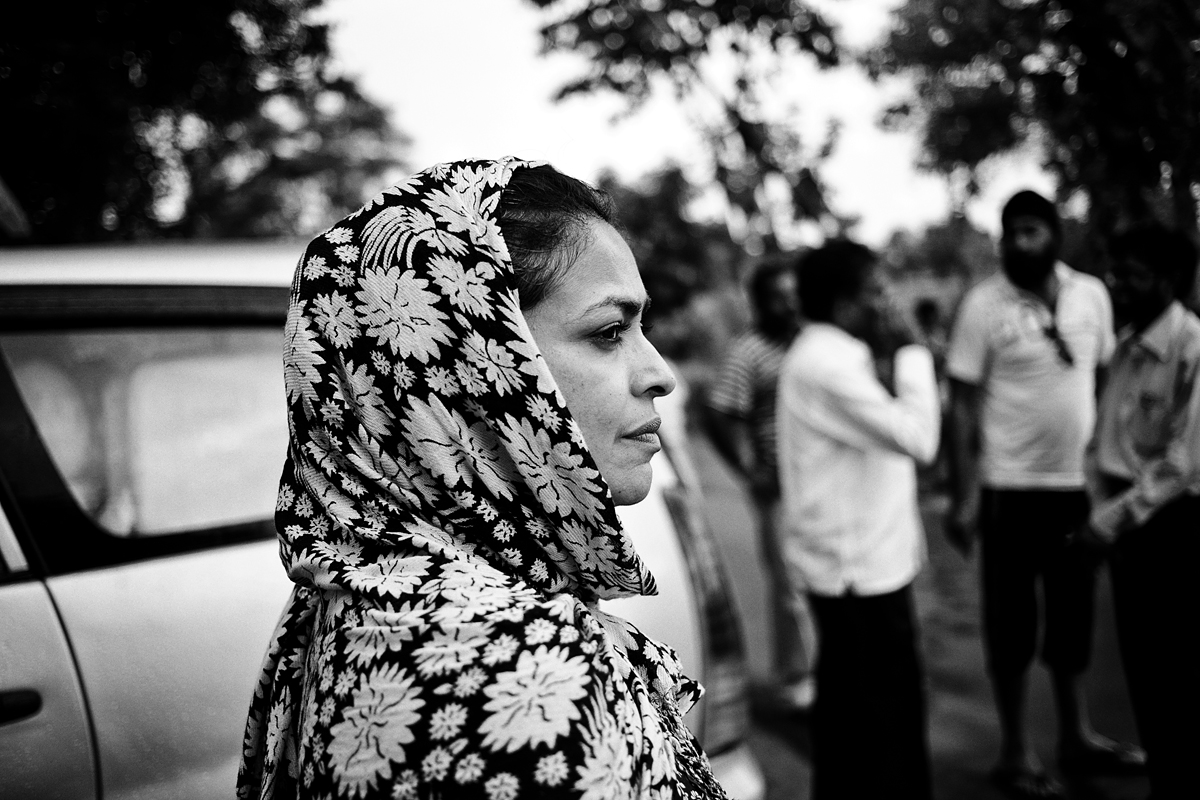
Me, reporting in Maharashtra. My friend Vivek took this photo. He was the photographer on the story.
I have reported difficult stories before. It was never easy to tell tales of tragedy from places like Iraq. But a piece that published on CNN.com today is the hardest story I’ve ever told.
Because it became very personal. Because it was raw.
The producer, the photographer, the cameraman who went with me to Maharashtra for this story had no idea how I was feeling. Even I did not know, really, the emotions that would surface and then haunt me as I returned home from India and began writing the story.
But in the end, I felt it would be disingenuous not to reveal a horrible truth about my own life.
I hope you will read the story on CNN.com. Here is the link:
As always, I have indebted to my editor, Jan Winburn. She edited the story with her usual brilliance and grace. But most of all, she believed in me. Again.
I hope rape survivors will be inspired by the quiet strength of Mathura. I know that I am.
I met Ahmad in 2007 in Nineveh province. I think about him and all the people I met over the years in Iraq and wonder what their lives are like today.
I just read an excerpt from Peter Baker’s new book, “Days of Fire: Bush and Cheney in the White House. It’s being touted as the most comprehensive account of the Bush-Cheney years, at least until historical archives are opened to the public.
What’s clear from the book is that Cheney was a major driver of the Iraq War. And a senior administration official is quoted as saying that America was looking for a fight, looking to kick someone’s ass.
So the Iraqi people paid the price.
I am looking forward to reading Baker’s book. I met him in Baghdad in 2002, when he was with the Washington Post and I was with the Atlanta Journal-Constitution. That was four months before the invasion and all foreign journalists were made to stay at the Al-Rashid Hotel — the one that had a mosaic of Papa Bush’s face on the entrance floor. You couldn’t enter the hotel without stepping on the presidential mug.
I read about Baker’s book today along with the latest media reports of more bloodshed. At least 43 people were killed Sunday. Dozens more were wounded.
A suicide bomber blew himself up in a crowded coffee shop in a predominantly Shiite neighborhood in southwest Baghdad, not too far from where I was in March when I was last in the Iraqi capital. Many of the victims were young men gathering to drink tea, smoke hookah and play games, officials told CNN.
Earlier, in mainly Sunni Anbar province, three attacks killed six people.
At least 350 people have been killed in October.
Take a look at these numbers compiled by the United Nations mission in Iraq. They are nothing short of shocking:
September: 887 killed; 1957 injured
August 2013: 716 killed; 1936 injured
July: 928 killed; 2109 injured
June: 685 killed; 1610 injured
May: 963 killed; 2191 injured
April: 595 killed; 1481 injured
March: 229 killed; 853 injured
February: 418killed; 704 injured
January: 319 killed; 960 injured
Adding to the horror is a new survey that estimates the civilian death toll of the war to be much higher than believed — 500,000.
Yet Iraq is but a blip on the news. Iraqis are not a part of the global conscience, at least, certainly not a part of the American conscience.
My heart bleeds for Iraq. I think about friends I made there; how so many of them lead lives marred by hatred. It’s difficult to read about daily death and destruction now, more than 10 years after Bush and Cheney made the decision to attack.
Few American news outlets are covering events in Iraq the way they should be, I believe. It’s a mistake not to focus attention on the bloodshed. Terrible to ignore tragedy, worse to forget.
Last year was the milestone year. The big 50. I felt OK about it. 50 is the new 40, my older friends told me. I celebrated with a big party. My brother came from Canada, my cousin from New York. My sisters-in-law traveled great distances, too. Then everyone went home and life resumed, no different, really, than before.
Today is different.
Not that suddenly, I feel old. Or that there is no hoopla this year.
Today is different for one very important reason.
My mother suffered a massive stroke in 1982. On my birthday. She was 51.
That day changed our lives in so many ways. You can imagine all the obvious ways: my mother was in a coma for days in the Intensive Care Unit at Tallahassee Memorial Hospital and when she regained her senses, the left side of her body no longer worked. There were months and months of physical therapy for my mother. And even more months of adjustment for me and my family while we learned how to take care of an invalid, infirm woman.
She’d also lost a lot of her cognitive abilities and the mother I adored was suddenly gone. She was there in person, physically. But the woman I knew died on that day.
Over the next 19 years that she lived, I learned to relate to my mother on a whole new level. In the end, when my father also cruelly lost his cognitive abilities to Alzheimer’s, my mother became like my daughter. She’d ask me what she should wear, what she could eat. If anyone asked her a difficult question, she’d consult me before answering publicly. We exchanged roles.
My mother died in May 2001. I had to deal with her dying all over again. Except this time, there was nothing left of her at all. She was gone.
I’ve always feared turning 51. I feared it even more after I learned I was prone to hypertension — my mother’s blood pressure had soared to obscene levels before the stroke.
So on this day, I contemplate my mortality. And want desperately to make time stop so that I can have the opportunities to accomplish all that is left on my long, long list of things to do, places to see. It’s not that I want to be young again — I greatly value the wisdom time and experience have given me. Just that I feel the days whizzing past like speeding bullets.
Like everyone else, I want to feel that I did something good for this world. Now there are fewer days left for me to achieve that.
Seamus Heaney died today. The New York Times headline described him as “Irish poet of soil and strife.”
I don’t pretend to always understand poetry though I savor it. I am always awed by how poets use language in such an artful way. My favorite poet of all time remains Pablo Neruda, who is simply magical to me. Seamus Heaney was another writer I have admired for a long time.
My mother and me at the Acropolis in Greece. June 23, 1964.
My mother would have turned 82 today. I would have picked up the phone and called her. 011-91-33-2247-6600.
I would have said: Ma! Happy Birthday. I would have asked her what she was doing to celebrate.
She would have said that my pishi (aunt) was coming over for lunch. Nothing special was planned.
I wold have asked about what else was going on. She would have given me family updates — she kept in touch with everyone. She was the glue. She would have caught me up with gossip about the neighbors in our flat building.
She would have hurried through the conversation to get to the most important part. When will you come to Kolkata?
I would have said: In mid-September, Ma. I will be there soon.
I would have imagined her smile. She would have told me how she couldn’t wait to see me.
I will get on a plane to go home next week but she won’t be there waiting for me.
Happy Birthday, beautiful Ma. I miss you every waking moment.
John Alderman, who was captain of Mike’s cavalry troop in Iraq, at the grave Thursday.
Thursday evening, I drove out to Loganville, Georgia. I suppose it’s not a tremendous distance from downtown Atlanta but during rush hour, it took me more than an hour before I turned right onto Georgia Highway 81, named the Michael Stokely Memorial Highway.
It was the eighth anniversary of Mike’s death.
He went to Iraq with the 48th Infantry Brigade and was killed by a bomb in the Iraqi town of Yusufiya. I covered his memorial service in Iraq and later, when I returned home, I wrote about his father, Robert Stokely, and how he coped with his son’s death. I visited Mike’s grave with Robert one year after Mike died. Friends and family gathered to remember the fallen soldier at the exact time of his death. 2:20 a.m. in Iraq.
Over the years, I kept in touch with Robert; quoted him in several of my Iraq stories and wrote a longer piece about his own journey to Yusufiya a couple of years ago. He felt he would never have closure until he touched the dirt where his son fell. That journey did not turn out as Robert had planned it but it was healing nevertheless. You can read the story on CNN.com.
Michael Stokely was killed in Iraq in August 2005.
I’ve always felt grateful to Robert for sharing the details of his punctured life. It’s important, I believe, for America to know it has helped others cope with their grief.
Not too many people showed up this year for the annual gathering at Mike’s grave. As Robert said, people move on with their lives. We said our hellos and made conversation. It had already rained Thursday and the clouds looked down at us with a threat of more to come. We talked about how it was unusually cool for August, almost chilly, how it has rained so much this summer that Robert didn’t have to buy gallon jugs of water to keep the grass green over Mike’s grave.
There was nothing formal about the gathering. Just family and friends remembering Mike and reflecting on the path our lives have taken.
Robert and me at a November screening of an HLN documentary about his trip back to Iraq.
Before I began covering the Iraq War at the Atlanta Journal-Constitution, I never called anyone in uniform a friend. But now I know many people in the military. Before, I was like many Americans who are oblivious to the toll of war. Not any more.
On the way home on 1-20, I thought about Robert standing on the ground above his son’s coffin. He asked everyone to remember the men and women who gave their lives fighting for their country. To many, he said, they are just soldiers. To us, they are sons, daughters, fathers, mothers, brothers and sisters.
Today is not Veteran’s Day or Memorial Day but for families like the Stokelys, every day is one of remembrance.
Independence turned bloody as Hindus, Muslims and Sikhs crossed borders.
It’s too bad “Midnight’s Children” was a bust at the box office. I’m thinking that Deepa Mehta was perhaps the wrong director to give us the celluloid depiction of Salman Rushdie’s terrific book, which won the Booker Prize in 1981.
The protagonist and narrator of Rushdie’s story, Saleem Sinai, is born at the exact moment when India gained independence from Britain. The film, had it been a success, might have broadened knowledge of the painful history of my homeland, just like “Gandhi” had done years before. “Gandhi” won various Oscars in 1983, including best picture.
At 11:57 p.m. on August 14, 1947, the nation of Pakistan was born, carved out of land that was a part of British India. Five minutes later, at 12:02 a.m. on August 15, India was declared a free nation. To all my Pakistani and Indian friends: Happy Independence Day.
That independence came with a steep price. British India was partitioned along religious and political lines. Pakistan became the Muslim homeland and Muslims living in lndia crossed borders on the west and east. At the same time, Hindus and Sikhs in the new Pakistan made the trek to India. At least 10 million people were uprooted from their homes; some estimates say it was as many as 25 million.
It was far from peaceful, far from what Mahatma Gandhi, the father of non-violence had anticipated.
Hindus and Muslims butchered each other. Sometimes, entire trains from Punjab to Pakistan arrived with seats and bunks awash in red. Or vice versa. Women were raped; children slaughtered. There are no exact counts of the dead; just an estimate of 250,000 to 2 million.
Gandhi’s non-violent revolution turned exceedingly bloody. Brother against brother. Blood spilled in the name of religion.
My father’s generation remembers that ugly time in our history. His family was displaced from their home in Dhaka, Bangladesh, and started over in Calcutta. I heard stories from him and his friends and other Indians I have met from that era.
Atlanta physician Khalid Siddiq was one of those people. He told me he boarded a crowded train in New Delhi with his parents and four siblings to make a terrifying two-day journey through the farmlands of Punjab.
“I was very young but I think I understood what was happening,” he told me. “I could see the fear and anguish on my father’s face. It was a terrifying experience for everybody.”
Sohan Manocha told me he witnessed hundreds of killings as a young Hindu boy in Punjab. “That kind of horror leaves memories that are hard to erase, ” he said.
The stories of the painful birth of India and Pakistan are dying with the people who lived it. I am sorry I never recorded my conversations with people I knew.
“The 1947 Partition Archive is a people-powered non-profit organization dedicated to documenting, preserving and sharing eye-witness accounts from all ethnic, religious and economic communities affected by the Partition of British India in 1947,” the website says. “We provide a platform for anyone anywhere in the world to collect, archive and display oral histories that document not only Partition, but pre-Partition life and culture as well as post-Partition migrations and life changes.”
I’m glad someone took the time to preserve history.
It’s especially important since tensions between India and Pakistan have never settled.
Just last week, five Indian soldiers were killed last week along the heavily militarized Line of Control, the de facto border in the disputed region of Kashmir. Since then skirmishes have flared tension between the two rival nations. Again. (India and Pakistan have already fought two full-scale wars over Kashmir, which Pakistan argues should have been a part of the newly formed Muslim nation in 1947.)
So on this Independence Day, I remember all those lives that were lost in the making of free nations, in the making of our destinies.
Gold filigree earrings from the Sky Facebook page.
Last weekend, I went to a trunk show of jewelry crafted by my friend Anubha Jayaswal. She’s a friend from my hometown, Kolkata; her husband Vishal loves Bengali food more than I do. That’s true homage to the cuisine of my culture.
I bought a couple of pieces and enjoyed the afternoon talking with desi girls who, like me, are not big fans of the ornate gold stuff you see in Indian wedding photos.


 Love that we celebrate strength in a form of a woman. If only all women in India held such lofty status. Happy Durga Puja, everyone.


 Evil Reporter Chick