I awoke to news today that Iraqi forces were claiming victory in Mosul. Prime Minister Haider al-Abadi arrived in Mosul to personally deliver the message to the world: ISIS had been driven out of the northern Iraqi city that had been the extremist group’s crown jewel.
Victory. Yes. But at tremendous cost. The ancient city of Ninevah will never be the same.
ISIS took hold of Mosul in June, 2014. Thousands of Christians, Yazidis, Turkmen and other minorities fled under threat of forced conversions to the ISIS brand of Islam. Those who remained endured three years of the so-called Islamic State and its brutality and intolerance.
The campaign to oust ISIS began in October 2016. The fighting was brutal. Iraq’s second largest city is left in ruins; many of its ancient sites destroyed by ISIS. That includes the historic al-Nuri mosque with its leaning minaret known as Habda.
Thousands of Iraqis were killed; more than a million people were displaced from their homes.
#Mosul liberated: – 265 days; – 100,000 ISF vs. 5000 ISIS; – Iraq special forces lost 40% of their men; – 80% of west Mosul destroyed.
I was in Iraq last year when the campaign to retake Mosul was still in its early stages. I visited many of the camps set up for IDPs. Internally displaced people. That’s the term used for people who are forced to flee their homes for safety. Really, they are refugees in their homeland, separated from loved ones and the lives they once led.
Here are some of the children I met in the camps.
Yes, there is victory in Mosul. But what does the future look like for these children? They have been torn from the safety of the homes they knew and out of school for many months. Where will they return to? Will they even return?
Look into the eyes of one of these children. Imagine if this was your little boy or girl. Think of these children when you hear the news today. Think of what victory feels like for them.
Read a few of my recent Iraq stories published on CNN.com:
I often wonder what happened to all the people I met in Ramadi. (Photo by Louie Favorite)
My heart breaks every time I read news from Iraq. So much so that I find myself clicking away or turning off the radio.
Ramadi, the capital of al-Anbar province, has fallen to the Islamic State. I think of the people I met there during the height of the Iraq War and have to stave off tears. Ramadi and nearby Fallujah were the two most dangerous cities for American soldiers and Marines. Ramadi was believed to be the most dangerous place on Earth.
I was last in Ramadi in March 2007, when the Anbar Awakening was gaining strength, Sunni insurgents were laying down their weapons and there was, at last, a real hope for peace. Residents recounted the gross atrocities they had witnessed — assassinations and public beheadings, among them. They told me how they lived in fear so constant that eventually, they learned to go about their lives at that heightened level of anxiety.
Ramadi never had a chance to recover.
I found Ramadi apocalyptic. I did not see a single building that was not bullet-riddled or bombed. I did not speak to a single person whose life had not been shattered in some way.
I wonder if those people are still there. Or did they escape? I hope so.
What is it like to grow up with this kind of violence? Or to never be able to look forward to a future? It’s so hard for journalists in Iraq these days; too risky to walk the streets of Ramadi and talk to people. The stories are about battles won and territory lost. But we never hear the voices of human beings who are suffering.
The U.S. and Iraqi governments are scratching their heads on how to retake Ramadi from the clutches of ISIS. But all the strategizing in the world feels futile at the moment.
I reread one of my stories that ran in the Atlanta Journal-Constitution in 2007. It’s no longer posted on the newspaper’s website. But for anyone who is interested, here it is:
Scenes from Iraq: A PATH TO PEACE
By Moni Basu
The Atlanta Journal-Constitution
04/22/07
Ramadi, Iraq —- One afternoon last November, masked men raided the compound of houses belonging to Sheik Jassim Saleh Mohammed.
The intruders held an AK-47 rifle against the throat of Mohammed’s wife. They burned two houses. They killed 17 women and children. They killed his brother.
Overwhelmed by the carnage, the sheik uttered one word: “Enough.”
“I call it a decisive day,” Mohammed says, sitting on the front porch of his house overlooking a small lawn, pink roses and the charred ruins of his brother’s house. “After what they did to my family, I had enough.”
Mohammed was the first sheik in eastern Ramadi to turn against insurgents linked to al-Qaida in Mesopotamia. Today, he is part of a burgeoning movement of powerful Sunni tribal leaders who might have tacitly supported al-Qaida in the past but are fed up with the extreme violence. More than 40 sheiks have joined in a united front against both the insurgency —- which they say uses Islam as the rationale for slaughtering women and children —- and a perceived threat from Shiite Iran to the east. And they are cooperating with the Americans.
The sheiks call it the “Anbar Awakening.”
They wield considerable influence in the heavily tribal Anbar province that stretches west from Baghdad to Iraq’s borders with Syria, Jordan and Saudi Arabia. Col. John Charlton, the overall American commander here, says the sheiks’ support has allowed U.S. troops to raid restive neighborhoods, purge insurgents and set up American-Iraqi police stations throughout Ramadi, where the police force had been all but wiped out.
“The sheiks in this part of the world are the conduit to the community,” says Charlton, who heads the Fort Stewart-based 3rd Infantry Division’s 1st Brigade Combat Team, responsible for Ramadi since January.
“I could speak to all 400,000 people in Ramadi and have no impact,” Charlton says. “But if a sheik puts his arm around me, it’s a different story.”
Building relationships with community leaders has been a key facet of U.S. counterinsurgency tactics in Iraq. Part of the much-heralded security push that began Feb. 14 in Baghdad put American forces in the neighborhoods they patrol instead of returning to isolated military bases.
The strategy appears to be paying off here in Ramadi, where U.S. troops live in makeshift compounds throughout the city helping the Iraqi Army and police keep the calm.
Signs of normalcy have started emerging in Ramadi, until recently a ghost town. A man sells produce at a roadside stall. Laughing children walk down the street behind a woman who smiles and says “welcome” to passing American soldiers.
Lt. Col. Miciotto Johnson, an Atlantan who commands one of Charlton’s battalions, Task Force 1-77 Armor, says Ramadi is a tale of two cities —- one where bloodshed was as routine as sunrise, the other where guns have almost fallen silent.
>>>
The Iraqis say if you throw your hat into the air in Ramadi, it will come down with 12 bullet holes in it.
A drive down the main east-west road that runs parallel to the Euphrates River conjures images of Hiroshima after the atom bomb. Not a single building stands unmarked. A fifth-floor balcony crashed to the sidewalk. Gnarled metal gates resembling Twizzler sticks. Carcasses of blown-up cars. Shattered glass. Trash everywhere. Facades of what were once apartments, offices and shops riddled with bullet holes. “Swiss cheese,” as the soldiers call it.
Saddam Hussein’s troops and U.S. forces fought fierce battles here during the 2003 invasion. When the United States disbanded Saddam’s military, many of the disgruntled men came home to Ramadi.
Anda Khalaf, a colonel in the former Iraqi Army, says the insurgency was imported to Iraq by foreigners but mushroomed here because so many men were sitting at home, jobless and angry. Last year, half the terrorist attacks in Iraq occurred in Ramadi.
The city has been al-Qaida’s haven and America’s hell on earth —- the ugly, beating heart of the insurgency.
>>>
On patrol with American soldiers in Ramadi. Match 2007. (Photo by Louie Favorite)
The Americans believe democracy will help return this city to its people.
On a balmy April morning, Mohammed, the sheik from eastern Ramadi, heads to a district meeting. He is the leading candidate in an election to choose the district of Sufia’s representative on the Ramadi city council.
Mohammed wears the traditional dress for Arab men —- a pressed white dishdasha covered in a sheer black muslin robe with gold brocade trim. He is a simple man, a farmer who is not well educated. But he is smart enough to recognize his weaknesses and surrounds himself with polished men in suits and ties.
American military officers are at the meeting to ensure Sufia’s first act of democracy is unblemished. Mohammed enters a two-story building where two U.S. infantrymen were killed in a recent firefight and where, today, local ballots will be cast. In a show of good faith, American soldiers and Marines around the building remove their body armor and helmets. Standing unprotected on the street, they appear uneasy.
But there is no gunfire today. People are not giving the Americans the “evil eye,” a term soldiers use for glances that say: Get out.
“I am in shock,” says Sgt. 1st Class Thomas Dougherty of the more tolerant atmosphere.
Inside the building, the voting comes to a close. Mohammed, who heads the sizable al-Soda tribe, wins by a large margin. The Iraqis then serve lunch on long folding tables outside the meeting hall.
Capt. Jamey Gadoury, commander of 1st Battalion, 9th Infantry Regiment’s Charlie Company, shares lamb and rice with Sufia’s community leaders and members of the Iraqi police.
There are three ways to deal with insurgents, he says, tearing a piece of bread and scooping up a chunk of meat. “You either want to kill them, make them go away or get them on your side.”
When asked what happened to the insurgents in Sufia, Gadoury stops chewing his food and grins.
“You’re eating with them,” he says.
>>>
What Gadoury means is that some Iraqis who planted bombs and pointed rifles at the Americans just a month ago now have switched sides.
Yet with that welcome change comes uncertainty: There’s no easy way to tell good from bad.
The police often don’t wear uniforms. They cover their heads and faces with rags, sling AK-47s on their shoulders and ride in the back of pickup trucks. They look disquietingly like insurgents.
Ramadi’s ferocious fighting nearly wiped out the police force —- its numbers dwindled to 35 a year ago. Today, Johnson, the 1-77 Armor commander, says 4,500 police patrol the city through nine permanent stations and many more substations.
Red squares and triangles on a U.S. military map indicate security posts throughout the city. A few months ago, the map was nearly void of the shapes. Now it is covered in them.
>>>
Every American soldier who has patrolled Ramadi’s streets knows how to predict danger.
“Even if people don’t tell you anything, their body language does,” says 1st. Lt. Curt Daniels of 1-9 Infantry’s Able Company.
Daniels leads his platoon through Melaab, a neighborhood known as “the heart of darkness.”
When residents are asked what it was like here before the recent calm, they glide their right index finger across their throats. The insurgents brazenly beheaded people in public and distributed videos of the executions.
Daniels walks over a road where patches cover craters created by improvised explosive devices. The Americans recently found 15 IEDs and 2,500 pounds of explosives in Melaab.
In January, Ramadi suffered about 140 violent attacks a week. By the end of March, it dropped to a little over 60.
Daniels says insurgents are “laying low now” after the sheiks cleared the way for security forces to saturate neighborhoods.
“There’s no way you are going to kill or capture every insurgent,” he says, surveying the neighborhood from the rooftop of a police station, the sound of gunfire echoing in the distance. Then Daniels takes a line straight out of the Army’s counterinsurgency manual: “As soon as you win the faith of the people, the insurgents go away.”
Johnson, the 1-77 commander, says the peace will not hold in Ramadi unless local forces take control.
“They see my soldiers as just that —- soldiers,” he says. “The populace trusts the Iraqi police. These are their fathers and brothers, uncles and cousins.”
If anyone can sniff out bad from good, Johnson says, it’s the local police.
>>>
The day after his election, Mohammed, the sheik from Sufia, arrives at a joint Iraqi-American camp in central Ramadi for his first city council meeting.
He clutches a gray file filled with notes and says he already has started thinking of reconstruction projects.
Outside, the skies are ominous. It has been rained intermittently, but that’s enough to flood this city without any infrastructure. Mohammed wipes the mud off his leather loafers. He adjusts the white kufiya on his head and appeals to Ramadi Mayor Latif Obaid Eiada.
“We need many things,” Mohammed says.
Every district representative echoes Mohammed’s statements. Everyone is impatient.
Charlton, the brigade commander, attempts to soothe the crowd. He knows that the 15 months his brigade spends here will only be the start of an arduous process.
“This is probably the most damaged city in Iraq,” he says. “I’ll bet my paycheck on that. It’s going to take years to put it back together.”
Charlton promises the Ramadi council that U.S. forces will support its reconstruction priorities.
Realizing the fragility of the fledgling council, he implores them to keep on the right path. “We’ve worked too hard to let terrorists back into the community,” he says.
Mohammed nods in agreement. He has paid the price for peace.
Denny and me in southwest Baghdad. March 2006. Curtis Compton took this photo.
I first met the boys of Charlie Company, 1/121 Infantry, in December 2005. I was an embedded reporter, a lost soul among the rough and tumble men of the Georgia Army National Guard. What did I know about the military, about the U.S. Army? Very little.
I arrived with trepidation in my heart. But the soldiers of Company C welcomed me. One of them was Sgt. Thomas Denny.
He was known by his last name, as is standard in the Army. Denny. He worked in the main office of Charlie Company, the admin guy. For that, he took hell from other soldiers who went out on patrol after patrol. Denny. Yeah. He’s the guy who sits at the desk. But that wasn’t true.
Denny told me about how he felt bad that he was the lucky one who got to spend so much time on base while his buddies went outside the wire, on the menacing streets of southwest Baghdad at the height of the Sunni-Shia wars. He talked to me for hours. About how he grew up in Ohio and moved to Georgia in high school. About how he loved the outdoors—hunting and fishing.
Denny in the Charlie Company TOC at Camp Liberty. March 2006.
He told me he wanted to go out on every patrol. “But, I’ll be honest, Miss Moni,” he said. “Every guy who goes out there… well… you just never know. You just never know if you’ll make it.”
I wrote down Denny’s words on December 18, 2005, in my Iraq journal. It was among the many conversations I had with him.
One morning, before I flew south to Tallil, he gave me a cross made out of steel hung on a leather chain. “Wear it,” he said. “And think of us poor f—s. Think of me. Be safe.”
I looked at that cross today when I got home from a trip out West to Alaska. Maj. Will Phillips informed me two days ago that Denny had died. He survived Iraq. But he did not survive cancer.
Denny didn’t always sit at the desk. He went out on missions. He put himself out there. He told me he was devastated that some of his Army comrades thought him a coward.
I stand testament that he was not.
The photograph of me in Iraq that has been publicized the most is the one on this post. Of me with Denny. Of me, protected by Denny.
I had a dream last night. It was the same one I’ve had since August 20, when I learned of Jim Foley’s death.
A man in black holds a small knife in his left hand. He is too cowardly to show his face. But he holds up Jim’s face. For the world to see.
I have been told that if one uses a small knife for such a brutal method of execution, it is an excruciatingly painful way to die. Not like the guillotine; not like a heavy blade making a clean chop.
I dream this every night. I have dreamed it before. After Daniel Pearl’s murder in February 2002 by al-Qaida mastermind Khalid Sheikh Mohammed.
I do not understand people who wish to kill journalists and aid workers. I hope I will never understand them.
I know this: that if my dreams are so troubling, then how traumatic are these acts to the loved ones of those subjected to such heinous acts? I cannot imagine.
Some Muslims in that part of the world have told me that no less heinous acts happen in America each year. Murder in the most chilling fashion. Rape. Assault. Torture. Grisly crimes that make headlines — and some that do not.
But one act does not beget another. One crime does not justify another.
Jim was a journalist who cared. So was Steven Sotloff. David Haines dedicated his life to the betterment of others. How many more innocents will be killed in this horrific way?
I will see Jim Foley in my dreams tonight. Again. I am sure of it.
And, in the morning I will again awake saluting his courage, saluting all those who put themselves in harm’s way for making this world a little bit better.
A few months ago, my friend and colleague Lateef Mungin died quite suddenly. This morning, more shocking news awaited me.
CNN photojournalist Sarmad Qaseera passed away. He was 42.
Here’s the thing. Like Lateef, Sarmad was always smiling, always cracking jokes. His joy in life was infectious. I never heard him get bitter like so many other journalists in the war zone.
He came to America from his native Iraq and lived here in Atlanta. He told me how he lived with his ailing mother and was her primary caregiver.
He traveled constantly for work. He survived war zones, riots and disasters. But a long life was not to be his. It’s something a lot of my CNN friends are grappling with today.
I salute Sarmad for his courage and talent in journalism. I salute him for being the very best of humanity.
You are gone from us too soon, Sarmoudi, Habibi. It is a terrible, terrible loss for the world.
Check out this video of Sarmad talking about being a cameraman in dangerous situations: http://cnn.it/1uarHEB
Honoring the courage and fortitude of James Foley today. Rest in peace.
I had intended to write more about him but words are failing me now. So I am posting a few links for you. I hope you will think about how so many journalists put themselves in harm’s way so that you may know the truth about our sometimes vicious world.
Yezedi kids in Baronah, a village near the Sinjar Mountains.
Who are the Yezedis, the 40,000 people who are hiding in the Sinjar Mountains from the horror of the Islamic State of Iraq and Syria militants?
They are not Muslims. They are a people largely forgotten by the world. In 2007, I had the opportunity to spend time in Nineveh province in the towns and villages around the Sinjar Mountains. Here is a blog post I wrote for the Atlanta Journal-Constitution on April 6:
Caesar, an interpreter for the U.S. Army, shuttles us into the courtyard of his house in Baronah, Iraq. He is anxious for Maj. Daniel Rice to see where he lives, meet his family.
Ceasar was proud to take us to meet his family. His daughters dreamed of leaving Iraq one day.
Caesar (his real name has been withheld for safety reasons) is proud of who he is. “I am not Muslim, ” he says. “I am Yezedi.”
Rice, a border patrol transition team officer from Atlanta, sits on a white plastic chair and drinks a can of the local version of RC Cola. Today, he is the guest of honor.
The women of the family usher me into one of the rooms to show me the newborn of the family lying in a small crib. Caesar introduces me to his sisters. They are wearing slinky skirts and body-hugging blouses. Gold jewelry adorns their necks, ears and wrists.
The Yezedis are an obscure sect whose beliefs are ancient and whose practices are often misinterpreted.
No one knows exactly how many Yezedis are left in the world though it’s estimated that 100,000 live here in northwestern Iraq, along the Sinjar Mountains.
The Yezedis are an insular people who have their own customs. They never wear the color blue or eat lettuce.
They have kept their religion alive through oral history and have falsely come to be known as devil worshippers because they are followers of the fallen angel, Lucifer.
The Yezedis, however, believe Lucifer was forgiven by God and returned to heaven. They call him Malek Taus (the peacock king) and pray to him. They do not ever use the word “Satan.”
In the Yezedi villages, women don’t have to cover their heads. They consume alcohol. Cans of Heineken pile up on trash heaps. At a local new year’s festival, Georgia Army National Guard soldiers were offered whisky (they declined, of course).
The Yezedis, like their neighbors the Kurds, were persecuted by Saddam Hussein after he took power in 1979. When the dictator was toppled in 2003, the Yezedis had great hopes that their lives would take a turn for the better.
They believed in the Americans as saviors who would release them from their misery.
I took an instant liking to a Yezedi boy named Ahmed. I wonder if he and his family are safe now.
But now, in the fifth year of the war, frustration surfaces in Yezedi villages.
In nearby Yarmouk, the mukhtar (mayor), Qasim Sameer Rashu, sits down eagerly with Maj. Voris McBurnette, a high school principal from Raleigh, N.C., who is serving in Iraq on a military transition team.
Rashu leads McBurnette into a large hall lined with carpets on the floor and fancy lighting fixtures on the ceiling. There is, however, no electricity.
Rashu doesn’t hold back. He unleashes a torrent of complaints — no electricity, no water, no food supply.
“Electricity? We have forgotten what it is, ” Rashu says.
“In the beginning we were happy to see coalition forces. They got rid of Saddam. Now we are disappointed.”
McBurnette explains that coalition forces will do less from now on.
“It’s time for the Iraqi government to do more, ” he says.
“You are right, ” Rashu says. “But for three months, they have done nothing for us.”
He says insurgents often target trucks carrying food and medicine into the village.
“What if your kids were without food, without water, without power?, ” Rashu tells the major.
“We think the insurgents come from outside of Iraq but the Arabs here help them. And the Iraqi government — they are not hungry. They don’t know what’s going on in these villages far away from Baghdad.”
They are a forgotten people, Rashu says.
“We feel safer with Saddam gone but the services we have are worse.”
McBurnette explains that the Iraqi government must learn to respond to its own citizenry; that Americans can no longer do their job for them.
And then the mukhtar makes a politically-charged statement.
“We want to be part of Kurdistan.”
Though they practice a different religion, the Yezedis have much in common with the Kurds. They come from the same ethnic stock.
But because they occupy villages that sit on the borderlands between Arab Iraq and Kurdistan, the Yezedis were caught for years between the two.
The Kurds, who established an autonomous region after the 1991 Gulf War, now exercise influence in the Sinjar area but few Yezedis want to be co-opted by their northern neighbors. They have fought for centuries to maintain their identity. Rashu speaks out of economic desperation.
“In four years, the only help we have seen is from Kurdistan, ” he says.
Back in Baronah, Caesar’s family don’t want to let Rice and his team leave. They want him to experience Yezedi hospitality.
Caesar’s family, meanwhile, shows me albums containing snapshots of weddings and vacations. They like to go to Dohuk, a Kurdish city in northern Iraq, where “things are so nice.”
The Yezedis are far removed from the bustling streets of Baghdad. Overlooked even in a war that cruelly highlights ethnic and sectarian differences. There is no mention of them even by those who want to ethnically carve up Iraq into separate nations.
Sadly, one man tells me, the only connection to Iraq these days is through bloodshed. The Yezedis, he says, are prone to bombings and assasinations just as their Sahiite, Sunni and Christian brethren living south and east of them.
Caesar’s sister wants me to take home a photo from their family album. I tell her I cannot accept something so personal.
She tells me they have never seen a foreign journalist in their village before. She says she probably won’t again. She is part of a forgotten people.
Mike and me in Baghdad in April, 2006. He believed in love. I wonder if he still does.
I met Mike when sectarian strife exploded in Baghdad in 2006. That was not his real name, of course, but it was what he went by in his job as a translator for American soldiers.
Mike and I spent several evenings chatting at a coffee shop on the vast Camp Liberty complex. He was a smart well-spoken man with Antonio Banderas looks. He told me about his life in Iraq before the war. He taught computer science at a small Baghdad college and ran a photo processing shop.
He told me about the hope he’d held in 2003 after the ouster of Saddam, after which he worked as a security guard for Kellogg, Brown & Root. Eventually he found a job as an interpreter for the U.S. Army.
But things did not progress the way he’d expected and his homeland seemed on the verge of civil war.
The Georgia Army National Guard unit I was embedded with was then patrolling the streets of southwest Baghdad. Sometimes, Mike would peer out the sliver of a bullet-proof window in the back of a Bradley Fighting Machine and look for a small stucco house on one of the main thoroughfares.
Over coffee one day, I asked him why he stared so intently through the glass.
“Asra,” he said.
“Asra? Who is that?” I asked.
She was the woman he adored. They shared dreams. Of going to Sulaimaniyah to see snow for the first time in their lives. Of getting married, having children.
He bought American shampoo for her from the PX at Liberty. She had long, thick hair, he told me.
Sometimes, he broke Baghdad’s curfew and snuck into Asra’s house late at night. They knew they could not be seen together.
But he could no longer do that. They knew their love could bring them serious trouble.
Mike was Shiite and Asra, Sunni.
Mike was unwanted as a Montague in the house of Capulet.
Mike wished Asra would stand on her balcony when the Bradley thundered past her house. But she didn’t step outside anymore. It wasn’t safe.
A month earlier, the bombing of a Shiite mosque in Samarra worsened the sectarian violence in Baghdad. I remember seeing bodies strewn on the streets of the capital. I could see that many had been tortured or mutilated or shot in the head, execution-style. Revenge killings soared. Neighborhoods in which Sunni and Shiite lived side by side went one way or the other. Thousands of Iraqis were driven from their homes.
I have been thinking of Mike a lot lately as I watch the Islamic State of Iraq and Syria (ISIS) insurgents battle towards Baghdad. I fear there will be all-out sectarian war. Sunni against Shiite. Blood spilled on the very soil where the division began with the killing in 680 AD of Muhammad’s grandsons in Kerbala.
We may never know modern-day Iraq again. I can see how borders might get redrawn. I am not necessarily opposed to that – the lines, after all, were drawn by the British to serve colonial interests and Iraq was, in many ways, an artificially assembled nation. But it is heartbreaking to see the carnage.
ISIS makes al Qaida look friendly. There have been reports of crucifixions, mass executions and beheadings. The atrocities make Iraq look like Yugoslavia on speed. That’s how Middle East politics expert Gareth Stansfield described the situation in a recent National Geographic interview.
I wonder if Mike and Asra were ever able to be together, start the family they wanted. I don’t have any way of contacting him anymore. I wish I did.
He told me once that it made no difference to him that Asra was Sunni, though her family didn’t see it that way. He saved a huge chunk of his American paycheck every month to build a house for Asra and himself in a Baghdad neighborhood that was then still very mixed.
He knew he was fighting the odds. He told me it would take a miracle to realize his dreams in a country fraught with war. But he wasn’t going to give up — he still believed in love.
Ramadi looked apocalyptic when the Sunni insurgency raged there in 2006.
I fought off tears as I read Sunday’s New York Times. The news from Iraq was horrifying.
A vicious civil war seems imminent as fighters from the Islamic State of Iraq and Syria (ISIS) point their guns toward Baghdad.
They are men who make al-Qaeda look like nice guys. And the Taliban, wimps.
They have taken over much of Nineveh province — Mosul, Iraq’s second largest city, and Tal Afar. They are now taking aim at Samarra and threatened to destroy a historic Shiite shrine there. An attack on that shrine in 2006 unleashed sectarian bloodshed. Entire neighborhoods in Baghdad and other places were ethnically cleansed.
I remember how hard it was after that to make amends.
I was in Anbar province when the Sons of Iraq program was just getting off the ground. It began with Sunni Sheik Sattar al-Rishawi who helped launch the Anbar Awakening, a movement to stop the extreme violence that had gripped Iraq’s only Sunni-majority province.
I patrolled with 1-9 Infantry soldiers who dubbed one neighborhood in Ramadi “the heart of darkness.”
Cities like Fallujah and Ramadi looked apocalyptic. I don’t think I saw a single building in Ramadi that had been spared from bullet holes.
I walked the streets of a Ramadi neighborhood called Melaab with Able Company of the 1st Battalion, 9th Infantry Regiment. The soldiers called the place “the heart of darkness.”
When I asked residents what it was like to live there, they glided their right index finger across their throats. Sunni insurgents brazenly beheaded people in public and distributed videos of the executions.
Ramadi, back then, was the perhaps most dangerous place on Earth. And it was widely believed that the sheiks of Anbar were supporting the insurgents.
Then they began withdrawing that tacit support. I sat with Sheik al-Rishawi’s brother, Ahmed, to understand why his family and others had come around to helping the Americans establish peace.
He showed me his camels (see the photo at the top of my blog), sipped sweet chai and told me the people were just weary from that kind of extreme violence. His own father and brothers were killed by Al Qaeda in Mesopotamia.
He invited U.S. commanders into his palatial home and talked strategy with them. Such friendships had seemed improbable just months ago but the sheiks were determined to bring peace.
From that movement came the Sons of Iraq. Insurgents who once pointed their guns at Americans and their Shiite brethren began to help keep the killing out of their territories. During the so-called surge in U.S. troops, the Sons of Iraq program was in full swing. The Americans paid them $10 a day to keep terrorism at bay.
When the Anbar Awakening first took hold, an uneasy calm came to Ramadi. I went to a polling station where people were voting in a city council election. Amazingly, there was no gunfire that day.
Outside, Capt. Jamey Gadoury, commander of 1-9 Inftantry’s Charlie Company, took his helmet and flak jacket off. We shared lamb and rice with community leaders and members of the Iraqi police.
There were three ways to deal with insurgents, Gadoury told me as he tore a piece of bread and scooped up a chunk of meat. “You either want to kill them, make them go away or get them on your side.”
“So what happened to the Sunni insurgents here?” I asked.
Gadoury stopped chewing and grinned, as though he were onto some awful secret.
“You’re eating with them, ” he told me.
I looked around and suddenly lost my appetite.
I think of my days in Anbar now as I read the tragedy unfolding in Iraq. All that ingenuity to befriend the enemy and make peace. Where did it all go?
Many have blamed Iraqi Prime Minister Nuri al-Maliki for stirring Iraq’s cauldron of ethnic strife. Others have blamed President Barack Obama for withdrawing U.S. troops prematurely.
I won’t go into all the reasons I think that violence has come back with a venomous vengeance — I’ll save that for a later post.

 Victory. Yes. But at tremendous cost. The ancient city of Ninevah will never be the same.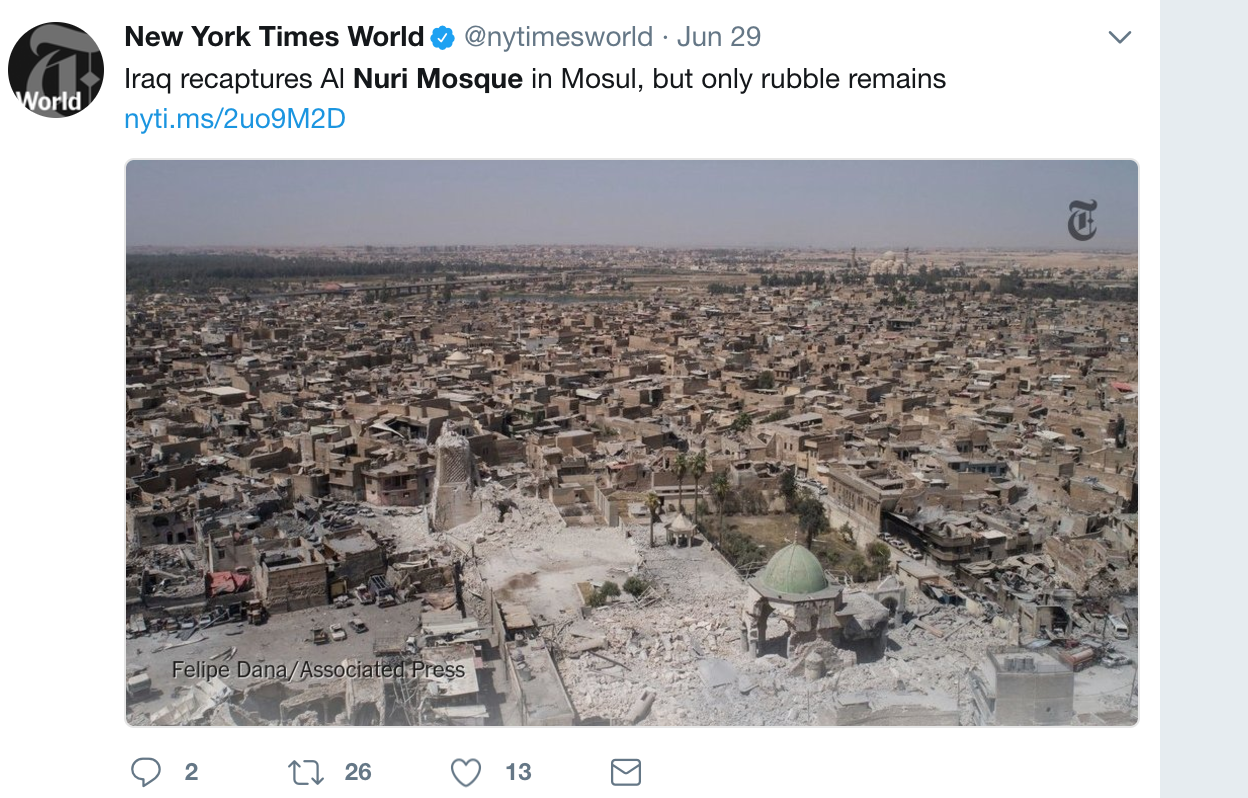


 Evil Reporter Chick