Evil Reporter Chick

Random thoughts in war and peace

Archive for the category “Family”

Shonakaka

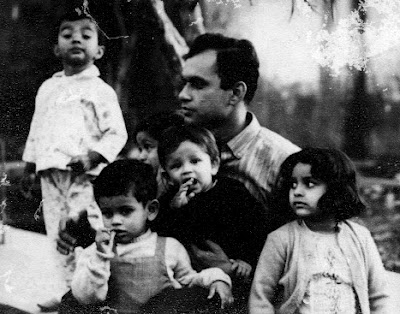
Shonakaka with me,  (from right), my cousin Jayanta, my brother, Shantanu,
my cousins Sudip and Suman at our grandfather’s house  in Kolkata. Circa, 1968.
The last time I saw Shonakaka, I knew he was ill.
Gone was the mirth; his enormous zest for life reduced to a meager smile. At a family gathering in New Delhi last December, he could hardly eat a thing.
Shonakaka was suffering from renal failure and had to be most careful about what he put in his belly, especially foods high in phosphorous. His son — and my cousin — Ronny was not pleased his father had put a heaping spoon of daal on his plate.
If you knew Shonakaka at another time in his life, you would hardly believe my words.
He was always the boisterous one; the one who loved to eat, drink and make merry. ”Live life king size,” he always said. At my cousin Suman’s wedding in California, Shonakaka danced atop Suman’s brand new Acura Integra.  We laughed, amazed at Shonakaka’s energy, though, perhaps, Suman was a tad worried about dents and scratches on his shiny car.
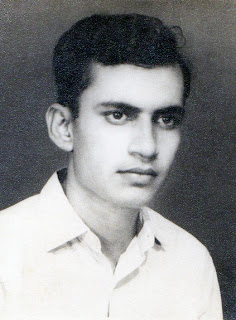
Shonakaka as a young man.


Unfair then that at a fairly young age, Shonakaka was forced to adopt a curtailed regimen and give up things that he loved. Cruel even.
He was my father’s youngest sibling. Kaka means father’s younger brother in Bengali. And Shona means gold or someone very precious. It used to be the norm to have a naming convention so as to avoid calling elders by their first names. That was considered disrespectful.
Shonakaka was born Ranjan Kumar Basu on July 8, 1942 in Lucknow, the capital of Uttar Pradesh. He was 18 years younger than my father and grew up as the baby in a family of five boys and three girls.
Now, within the span of a few months, that generation of my father’s family is down to just a brother and sister still living. Everyone else, including my father, is gone.
Many of my friends in America may not understand the pull of an uncle or aunt.
I was raised in an extended family system in which my grandfather’s house was occupied at various times by various members of the family. That meant Shonakaka often stayed in one of the many bedrooms in the house.
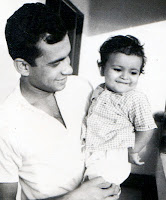
Shonakaka holding me. I was about a year old.
When I was a baby, he made me cry and took a photograph of me wailing. Just to be contrary, he said. Why should I be happy in every shot?
From his travels abroad, he brought us back chocolates and other goodies that were non-existent in India in the 1960s and early ‘70s. He regaled us with stories of his travels – each adventure made grander with Shonakaka’s unique infusion of enthusiasm and zeal.
Once, he started growing chickens on the roof. My brother and I raced up the stairwell every morning to see how many eggs we could retrieve. And in the backyard, he built a tank to farm tilapia so we’d have the freshest fish.
Shonakaka (center) at a dinner at my parents’ house
in Kolkata in the late 1990s.
It was understood that Shonakaka would fix the menu for family weddings and other festive events. I’ll always have images in my head of my two youngest uncles breaking into a pot of syrupy sweets before they even made it into the kitchen.
After he married my aunt, they lived for a while on the ground floor of the family house. It was there that my cousin Bideesha — Ronny’s elder sister — was born. I often babysat her with my brother and our housekeeper, Shantidi, when Shonakaka and Kakima went out with friends.
Shonakaka was not far from home when he was attacked on the streets with acid and lived the rest of his life with scars. But he always rose above his woes. He never let anything interfere with living life to its fullest.
Until recently, when his health began to fail him.
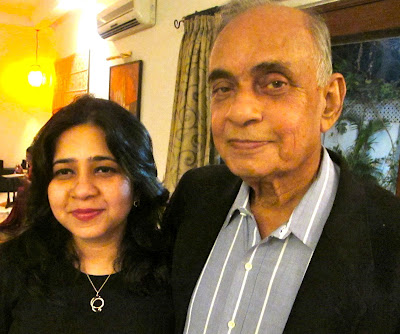
Shonakaka with his daughter, Bideesha, in Delhi last
December. That was the last time I saw him.
I’d not seen him in a couple of years when we met last December. He was not even 70 yet but looked frail. He’d lost weight and suddenly, he appeared to me just like my grandfather. At the time, my aunt in California was in her last days of battle with cancer. It was then that I realized how those I loved in India were going away, how I was losing the links that kept drawing me back all these years.
The finality of death brings with it a host of regrets. I always hear people say, I wish I had done this and I wish I had done that. Yes, I have my regrets regarding Shonakaka. I wish I had visited more in recent years. I wish we had talked more on the phone. But I am glad for what I had with him. Glad that I made the trip to Delhi to see him in what turned out to be the very last time.
And that he was still smiling then.

Kaka

Kaka, standing on the balcony of the house
in New Alipur in the 1950s.

When I was a little girl, we lived in a house my grandfatherbuilt. It was common then for sons to remain in the house with their parentseven after they were married and had children. It was an extended family systemthat is dying out fast now in urban India.
I grew up rich with memories of relatives, close anddistant. I was privy to my father’s family history, told in most vivid detailby my uncle, Samir Kumar Basu. I always knew him as Kaka, the Bengali moniker for a father’s younger brother.
Kaka was only a year and half younger than Baba. The twowere extremely close growing up in Dhaka, Bangladesh, united perhaps in theireye problems that took root at a very early age. Both had macular degeneration.Both wore glasses so thick that I substituted them for magnifiers to look atflower parts for biology class.
Kaka lived on the third floor of my grandfather’s house inNew Alipur, then a fairly new development in Kolkata. He was a brilliant manand soon rose to the top of the companies where he worked. Eventually, hebecame director of Chloride India.
We ate breakfast together every morning. I sat with my roti,potatoes and cauliflower. He, with his half-boiled egg on a porcelain Englishstand and two pieces of white toast with butter.
Playing chess with my father in Florida, late 1970s

Afterwards, I climbed into the back of his Ambassador for alift to Gokhale Memorial, the school I attended  in those days. On the way, we would talk about everything.It must have been irritating for him to have a five-year-old chatterbox gononstop before a hard days work was about to begin. 
“Boddo kotha bolish,” he would say sometimes. You talk toomuch.
In the evenings, after homework, after an evening bath, Iwaited anxiously for my Baba and Kaka to return home. Both had a habit ofpacing from verandah to verandah. Kaka would whistle popular Rabindrasangeet. Itried to imitate him. How was he able to get tunes out with such precision?
We sat down to dinner together and Kaka always made sure togrill me on what I had learned that day. He’d quiz me with a geographyquestion. And when I wandered off point, he’d tell me I was talking too muchagain.
Kaka and me at a family wedding, 2009

In later years, Kaka moved out into a posh company flat. Iwanted to go spend days there not just because of the air-conditioning but tomonopolize Kaka’s time.

He never married or had children. Over the years, he grewaccustomed to life alone, though he was always generous to open up his home forothers. After my parents died in 2001, I often stayed in one of Kaka’s guestrooms.
Evening conversations were never dull with Kaka. We arguedsometimes but he always treated me with respect; asked me about things inAmerica that he did not know well. He was one of the few members of my familywho took a keen interest in my journalism. Even introduced me to his friends totalk about the Iraq war.
Kaka at Calcutta Club.

He especially liked to gab with his peers at Calcutta Club,a social club that was started in 1907 when Indians were not allowed into thewhites-only Bengal Club. Later in life, when Kaka became frail and his eyesfailed him completely, he held onto his trek to the club as salvation from loneliness.He left exactly at a certain time and was rarely late coming home. He nappedfor three hours, limited his cocktail hour before dinner and ate with extremediscipline. I admired that about him. How he kept to routine. How he neverindulged.
The last time I saw Kaka was in early December. I had stayedwith him for almost two weeks during a visit home. He liked to listen toBengali songs on my iPod. The noise-cancelling headphones, he said, made itfeel as though he were in a concert hall. He marveled at the technology thathis poor eyesight prevented him from enjoying.
Some nights, we watched Bengali soap operas on television.He listened intently to the dialog and when the screen was silent, I describedfor him what was unfolding.  Ithought it was grossly unfair that a man who lived by himself should not havethe benefit of sight – without being able to read or enjoy television.
But Kaka never felt sorry for himself or allowed pity. Iwill always think of him as the most fiercely independent person in my family.
Several years ago, the night of my departure from Kolkata,Kaka sat me down at his dining table. 
“Wait,” he said, shuffling off to his bedroom, counting hissteps as he always did and feeling his way to his closet.
He returned a few minutes later with an old jewelry box. Ithad once been a rich blue velvet. Now it was worn, the cardboard peekingthrough.
“Toke ar ki debo?” he said. What else can I give you?
I took that to mean that he thought I had all that I needed.True. Or that I wasn’t one for ornate ornaments that most Bengali women ogle.Also true.
He began telling me a tale of a trip he made to Hyderabad,years before my birth. The southern Indian city is famous for two things:Biryani, the Mughlai rice dish, and fresh water pearls, he said.
My cousin Sudip took all of us out to eat in 2005.
Kaka loved food and enjoyed it throughly.

“I bought this in Hyderabad. It’s not biryani,” he laughed.

A string of iridescent pearls glowed under the light of hischandelier.
“Kaka,” I said. “You don’t have to give me these.”
I wondered why he had bought them. Had they been meant for someone?Or had he just picked them up because it was the thing to do in Hyderabad?
“It’s a very small thing,” he said. “Wear them and think ofme.”
Last November, he’d called me in Atlanta to ask that I bringhim good Belgian chocolates. He loved the taste of cocoa on his tongue justbefore he went to sleep every night.
Kaka at a wedding in 2009. 

My aunt, Pishi, told me that Monday night, Kaka had askedfor chocolate. She took that to mean that he was recovering from a recent boutof illness. But Wednesday, he was gone.

He died in his sleep, peacefully.
In 2010, when I visited Kaka, I had recorded some of ourconversations. Kaka loved to tell me stories about my father’s childhood. I hadplanned to finish those conversations. Ask him questions about a time with few records, save a few old black and white photographs. Kaka was awonderful storyteller and now an important part of my family’s oral history hasbeen silenced.
He was the eldest living of my father’s siblings. Manythought him as the family anchor. I simply thought of him as Kaka, the man whobecame my father after my own died, the man who stood by me always.
I will miss you terribly.

Balaka


It’s done.

The flat in the building called Balaka (which means swan in Bengali) at 68 B Ballygunj Circular Road is no longer my home. After nine-and-a half years of caring for it from across the globe, I completed the final act of an arduous sales process in Kolkata.

I’ve posted a photo taken out front this week. With me are Kalu and Bimal, two men who have done menial jobs at the building for most of the years my parents lived there.

In that flat, simple and not so large by American standards, I laughed, loved and lost. It was home for so many years.

It was there that my mother regained her verve for life after a massive stroke nearly took her life in 1982. She gained freedom in her small way, learning to wheel herself around the rooms and hallways with ease, poking her head into the kitchen and instructing the housekeeper how to make perfect Bengali fish curry.

Some evenings, she arranged for musicians to come to the flat. We’d sit on rugs on the floor and sing the songs of Tagore. My mother’s voice was gone when she was left half paralyzed, but she belted it out anyway. I sometimes caught her eyes watering. She lamented little after the stroke but I knew she yearned to play again the harmonium and sing the songs she loved most.

In the morning, after she had her third round of Darjeeling tea, she picked up the phone and called our relatives and friends to learn news of their lives. My mother was the glue that held our family together. When she died, I stopped knowing details about my aunts and uncles, cousins and friends.

It was there in that flat that my father sat at the dining room table for hours pruning his bansai plants. He filled the verandahs with greenery. The dahlias bloomed with fierce, spreading hues of reds, pinks and oranges across the view.

Or he sat with his magnifying glass struggling to read newspapers when the macular degeneration in his eyes began to blur his world. He often worked out his mathematical and statistical theories in his head, his hands moving in the air as though there was a chalkboard before him. He had made a name for himself in probability theory. Later in life, when Alzheimer’s began winning the battle, my father could not add two plus two.

Everything changed today when I signed over the final documents to the man who purchased our flat earlier this year. I waited in the West Bengal registration office for a long time, sandwiched between a zillion people in a British-era building now filled with cobwebs and dust.

My friend Vijay (on the right in the registration office photo) made it all happen for us. Without him, my brother and I might have still be mired in West Bengal bureaucracy. I really don’t know how to ever thank him.

But for a moment, after I signed the final document, I felt as though I had wronged my parents somehow. As though I had given away the place where they had found solace. I asked the new owner if I could take the brass nameplate on the door that carried my father’s name. (photo)

Then I descended down the long British Raj era staircase, its terrazo warped by footsteps from many decades. I turned back only once. And left with my memories, brilliant like diamonds.

Coming home


The taxi refused to take the Eastern Bypass — too dangerous in the wee hours of the morning before the sun comes up and lights up the despair of Kolkata. Instead, we took the old route from the airport in the northeastern part of the city to the south.

I had not taken these old roads in a while. But as a little girl, when life was harder, but oh, so much simpler, we traveled to the airport this way and stood on the “viewing deck” to see planes take off and land. It was a rarity then. Flying seemed so exotic, so other-worldly. Now, all I do is complain about sitting in cramped seats as we pass over oceans and continents.

At 3 in the morning, the city is finally quiet.

The thousands and thousands of street stalls and stores (like the ones in this photo of a shopping area near my house) are shuttered. Those who can afford it are sleeping soundly in the comfort of air-conditioning. Most are under whirring ceiling fans that bandy the humidity about — or nothing at all.

The heat has fallen after months of the monsoon, but after the glorious autumn weather in Atlanta, I feel hot. Restless.

I had not expected to pass by the flat my parents called home for so many years. I have returned to Kolkata this time to finalize its sale.I thought I would not have to see it until later.

But instead, we pass by the front gate, the taxi driver unknowing of the burst of emotions within me. I try hard to hold back the tears. I feel them welling. I don’t know whether to look or not. But I cannot control my glance.

I peer at the gate through which the taxi might have driven had Ma and Baba still been here. Ma always stayed up for me, no matter how late. I’d walk in through the front door and see her in her wheelchair, her eyes heavy with sleep would light up instantly at the sight of her only daughter.

She’d have tea ready for me. Maybe a snack. My bed would be made up with fresh sheets, a clean towel hanging in the bathroom.

There is no one waiting for me now.

The taxi driver carries me away from that moment of intimate familiarity to another place. A friend’s flat, perfectly comfortable but with the sting of loneliness. Daylight breaks early here; by 5:30 the city is springing to life again. But for me, today, everything is dark.

Ma


I refrained from posting this on Mother’s Day out of respect for all my friends who are mothers and for all my friends who still have mothers.

But Mother’s Day is tough. Very tough.

Nine years ago, my mother died.

May 19, 2001.

A few months before 9/11. It became a year that everyone remembers for the terrorist attacks. I remember it as the year my father died, and, exactly two months later, my mother.

Every year on this day, a melancholy descends on me.

I don’t feel like doing much of anything save look at her photographs and her handwriting — I still have all the letters she wrote me from Kolkata. I even have her clothes, fresh from her closet in our flat. Even after all these years, they smell like her, though the scents are fading and I desperately don’t want them to. I put a few of her things in a plastic bag to prevent her from escaping.

I miss her smile. I miss her hand on my forehead. I miss her kiss and her embrace.

I miss everything about her.

She had a massive stroke in 1982. She was only 51 then. But she lived another 19 years, bound to a wheelchair, half her brain cells gone. Toward the end of her life, we exchanged roles. I became a mother, taking care of her, making all the important decisions in her life. She was almost like my child, completely dependent on me.

And yet, every time I gazed into her eyes, I thought of the immense sacrifices she made — as a young Bengali woman who came to these shores not speaking English, not knowing how to operate an electric stove or drive a car. She endured the death of her own parents from afar, endured her loneliness. Never shared her pain with us; only her joy.

Only later, only after she died and it was too late to talk, did I discover her journals and writings. Only then did I realize how incredibly steely my mother was.

Only now do I appreciate her fully. Now that she is gone. Forever.

And a deep void fills my life. Today on the anniversary of her death. And every day that I live.

Sisters


I don’t have a sister, though sometimes, in my childhood, I got a taste of what that might be like because we lived among extended families. The line between a cousin and a sister quickly blurred.

But I longed for the sister I never had.

Like Elizabeth and Jane Bennett in “Pride & Prejudice.” Or even the dysfunctional variety in “Rachel Getting Married.”

I wanted to share clothes and the heart’s innermost secrets. Wanted to whisper into the night until we both fell asleep. Wanted someone to be there. Always.

So when Deirdre came to visit Eileen, I went to see the Drennen girls. Of course, I enjoy spending time with them — I have known Ei for almost three decades and first met Deirdre in the mid-1980s when she came to visit Ei in Tallahassee. I gave her one of my salwar kameez suits. It looked grand on her, I thought. She was so thin and tall and pretty.

Eileen has four sisters. I have always been jealous of that. But she gels perfectly with Deirdre. Unmistakably sisters. One comforts the other — always has, in times of divorce, illness and the darker things in life that take us down.

We sat around the living room table and talked. And talked. For a few moments, I pretended. Sisters, we were.

And at 10:30 at night, when the Drennen girls realized their bellies were empty and the groceries were still intact, we piled into the kitchen to fix a fattening concoction of macaroni with Swiss chard, cheese and more cheese.

How divine.

Post Navigation

Follow

Get every new post delivered to your Inbox.

Join 5,416 other followers

%d bloggers like this: